
 Article
November 13, 2026
7 min read
 FirstConnectt
Enterprise communication insights
Article · FirstConnectt Insights
Every New Tool Solves a Problem. But What Happens When They Don’t Work Together?
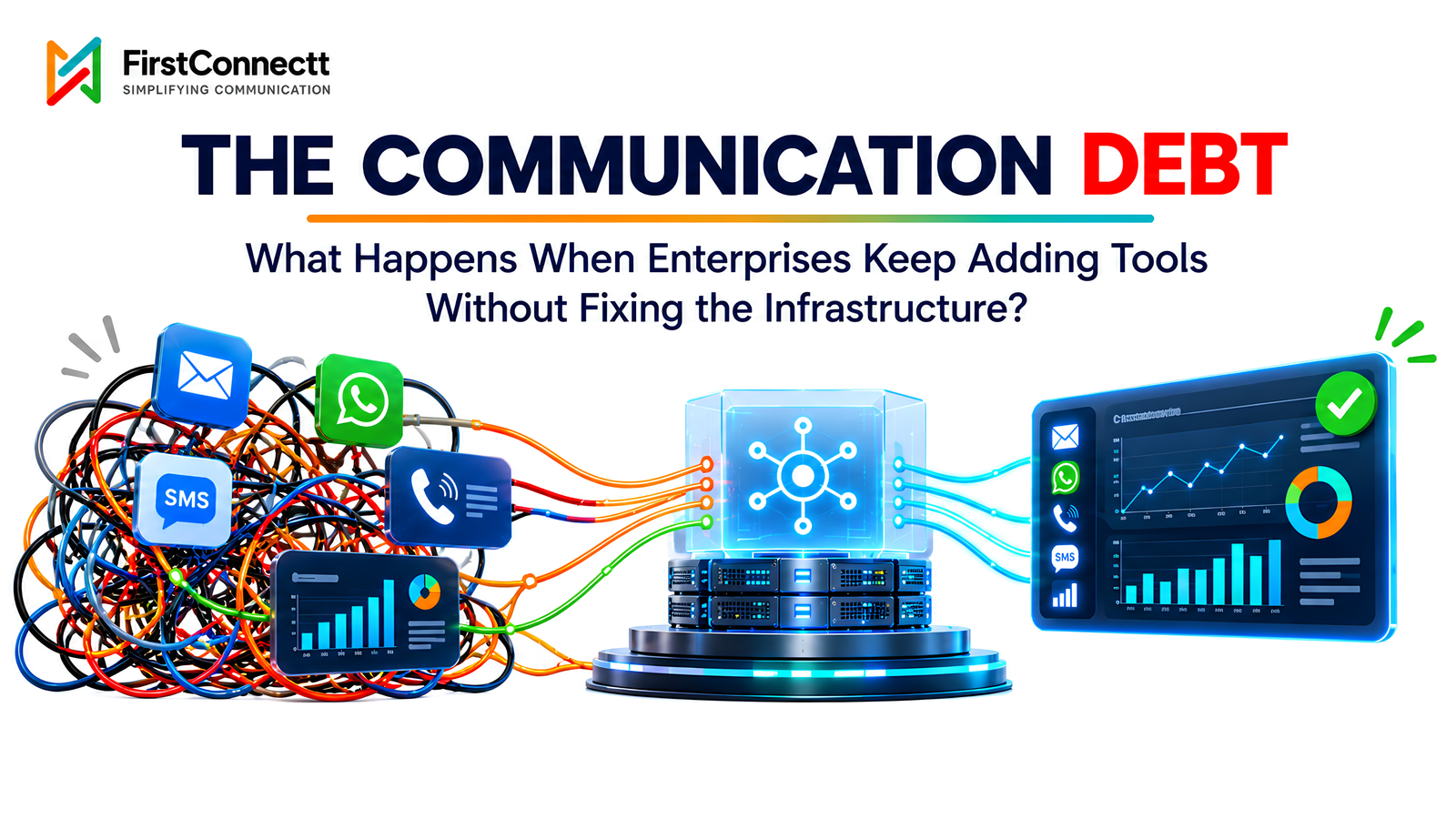
A business starts with SMS alerts. Then it adds WhatsApp for support, a voice tool for calls, another vendor for email, and dashboards for each. Every tool solves one problem. Over time, though, teams switch between screens, developers maintain extra links, and customer data scatters. Enterprise communication infrastructure rarely gets fixed along the way. The issue isn’t how many tools you own. It’s whether they connect.
Here’s what that gap, called communication debt, really costs.
Communication debt is the technical and operational complexity that builds up when businesses keep adding communication systems, integrations, vendors, and workflows without improving the base underneath.
It works like technical debt. Technical debt grows when quick technology choices create future maintenance problems. Communication debt grows when disconnected tools create long-term integration and operating problems. Both look manageable early on and get costlier as the business grows. The cost is easy to miss because each tool still works.
Common sources include separate APIs for each channel, several vendors with different interfaces, disconnected dashboards, repeated integrations between applications, and inconsistent customer data. MuleSoft’s 2025 benchmark of over 1,050 IT leaders found the average enterprise manages 897 applications, yet only 29% are integrated.
Using several vendors isn’t automatically a problem. Complexity becomes debt when the setup is hard to manage, maintain, and scale. Communication debt is the accumulated cost of building without a long-term integration plan.

Communication debt grows slowly, not through one big decision. It usually follows four stages.
Stage 1: Solving immediate requirements.
A department picks a tool for a specific need. Marketing adopts one messaging platform, while support chooses another.
Stage 2: Adding more integrations.
As needs grow, developers connect each tool with CRM systems, databases, and internal software.
Stage 3: Creating separate workflows.
Departments build their own processes, dashboards, and rules. Customer information doesn’t move consistently between them.
Stage 4: Managing the complexity.
The business now spends time and money maintaining integrations, fixing failures, updating settings, and coordinating vendors.
Picture an enterprise running separate systems for OTPs, promotional SMS, WhatsApp support, and voice calls. Each works alone. Together, they form a fragile communication technology stack. Debt often begins with convenient short-term choices that nobody revisits as the business grows.

Debt is easy to ignore because it rarely shows up as one line in a budget. It hides in many small tasks, delays, and workarounds.
Every extra integration needs development, testing, monitoring, and upkeep. When systems have different setups, even small updates get complicated. The same MuleSoft research found IT teams spend about 39% of their time building custom integrations.
Separate dashboards make it hard to see the full communication journey. Teams see single-channel results without knowing where the customer experience breaks down.
When something fails, teams may need to check several vendors, APIs, and internal systems before finding the cause.
Customers get duplicate updates, conflicting information, or repeated questions because systems don’t share context.
When workflows are hard to manage, even routine changes need developers. That slows business teams who must respond quickly.
Communication debt affects more than IT budgets. It shapes customer experience, operational efficiency, and business agility. MuleSoft’s research also found that 83% of respondents believe delays equate to lost revenue opportunities.
Enterprises often collect vendors over time: one for SMS and OTPs, another for the WhatsApp Business API, a third for voice, and more tools for support automation and analytics. Each brings its own contract, billing, technical contact, and service terms.
The daily effects add up. APIs and documentation differ. Service-level agreements and support processes differ. Reports arrive in different formats. Vendor coordination takes more effort, and changing or linking systems takes more work.
Several providers can be useful for backup, regional coverage, or special needs. The problem is unmanaged sprawl, not variety itself. A single outage can take hours to trace when SMS, WhatsApp, and voice each sit with a different provider and a different support team. Enterprises should judge their whole communication ecosystem, instead of picking every new tool alone.
Adding channels and connecting interactions are two different things. A customer gets an SMS about an order, asks a question on WhatsApp, then calls support. If each channel runs alone, the support team can’t see earlier interactions. The customer repeats details, departments send duplicate updates, and the business can’t see the whole journey. Automation suffers too. A reminder bot on one channel may keep messaging after the issue was solved on another. Deloitte Digital’s 2024 Global Contact Center Survey found only 13% of contact centers could keep customer context while moving someone between channels.
True omnichannel communication needs more than channel availability. It needs integration, shared context, coordinated workflows, and consistent customer information. More channels give customers more options. Connecting them improves the experience.
This is the gap FirstConnectt is built to close. FirstConnectt is a global CPaaS provider supporting A2P messaging, WhatsApp Business API, RCS, voice, Conversational AI, and Agentic AI. These capabilities help enterprises explore connected workflows through one common platform. Businesses can assess how they fit existing systems and customer engagement needs.
Building a communication ecosystem that scales takes more than adding another tool. It takes the right infrastructure. Explore how FirstConnectt can support your enterprise communication strategy.
Reducing debt doesn’t always mean replacing systems. It starts with understanding how they work together.
Step 1: Audit the existing communication stack.
List every tool, API, vendor, integration, dashboard, and workflow in use.
Step 2: Identify overlapping capabilities.
Check whether several tools do similar jobs, and look for chances to simplify.
Step 3: Map the customer communication journey.
See how customer information moves between SMS, WhatsApp, voice, support systems, and internal applications.
Step 4: Build an integration strategy.
Favour reusable APIs, consistent data structures, and communication API integration that links relevant business applications.
Step 5: Establish clear ownership.
Decide which teams own workflows, vendor relationships, integrations, and performance monitoring.
Step 6: Review infrastructure regularly.
Check whether the setup can handle growing traffic, new channels, changing expectations, and future business communication automation.
Good communication infrastructure management is an ongoing habit, not a one-time project. Start small. Pick one high-traffic journey, such as OTPs or order updates, fix its integrations first, and apply what you learn to the next one.
CPaaS offers communication capabilities through APIs. Enterprises can plug several supported channels into existing applications and workflows. A shared CPaaS platform can reduce the need to manage entirely separate integrations for each channel. Connected capabilities support more coordinated customer interactions, and central visibility may get easier, depending on the platform’s features and setup.
CPaaS doesn’t erase debt automatically. Enterprise communication infrastructure still needs sound architecture, data governance, monitoring, and integration planning. For example, one API layer can send OTPs by SMS, support updates on WhatsApp, and callbacks by voice, using the same customer record. That cuts repeated work for developers and gives business teams one place to check results. Used well, it helps companies move toward a structured environment instead of piling up disconnected tools.
Communication debt grows when short-term choices create long-term complexity. Disconnected tools hurt maintenance, visibility, customer experience, and efficiency. The fix starts with a review of existing systems and a clear integration plan, not another purchase. Stronger enterprise communication infrastructure, with CPaaS as part of the move, turns scattered tools into connected communication. Businesses that act early spend less on repairs and respond faster to change. FirstConnectt supports that shift across messaging, voice, and AI. The next stage of enterprise communication won’t be about how many tools a business owns. It will be about how well those tools work together.
It’s the technical and operational complexity created when businesses collect disconnected communication tools, APIs, vendors, and workflows without a clear integration strategy.
It can raise maintenance costs, complicate integrations, reduce visibility, slow issue resolution, and create inconsistent customer experiences.
No. Several providers can support backup and special needs. Problems arise when integrations, ownership, and workflows aren’t managed well.
Audit existing tools, remove duplication, improve API integration, set clear ownership, and review the architecture regularly.
It can help consolidate capabilities and simplify integrations, depending on the platform and how the enterprise implements it.
Share this article
Article
 Article
 Article
Ready to put these ideas to work? Talk to our team about your communication stack.
Get Started →