
 Article
November 13, 2026
7 min read
 FirstConnectt
Enterprise communication insights
Article · FirstConnectt Insights
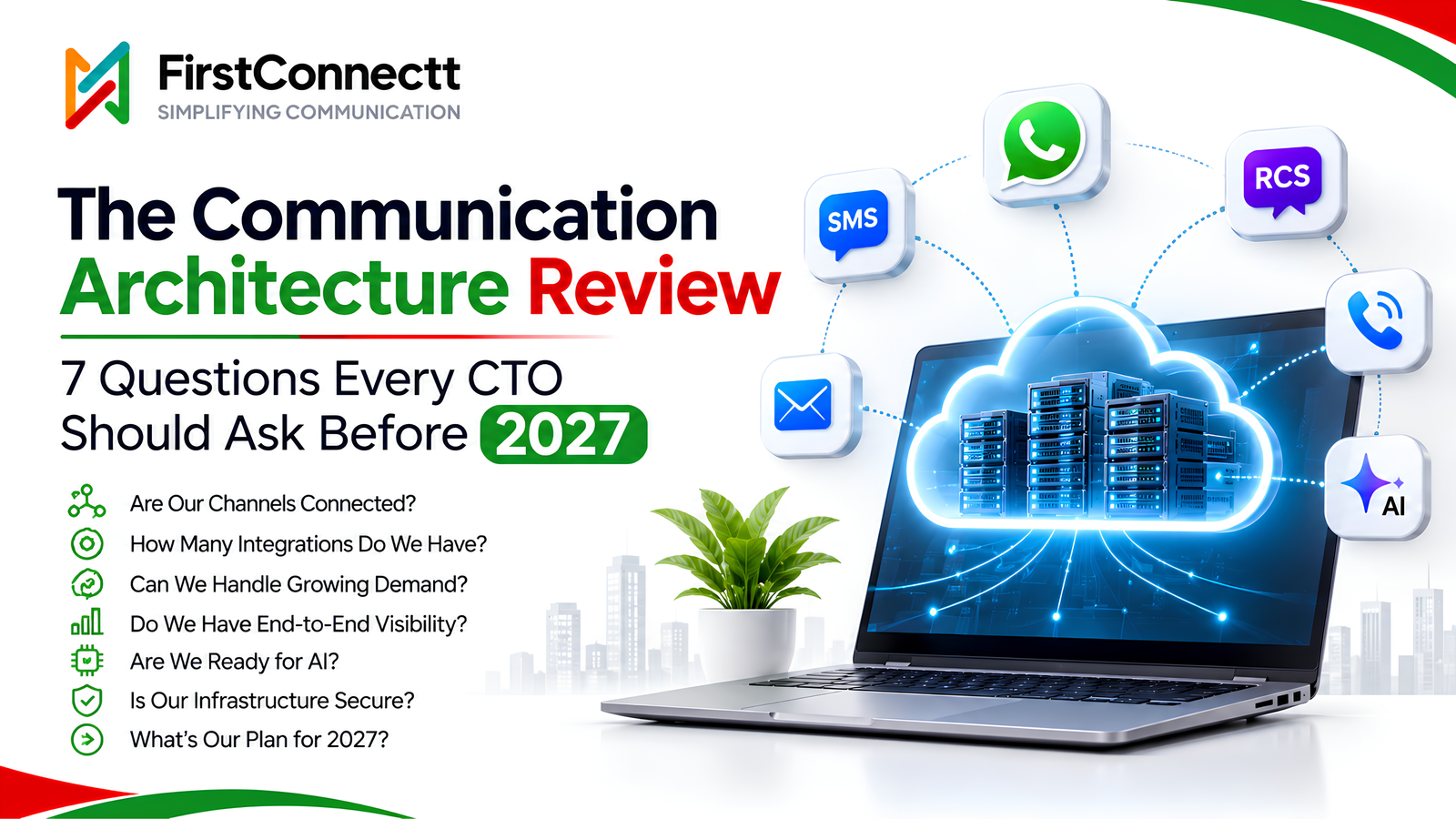
Is your communication infrastructure ready for 2027? Teams often review their cloud setup, databases, and security. Communication systems usually get a look only after something breaks. Yet alerts, logins, support, and automated chats all depend on them. Enterprise communication infrastructure may work perfectly today. However, that doesn’t mean it’s ready for tomorrow, as channels, APIs, and AI keep adding load. A review should happen before growth exposes the weak spots.
Moving forward, this blog carries the critical seven questions to ask first to review your communication architecture.
Communication systems deserve the same attention as any other core technology. Customer communication now relies on APIs, databases, CRM systems, applications, and outside providers. Channels keep growing across SMS, WhatsApp, RCS, voice, email, and AI. Delayed alerts, failed integrations, and disconnected workflows hit operations directly. AI and automation add new integration, security, and governance questions.
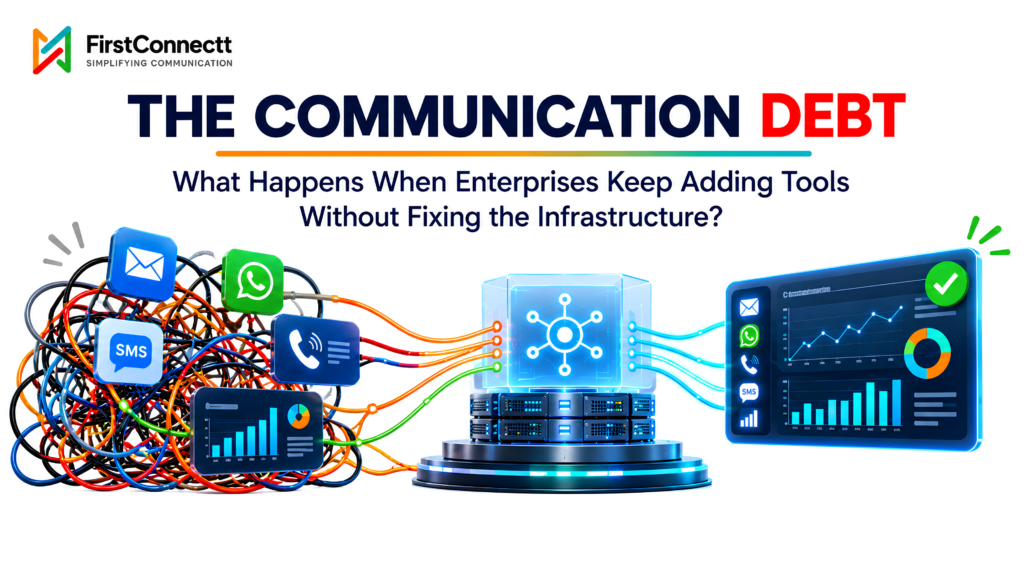
Enterprise communication infrastructure should be reviewed as a whole, not one platform at a time. A communication infrastructure review isn’t about replacing tools. It’s about seeing how systems work together, where risks sit, and what needs work. Small gaps stay hidden until traffic grows or a launch goes wrong.
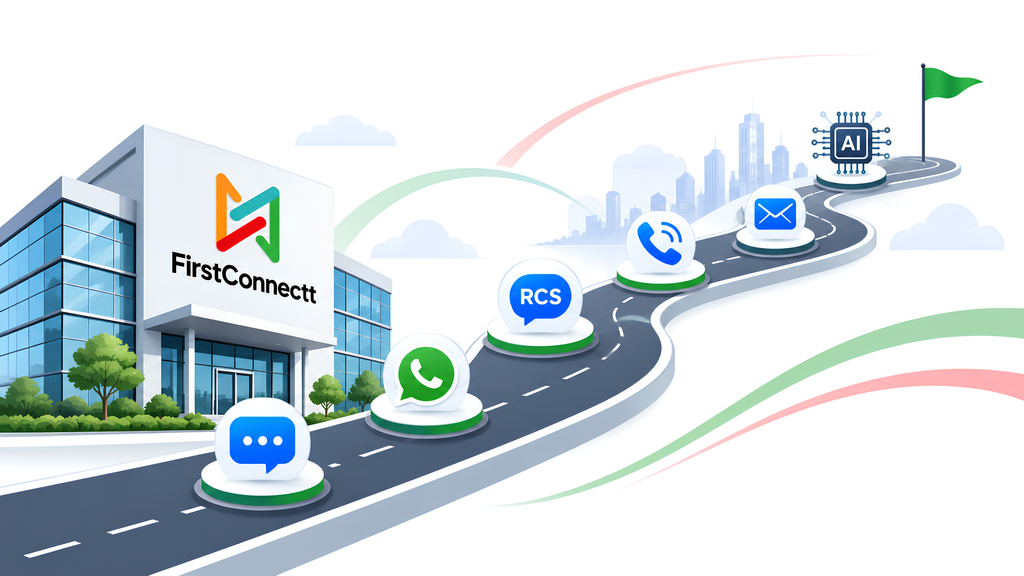
This is the kind of review FirstConnectt supports. FirstConnectt is a global CPaaS provider focused on enterprise communication, with A2P messaging, WhatsApp Business API, RCS, voice, Conversational AI, and Agentic AI. Enterprises can explore how these capabilities fit their existing communication architecture and future needs.
Preparing your communication systems for the next stage of growth? Explore how FirstConnectt can support your enterprise communication strategy. Now, the seven questions.

Start with how channels work inside your organization. Are SMS, WhatsApp, RCS, voice, and email run on separate systems? Can interaction history move between channels? Do departments see consistent information? Can customers switch channels without repeating themselves?
Offering many channels isn’t the same as omnichannel communication. Fragmentation continues when channels don’t share context. A support agent should see a customer’s WhatsApp chat before answering their call. Deloitte Digital’s 2024 Global Contact Center Survey found only 13% of contact centers could keep customer context between channels.
What good looks like: connected workflows, sensible data sharing, consistent processes, and visibility across touchpoints.
Count your providers, APIs, and integrations. Are different APIs handling different functions? Do tools overlap? How hard is it to replace, update, or maintain a provider? Is every dependency documented? Who owns each integration, and what happens if that person leaves?
MuleSoft’s 2025 benchmark found the average enterprise runs 897 applications, with only 29% integrated. Unmanaged sprawl adds maintenance effort and troubleshooting time. Several providers can still make sense for backup, special needs, or regional coverage. The concern is unmanaged dependencies.
What good looks like: a documented stack, clear vendor ownership, reusable communication API integration, and a plan for managing dependencies.
Test how the system copes with growth. Can it handle higher message and call volumes? What happens during seasonal peaks, campaigns, or high-traffic events? Are API rate limits known? Can teams monitor latency and delivery failures? Are recovery plans written and tested? Ask engineers for load-test results, not assumptions.
Think of e-commerce sales, banking alerts, ticket bookings, and logistics updates. ITIC’s 2024 survey of over 1,000 firms found an hour of downtime costs more than $300,000 for over 90% of mid-size and large enterprises. Communication system scalability means holding performance steady, managing dependencies, and reacting to surprises.
What good looks like: tested capacity, performance monitoring, clear service-level expectations, practical recovery plans, and a tested failover path.
A delivery report alone doesn’t tell the full story. Many teams stop at delivery rates, which show only part of the picture. Can teams track messages beyond API acceptance? Can they spot delays, failures, and patterns? Can they see customer responses and unresolved interactions? Are reports available across channels? Can they find where a journey breaks? Track drop-offs, repeat contacts, and resolution time too.
Uptime, delivery, response, and resolution are four different things. A message can arrive and still fail to prompt the intended action.
What good looks like: meaningful monitoring, consistent reporting, actionable delivery data, and visibility into outcomes.
Check whether AI can plug into real workflows. Can AI systems reach accurate business information? Do automated conversations connect to existing workflows? Is there a clear handover to human agents? Are AI actions limited by permissions? Can teams monitor responses, decisions, and escalations? Test edge cases, such as unclear questions or missing data, before launch.
Say a customer asks about a delayed payment. An AI assistant pulls the relevant data, shares an update, and escalates if it can’t resolve the issue. An AI assistant that isn’t integrated becomes another disconnected tool. Business communication automation only works when systems share data.
What good looks like: reliable integrations, defined permissions, human escalation, monitoring, and governance.
Security can’t be an afterthought. How is customer data protected across systems? Who can see conversations and transaction details? Are access controls and authentication in place? Are consent and preferences handled correctly? Do vendors and integrations meet security and regulatory needs? Ask for security documents, and test how opt-outs are enforced.
Data handling matters at every step, including APIs, third parties, storage, and internal apps. Requirements vary by industry, data type, channel, and regulation.
What good looks like: documented controls, access management, data governance, vendor assessments, and regular compliance reviews.
Look past today’s performance to long-term flexibility. Can new channels join without a rebuild? Can the setup support new AI capabilities and automation? Will it connect with future CRM, ERP, and customer apps? Can strategy change without adding technical complexity? Does it match the long-term roadmap? Ask how long adding a new channel would take, in weeks and in effort.
Requirements will keep changing. The aim is adaptable enterprise messaging infrastructure, not a growing pile of isolated fixes.
What good looks like: modular integrations, reusable APIs, flexible workflows, and a clear roadmap.
Turn the answers into action in four steps.
Document: Create an inventory of communication tools, vendors, APIs, integrations, and workflows.
Identify: Find disconnected systems, overlapping capabilities, performance gaps, and security risks.
Prioritise: Separate urgent operational issues from longer-term improvements.
Plan: Build a roadmap for integration, scalability, monitoring, automation, and governance. Set owners and dates for each action so the plan doesn’t stall.
You don’t need to replace every system at once. Base improvements on business priorities, technical feasibility, and measurable needs. A review matters only when it leads to clear decisions.
CPaaS (Communications Platform as a Service) delivers communication capabilities through APIs. It helps enterprises add several channels to existing applications and workflows, and a shared platform simplifies managing them. A common platform can also give teams one dashboard for delivery and failures. CPaaS solutions can support connected engagement through SMS, WhatsApp Business API, RCS, voice, and AI.
However, CPaaS isn’t an automatic fix. Its value depends on integration quality, platform capabilities, security, and implementation. Ask providers for service-level commitments. Used well, it supports a more structured enterprise communication platform.
Communication systems are tied ever closer to enterprise operations. Disconnected systems, limited visibility, and outdated integrations create long-term problems. CTOs should review their architecture before those problems hit performance. Strong enterprise communication infrastructure isn’t about adopting every new tool. It’s about building a base that adapts as needs change, with clear ownership, tested capacity, and secure integrations. Closing gaps early costs far less than fixing outages later. FirstConnectt supports that work across messaging, voice, and AI. The strongest communication architecture isn’t the one with the most tools. It’s the one that helps every part of the business work together.
It’s the structure of platforms, APIs, channels, integrations, and workflows enterprises use to manage customer and business interactions.
Regular reviews reveal integration gaps, vendor dependencies, scalability limits, security risks, and operational inefficiencies before customers notice them.
CPaaS provides APIs and communication capabilities that businesses integrate into existing applications and workflows.
Periodically, and whenever business scale, technology, security needs, or communication needs change significantly.
Share this article
Article
 Article
 Article
Ready to put these ideas to work? Talk to our team about your communication stack.
Get Started →