
 Article
November 13, 2026
7 min read
 FirstConnectt
Enterprise communication insights
Article · FirstConnectt Insights
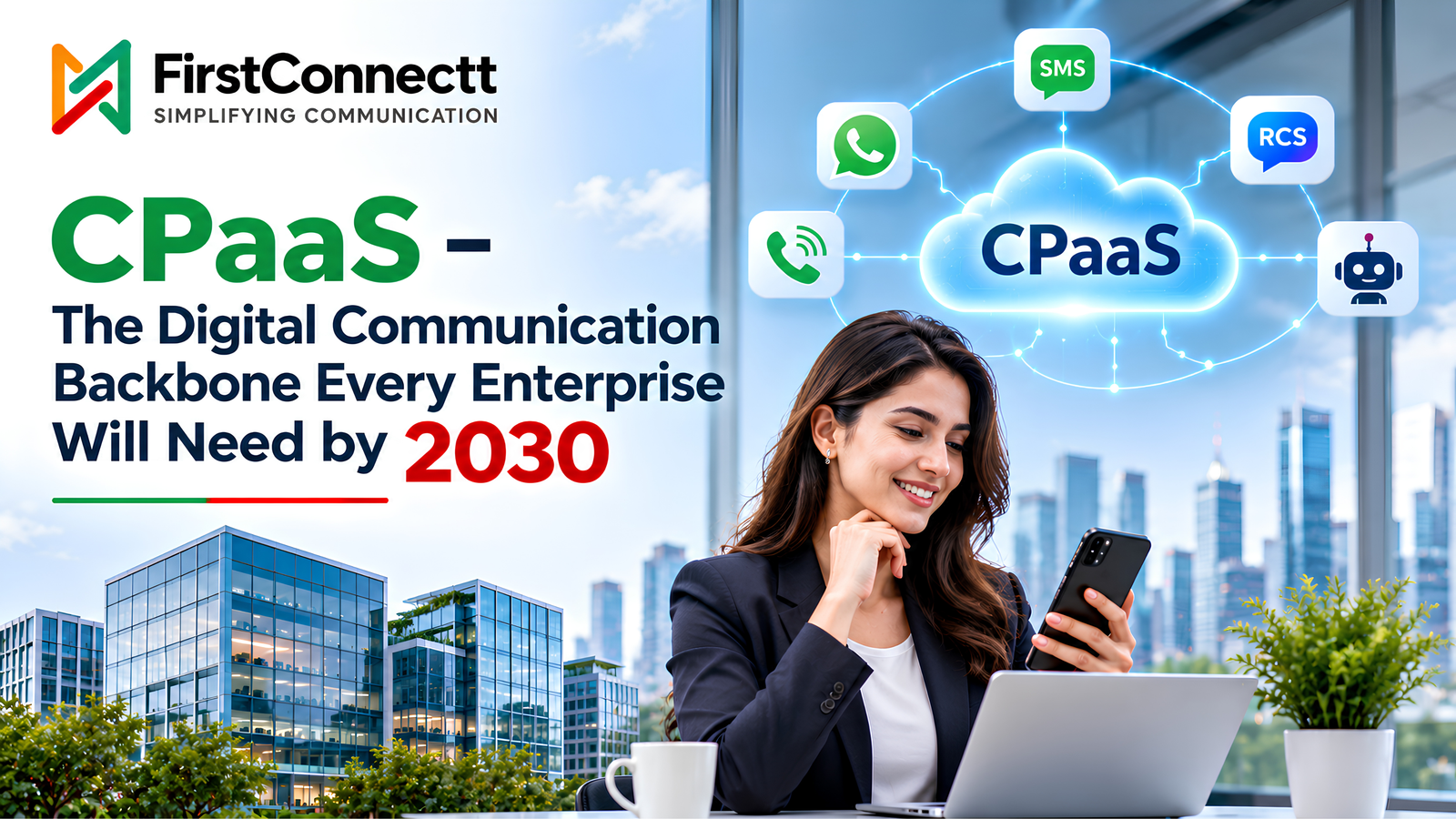
The enterprise infrastructure is shifting immensely! Now, enterprises may compete less on products and more on how well they talk to people. Customers already expect quick replies, timely updates, and the same experience on every channel. AI assistants, digital payments, and self-service journeys all depend on connected communication. CPaaS for enterprises supplies that connection, linking apps, channels, and customer data. Communication is moving from a support task to core infrastructure.
Here’s why that shift matters.

Communications Platform as a Service, or CPaaS, lets businesses add communication features to their own apps and workflows through APIs. Those features can include SMS, voice, the WhatsApp Business API, RCS, and other supported channels. As a result, instead of building each one from scratch, enterprises connect them to systems they already use.
A banking app can send transaction alerts. An e-commerce platform can share order and delivery updates. A standalone messaging tool usually does one job. A CPaaS platform links communication with wider business workflows.
The market is growing. Studies say the global CPaaS market has reached $14.9 billion in 2025. And by 2034, it is projected to reach $82.1 billion. CPaaS for enterprises builds communication into the customer journey, instead of treating it as a separate task.
Four developments are changing what businesses need from enterprise communication infrastructure. These are likely trends based on current adoption, not guaranteed outcomes.
AI-driven interactions: AI assistants will increasingly handle customer queries, service requests, and routine workflows.
Omnichannel expectations: Customers will expect businesses to use the right channel without losing context along the way.
Real-time business processes: Payments, deliveries, bookings, and account activity depend on timely notifications and responses.
Connected enterprise systems: CRM platforms, support software, payment systems, and business apps need to work together.
Adding more channels doesn’t automatically improve the experience. Enterprises must connect channels to the right workflows and keep visibility into every interaction. The challenge isn’t sending more messages. It’s coordinating communication across increasingly connected operations.

Enterprises can use SMS, voice, WhatsApp, RCS, and other supported channels based on the purpose of each interaction. A retailer might send an order confirmation first, then a delivery update, then open a support chat if needed. This is omnichannel communication in practice.
APIs let businesses add communication features to existing apps without building each one alone. Common uses include onboarding, authentication, appointment reminders, payment alerts, and customer support.
Automated messages can handle routine interactions across large customer bases. That cuts repetitive manual work and keeps responses consistent. Business communication automation still needs monitoring, clear escalation, and human support when needed.
CPaaS capabilities can support AI-powered communication through automated replies and connected journeys. Conversational AI talks with customers. Agentic AI may take actions within defined permissions and workflows.
Enterprises need delivery statuses, interaction histories, performance monitoring, and reports to see how communication really performs.
A CPaaS platform brings channels, applications, automation, and visibility into one connected environment.
| Industry | Potential CPaaS applications |
| Banking and financial services | Transaction alerts, authentication messages, payment reminders, service notifications |
| E-commerce and retail | Order confirmations, delivery updates, returns, promotions, customer support |
| Healthcare | Appointment reminders, registration updates, follow-up communication |
| Logistics | Dispatch notifications, delivery coordination, status updates |
| Education | Admissions communication, fee reminders, application updates, student support |
| Travel and hospitality | Booking confirmations, itinerary updates, check-in reminders, disruption alerts |
Each industry has different needs around consent, privacy, security, and message frequency. No enterprise needs every channel. The right setup depends on customer behavior, business goals, existing systems, and applicable rules.
Overall, CPaaS solutions are flexible because businesses can adapt them to their own operations.
AI can change what a communication platform does. Conversational AI supports natural-language conversations. AI can sort requests and send them to the right workflow or human team. Agentic AI may perform specific actions, such as checking a request status, when the right integrations and safeguards exist.
Consider a customer asking about a delayed order. An AI-enabled workflow checks the available order data, shares an update, and escalates the issue if it can’t resolve it.
Good results depend on four things: accurate, current data; clear permissions and limits on AI actions; human escalation for complex or sensitive cases; and monitoring, security, and customer consent. AI makes communication more responsive, but its value depends on the infrastructure and controls behind it.
Use this checklist before choosing a provider.
1. Channel capabilities: Does the platform support the channels your business actually needs?
2. Integration flexibility: Can it connect with your applications, APIs, CRM systems, and workflows?
3. Scalability: Can it handle expected traffic and changing requirements?
4. Monitoring and reporting: Can teams track delivery, failures, usage, and performance?
5. Security and compliance: Are the right controls, data-handling practices, and regulatory needs covered?
6. Support and resilience: What happens during outages, delivery failures, traffic spikes, or integration problems?
Judge real capabilities, not just feature lists. Ask about service-level commitments, support processes, and recovery plans. The right enterprise messaging platform should fit your long-term architecture, not solve only one immediate need.
CPaaS adoption brings responsibilities too. Legacy systems can be hard to connect. Customer consent, data privacy, and channel-specific rules need steady management. Too many or duplicate notifications annoy customers. Delivery failures and reliance on outside providers need monitoring. Using several vendors can leave workflows fragmented.
CPaaS alone doesn’t guarantee reliable delivery, compliance, or a seamless experience. Those outcomes depend on platform capabilities, integration quality, governance, and ongoing monitoring. Enterprises need a communication strategy alongside the technology.
FirstConnectt provides CPaaS capabilities for enterprise communication. Its platform brings together A2P messaging, voice, RCS, the WhatsApp Business API, Conversational AI, Agentic AI, and other supported capabilities. Enterprises can explore how these fit their customer engagement needs and existing workflows.
As businesses prepare for the next phase of digital growth, communication infrastructure deserves the same attention as other core systems. Explore how FirstConnectt can support your enterprise communication strategy.
As enterprises prepare for the next phase of digital transformation, communication infrastructure deserves a place in their long-term technology strategy. The right CPaaS approach can help connect customer interactions with business applications, automation, and AI-enabled workflows.
FirstConnectt brings together messaging, voice, RCS, WhatsApp Business API, and AI communication capabilities for enterprise use cases. Explore how these capabilities can fit your business requirements and existing communication workflows.
Explore enterprise communication with FirstConnectt.
CPaaS is a cloud-based model that lets businesses add communication features, such as SMS and voice, to their applications through APIs.
It helps connect communication channels with business systems, automate routine interactions, and manage customer communication more consistently.
It can provide the channels and integrations for AI-enabled conversations and workflows, depending on platform features and implementation.
Yes. It can support alerts, customer support, notifications, and multi-channel engagement. Suitability depends on scale, integration needs, and governance.
Not necessarily. Many enterprises will keep existing systems while adding CPaaS where it offers practical benefits.
Share this article
Article
 Article
 Article
Ready to put these ideas to work? Talk to our team about your communication stack.
Get Started →