
 Article
November 13, 2026
7 min read
 FirstConnectt
Enterprise communication insights
Article · FirstConnectt Insights
Customers Don’t Communicate in Just One Place Anymore!
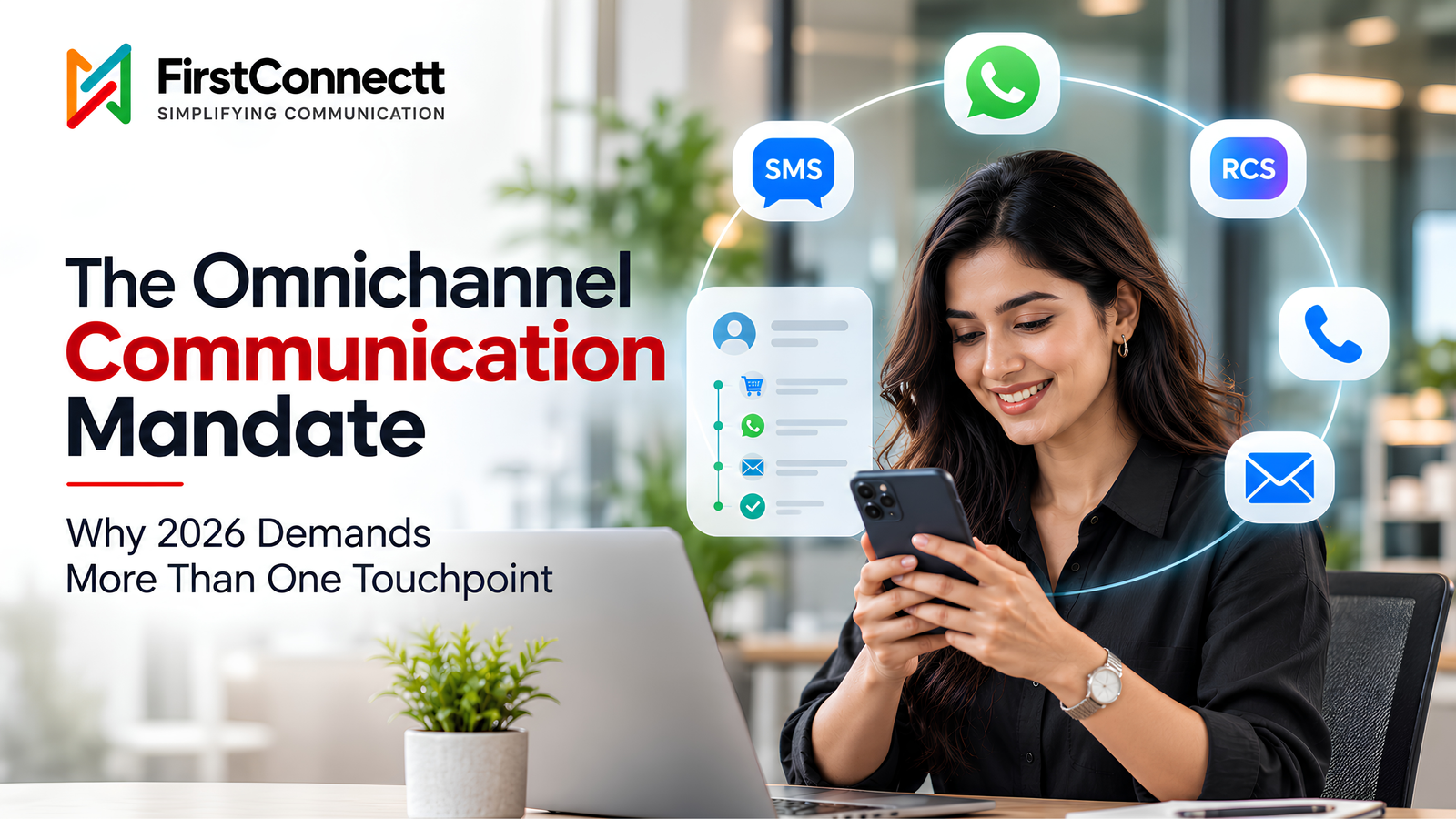
They see the product on social media, visit the website, ask a question on WhatsApp, get an SMS confirmation, then call support. To the customer, that is one relationship. Inside the business, it’s often five separate systems. Omnichannel communication links those steps into one flow. In 2026, offering many channels isn’t enough anymore. Channels must work together.
Here’s why, and how to make that happen.

Omnichannel communication is an approach where customer-facing channels work together to create a connected experience. It brings in channels such as SMS, WhatsApp, RCS, voice, and email. It keeps information consistent and, where integrations allow, keeps conversation context. It also coordinates messages around the customer’s journey.
Here’s a simple case. A customer starts on WhatsApp but needs a support executive. A well-integrated system lets the executive see the earlier conversation, instead of asking the customer to explain everything again.
This depends on integration, data access, and good setup. Offering several channels doesn’t guarantee a connected experience. Omnichannel communication links touchpoints into one consistent journey.
Multichannel vs omnichannel communication comes down to connection.
| Multichannel communication | Omnichannel communication |
| Businesses use multiple channels. | Channels work together as one connected experience. |
| Each channel may operate separately. | Interactions are coordinated across channels. |
| Customer context may not carry over. | Relevant context is kept through integrations. |
| Teams manage separate workflows. | Workflows connect different touchpoints. |
| Focus is on channel availability. | Focus is on the complete customer journey. |
Take a customer who asks about an order on WhatsApp, then calls support. In a disconnected setup, they repeat the order details. In a connected setup, the executive can see the earlier chat and carry on.
Multichannel gives customers more ways to reach a business. Omnichannel makes those interactions feel connected. More channels create more access. Better integration creates a better experience.
Managing customer communication across multiple channels alone can be hectic, inconsistent, and hard to scale. That’s where a reliable partner makes the difference. FirstConnectt is a CPaaS company in India serving enterprises across multiple channels. Its capabilities include A2P messaging, WhatsApp Business API, RCS, voice, Conversational AI, and Agentic AI. As an omnichannel communication platform for enterprises, it helps businesses explore connected workflows based on their operations and customer engagement needs.
As customer journeys become more connected, enterprises need communication infrastructure that can keep up. Explore how FirstConnectt can support your omnichannel communication strategy.
Four shifts make this a priority for any enterprise communication strategy.
Customers expect convenience: Some prefer WhatsApp for quick questions, voice for complex issues, or SMS for important updates. Businesses should learn real preferences, not assume everyone wants the same channel.
Journeys are less predictable: A customer may move between websites, apps, messaging platforms, and support teams before completing a purchase. Juniper Research projects spending through conversational commerce channels to reach $135 billion by 2027.
AI is changing interactions: Conversational AI and AI agents handle queries and routine requests. They need access to relevant information and connected workflows.
Consistency matters: When departments use separate systems, customers get conflicting information, duplicate notifications, or slow replies.
Omnichannel communication helps enterprises respond to how customers actually interact with them.

When history isn’t shared across channels, customers explain the same issue again. Salesforce research found that 56% of customers have to repeat or re-explain information to different representatives.
Separate systems make it hard for teams to coordinate notifications, follow-ups, and service updates.
Support teams may not see conversations handled by marketing, sales, or other departments. Deloitte Digital’s 2024 Global Contact Center Survey found only 13% of contact centers could keep customer context while moving someone between channels.
An automated reply may ignore an earlier interaction, an open complaint, or a recent transaction.
Separate reports make it hard to see how customers move between channels and where interactions break down.
Picture an e-commerce customer who gets a delivery update by SMS, asks a question on WhatsApp, then calls support with none of that history visible. Disconnected communication creates friction for customers and extra work for internal teams.
CPaaS, or Communications Platform as a Service, is the technology layer that lets businesses add communication features to their applications and workflows through APIs. CPaaS solutions typically cover these capabilities:
SMS and A2P messaging: transaction alerts, OTPs, reminders, and service notifications.
WhatsApp Business API: customer conversations, updates, and support.
RCS: richer branded messaging with supported features.
Voice: customer assistance, notifications, and voice-based interactions.
Conversational AI: automated conversations and query handling.
Agentic AI: AI-enabled workflows that perform defined actions within set permissions.
Bringing these together supports omnichannel messaging in one connected environment. Deloitte research found that only 25% of contact centers use dedicated omnichannel routing tools, so there’s plenty of room to improve.
CPaaS provides infrastructure and integration. The quality of the experience still depends on how businesses configure systems, manage data, and coordinate workflows. It helps enterprises move from managing single channels to building connected communication journeys.
AI can make omnichannel communication more responsive and context-aware. Conversational AI can handle routine questions across supported channels. It can spot customer intent and direct queries to the right workflow. Agentic AI can support defined actions, such as checking order information or starting an approved service request.
Human agents still handle complex, sensitive, or unresolved cases. Connected systems help keep context when a customer moves from automated to human support.
Consider a customer asking an AI assistant about a delayed delivery. The system checks available order data, shares an update, and escalates if a person is needed.
This needs human oversight, data privacy, clear permissions, and accurate information. AI can improve the omnichannel customer experience, but connected data and responsible setup remain essential.
1. Map the customer journey. Find where customers interact with the business, from discovery to post-purchase support.
2. Identify communication gaps. Spot where information gets lost between channels or departments.
3. Choose relevant channels. Pick customer engagement channels based on preferences and business needs.
4. Integrate communication systems. Connect APIs, CRM platforms, support tools, and key business applications.
5. Maintain conversation context. Make relevant interaction history available to authorized teams and systems.
6. Monitor performance. Track delivery, response times, unresolved queries, and customer experience.
7. Review and improve. Check regularly whether workflows meet business goals. Business communication automation works best when reviewed often.
An effective omnichannel strategy starts with the customer journey, not the number of channels a business adopts.
Customers don’t see communication as separate channels. They expect businesses to recognize their needs and give consistent information at every step. In 2026, enterprises must think beyond adding more touchpoints. Omnichannel communication, supported by the right CPaaS infrastructure, helps businesses build more connected customer experiences. The future of customer communication won’t be defined by how many channels a business offers, but by how well those channels work together. FirstConnectt helps enterprises build that connected foundation across messaging, voice, and AI, so every interaction feels like part of the same conversation.
It connects customer-facing channels so businesses can give more consistent, coordinated interactions throughout the customer journey.
Multichannel uses several channels. Omnichannel connects those channels to create a more unified customer experience.
Customers interact across many touchpoints. Connected communication reduces friction, improves continuity, and coordinates interactions.
CPaaS provides APIs and communication capabilities that businesses integrate into their applications and workflows to connect channels.
Yes. AI can support automated conversations, query handling, and workflow actions when linked to relevant data and safeguards.
Share this article
Article
 Article
 Article
Ready to put these ideas to work? Talk to our team about your communication stack.
Get Started →