
 Article
October 6, 2026
7 min read
 FirstConnectt
Enterprise communication insights
FirstConnectt
Enterprise communication insights
Article · FirstConnectt Insights
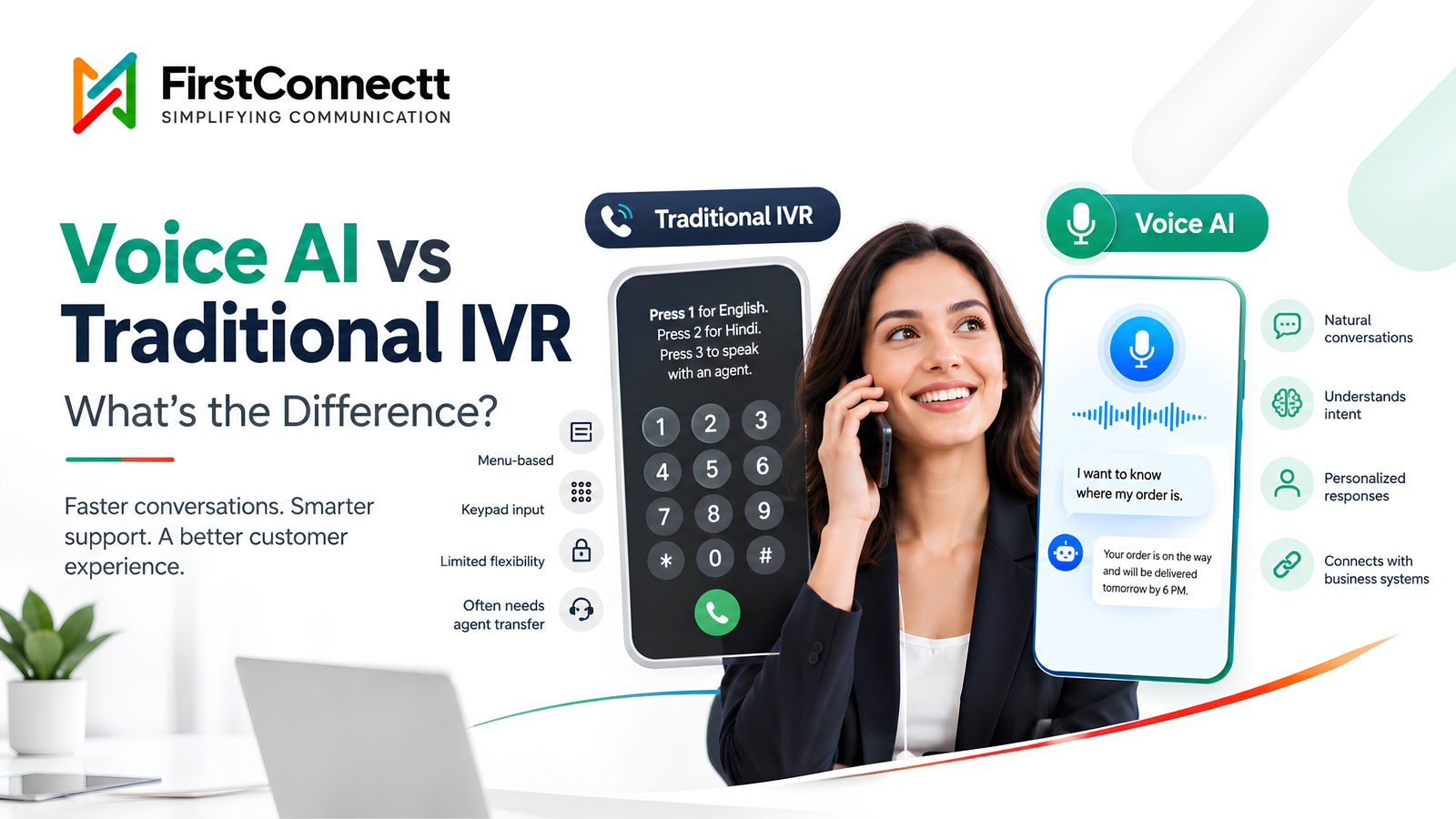
Press 1 for English. Press 2 for Hindi. Press 3 to speak with an agent. Millions of callers hear this every day, and fewer enjoy it. Customer expectations have shifted toward faster, more natural conversations. The debate around Voice AI vs Traditional IVR comes up often as businesses rethink how phone support should work. Neither technology has fully replaced the other.
Here’s how they actually differ, and where each one fits.
Interactive Voice Response, or IVR, is an automated phone system. It interacts with callers through pre-recorded prompts and keypad inputs. A caller might hear something like, ” Press 1 for sales, press 2 for support, press 3 to check an account balance.”
The typical IVR journey follows a fixed path. A customer calls, hears a menu, selects an option, and the system routes the call based on that choice. Traditional IVR handles call routing, account information, payment queries, appointment confirmations, and basic self-service well.
Its biggest strength is structure. Every caller follows the same predictable workflow, which makes it easy to build and inexpensive to run. Research from Vonage found that 61% of consumers consider IVR a poor experience, and 51% have abandoned a business entirely after reaching one, costing companies an average of $262 per lost customer each year.
Voice AI lets customers interact with a system using natural spoken language, instead of selecting from a fixed list. A customer can simply say, I want to know where my order is, and the system responds directly.
Modern Voice AI combines speech recognition, natural language understanding, AI-generated responses, and connections to business data and APIs. This makes it closer to an AI voice assistant than a traditional phone menu.
The core difference comes down to one idea. Traditional IVR asks customers to navigate a menu. Voice AI lets customers explain what they actually need, in their own words.

The clearest way to compare these two systems is side by side.
| Factor | Traditional IVR | Voice AI |
| Interaction | Menu-based | Conversation-based |
| Customer input | Keypad or fixed responses | Natural language |
| Flexibility | Limited | Higher |
| Personalisation | Basic | Context-aware |
| Intent recognition | Predefined options | Understands spoken intent |
| Complex queries | Often needs agent transfer | Can handle many requests |
| Integration | Usually workflow-based | Connects with APIs and systems |
| Human handoff | Based on menu selection | Triggered by intent or complexity |
Interaction model. Traditional IVR follows predefined paths that rarely change. Voice AI allows customers to speak naturally, without memorizing a menu structure.
Understanding intent. IVR depends on choices customers select from a list. Voice AI can interpret a full sentence, such as “I need to change my delivery address,” without forcing the caller into a category first.
Personalisation. Traditional IVR identifies a customer using account numbers or phone numbers. Voice AI can use customer context and connected business systems to shape a more personalized conversation.
Handling complex conversations. Traditional IVR works well when a request fits a predefined workflow. Voice AI can manage more open-ended conversations, though sensitive issues often still need a human agent.
IVR isn’t outdated or useless. It remains valuable for businesses that need predictable call routing, simple customer journeys, high call volumes, and cost-efficient automation. If a customer only needs to reach the right department, a simple menu can work faster than a full conversation.
The real question isn’t whether IVR is dead. It’s whether a fixed menu is enough for the experience a business wants to create. For straightforward workflows, it often still is.
Voice AI performs best in situations that need flexibility. Customers can describe their issue in their own words, rather than guessing which menu option applies. This speeds up intent identification, since the system doesn’t need multiple selections to understand a request.
With the right integrations, Voice AI can also take action, not just answer questions. A customer asks about an order, the system checks the relevant data, and responds with an update or completes the request directly.
Common examples include checking order status, scheduling appointments, answering account questions, qualifying leads, and routing complex calls to the right person.

There isn’t a universal answer here. Traditional IVR suits businesses with simple workflows, predictable use cases, and customers who mainly need routing. Voice AI suits businesses that deal with open-ended questions, want natural conversations, or need automation beyond basic menu navigation.
Many businesses don’t have to choose only one. A hybrid model often works better: IVR handles basic routing, Voice AI manages conversational requests, and a human agent takes over when a situation needs judgment. This combination usually delivers more value than replacing one system entirely with another.
Customers rarely stick to a single channel anymore. A typical journey might move from WhatsApp to SMS, to voice, to AI, and finally to a human agent if needed.
Consider a customer who receives an order update on WhatsApp, then calls with a question. Voice AI understands the issue and responds. If the request needs human attention, the conversation moves to an agent without the customer repeating themselves.
The goal isn’t simply automating calls. It’s building connected voice communication that fits into a wider business and customer communication strategy. This is where a CPaaS platform becomes useful, bringing SMS, WhatsApp, RCS, voice, and AI together through one connected infrastructure.
FirstConnectt helps businesses connect these channels and build more consistent customer journeys through its CPaaS infrastructure.
Banking and financial services use Voice AI for account queries, transaction support, and customer verification. Retail and e-commerce brands use it for order tracking, delivery queries, and returns.
Healthcare providers rely on it for appointment scheduling, reminders, and basic patient questions. Travel and hospitality companies use Voice AI for booking assistance and reservation updates. Real estate teams use it for lead qualification and property enquiries.
These use cases share one thing in common. None of them claim complete automation. Each one uses Voice AI to handle routine requests, while people remain available for anything more complicated.
Voice AI isn’t as simple as adding an AI voice to a phone number. Businesses should consider integration with existing systems, accuracy of intent recognition, and how well the system handles accents and different speaking styles.
Data privacy, customer consent, and security also matter, along with ongoing monitoring and quality control. Human escalation paths still need to exist for situations Voice AI can’t resolve on its own.
The objective should be better customer service automation, not automation just for its own sake.
Traditional IVR brought automation to phone support decades ago. Voice AI is pushing that automation toward genuinely conversational interactions. The shift looks something like this: press buttons, then speak naturally, then have intent understood, then get action taken, then connect to a human when needed.
The future isn’t simply IVR versus Voice AI. For most businesses, it will combine IVR, Voice AI, human agents, and other communication channels into one flexible layer. The conversational AI market reflects this direction, with MarketsandMarkets projecting it to grow from roughly $17 billion in 2025 to nearly $50 billion by 2031.
Traditional IVR is structured and predictable. Voice AI is more conversational and can handle a wider range of requests. The choice between Voice AI and Traditional IVR ultimately depends on a business’s workflows, customer needs, and level of automation.
For many businesses, the strongest approach is not choosing one over the other, but combining IVR, Voice AI, human agents, and other communication channels. With FirstConnectt’s CPaaS infrastructure, businesses can connect these channels to create more consistent and flexible customer journeys.
Traditional IVR uses fixed menus and keypad inputs. Voice AI lets customers speak naturally and interprets what they actually need.
Not always. IVR suits simple, predictable workflows. Voice AI suits conversational, more complex customer interactions.
Voice AI can replace some IVR functions, but many businesses combine both to build more flexible customer journeys.
Common uses include customer support, appointment scheduling, order tracking, lead qualification, and automated call routing.
CPaaS connects Voice AI with other communication channels and business systems, creating more connected customer communication.
Share this article
Article
 Article
 Article
Ready to put these ideas to work? Talk to our team about your communication stack.
Get Started →