
 Article
October 27, 2026
7 min read
 FirstConnectt
Enterprise communication insights
FirstConnectt
Enterprise communication insights
Article · FirstConnectt Insights
Customers Want Conversations, Not Channels.
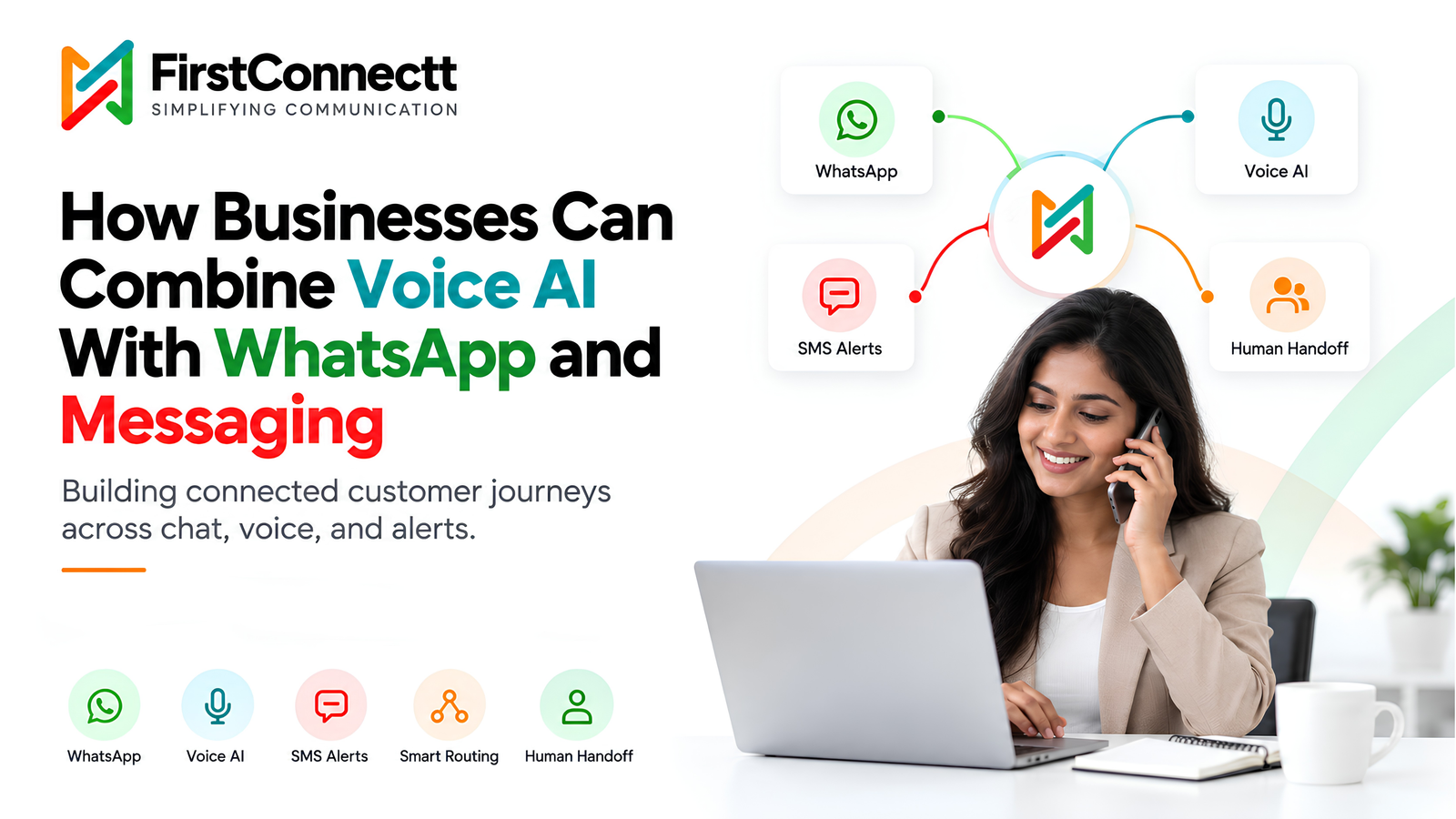
A customer messages a business on WhatsApp, asks about an order, and gets an answer. Then the question gets complicated, and typing stops working. This is where Voice AI enters the picture, picking up conversations that text alone can’t finish. Rather than treating WhatsApp, SMS, and calls as separate tools, businesses can connect them into one journey.
Here’s how these channels can work together instead of apart.
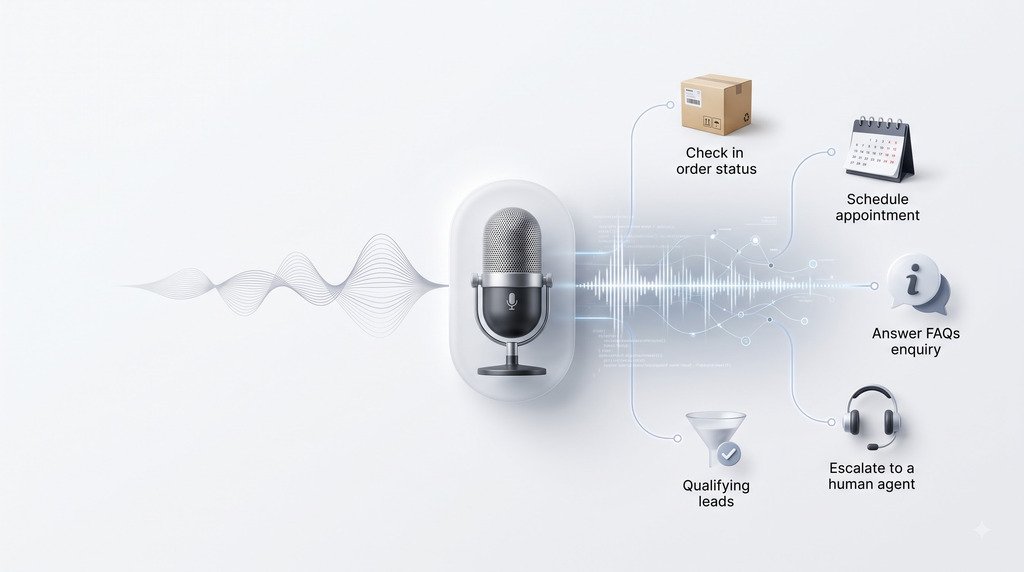
Voice AI uses artificial intelligence to understand spoken language and respond through natural conversation. Unlike traditional IVR, which depends on fixed menus and keypad inputs, Voice AI can understand what a customer actually means and respond accordingly.
It can answer frequently asked questions, check order status, schedule appointments, qualify leads, and escalate conversations to a human agent when needed. Voice AI for business is becoming less about simply answering calls and more about fitting into a broader workflow connected to messaging platforms and business systems.
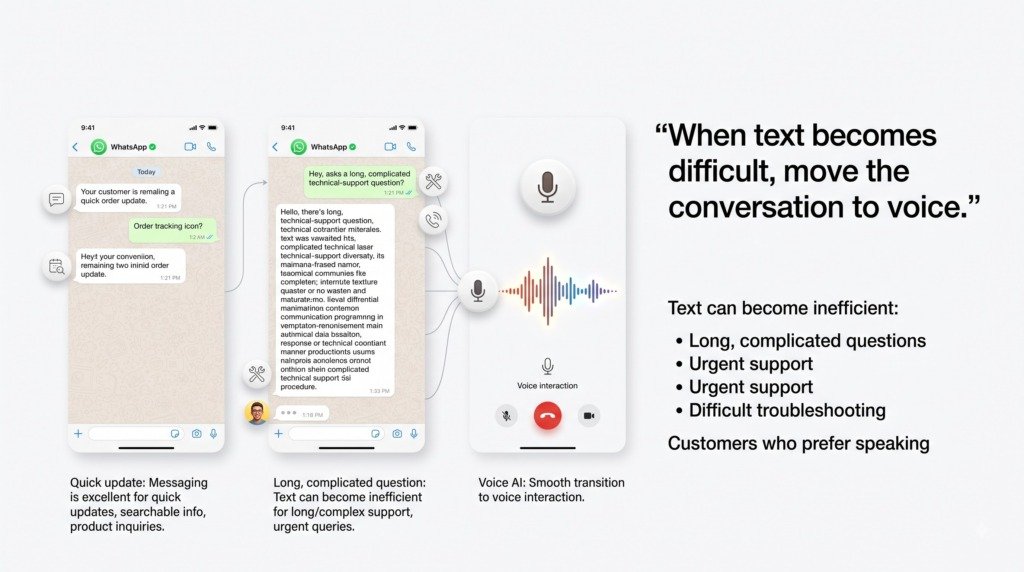
WhatsApp and other business messaging channels work well for many interactions. They’re convenient, searchable, and suited to quick updates. But text isn’t ideal for every situation.
Long or complicated questions, customers who prefer speaking, and difficult troubleshooting conversations can all stall inside a chat thread. A customer might start with a WhatsApp message, then need voice support to explain a technical issue properly.
This doesn’t mean every conversation should move to voice. The better approach gives customers the right channel at the right moment. WhatsApp and messaging can start a conversation, while Voice AI helps move it forward when text isn’t enough.
Combining these channels works best as a structured journey, not a random mix of tools.
WhatsApp often works as the first point of contact, handling product enquiries, service information, order tracking, and appointment requests. A customer might click a WhatsApp button on a website or reply to a campaign message.
The business can use WhatsApp automation to understand the customer’s intent and provide an initial response right away. Simple requests can stay entirely on WhatsApp. More complex ones can offer voice interaction instead.
Voice AI fits best when a question needs several steps, the customer prefers speaking, or the issue feels urgent. Picture this: a customer messages on WhatsApp, the chatbot understands the request, then selects to talk with an assistant. Voice AI starts the call, checks the required information, and either resolves the issue or transfers it to a person.
The transition should feel natural. Customers shouldn’t have to repeat everything from the beginning.
SMS remains useful for time-sensitive, transactional communication: OTPs, payment alerts, appointment reminders, and delivery notifications. A typical journey might look like this: a customer starts on WhatsApp, Voice AI helps resolve the request, SMS confirms the appointment, and WhatsApp shares any extra details afterward.
SMS also works well as a fallback channel when another one isn’t available. The goal isn’t using every channel for every customer. It’s using each one where it adds the most value.
Connected channels only help when they share relevant customer information. Nobody wants to repeat the same issue after moving from WhatsApp to Voice AI, or from AI to a human agent.
Shared context can include contact details, previous messages, order information, support history, and preferred language. If a customer already shared an order number on WhatsApp, Voice AI should be able to use it. The real advantage isn’t simply connecting channels. It’s connecting the information behind them.
Not every request needs a voice call, and not every issue can be solved by a chatbot. AI can identify the best next step based on intent, urgency, conversation history, and issue complexity.
An FAQ might go to a WhatsApp chatbot, an OTP request to SMS, and complex troubleshooting to Voice AI, while a sensitive complaint moves straight to a human agent. This reduces unnecessary calls while still routing customers to the most suitable channel.
Automation manages repetitive tasks well, but some conversations still need empathy or specialised judgment. Human handoffs matter when a customer is frustrated, the issue is sensitive, or the request falls outside what AI can handle.
The handoff should carry the conversation history and relevant details along with it, so a human agent doesn’t have to restart the interaction from zero. Good AI-powered customer support knows when to continue, when to ask, and when to hand over.
These patterns show up across several industries in similar ways.
A product enquiry starts on WhatsApp, with details shared through messaging. Voice AI helps answer product questions, SMS confirms payment or delivery, and WhatsApp handles order tracking afterward.
OTPs and verification run through SMS, while service requests happen on WhatsApp. Voice AI can guide account-related questions, with human escalation for sensitive issues requiring strong security and compliance.
WhatsApp handles appointment requests, SMS sends reminders, and Voice AI confirms bookings or follows up afterward. Its role stays focused on scheduling and information, not medical decisions.
Booking confirmations and check-in reminders move through WhatsApp and SMS, while Voice AI handles urgent issues by phone. This helps businesses respond quickly without adding pressure to support teams.
Combining these channels brings several real advantages. Customers get a better experience by choosing between text, voice, AI, and human support. Responses get faster, since automation handles common requests without waiting for an agent.
Support workload drops as simple queries stay on WhatsApp and messaging, while Voice AI manages voice interactions. This creates more connected omnichannel communication, where customers move between channels without repeating themselves. Automation improves scalability during high communication volumes, and communication data shows where customers drop off and which channels perform best.
Combining Voice AI with WhatsApp and messaging needs more than separate tools. Businesses need a communication layer connecting channels, APIs, workflows, customer data, and automation.
CPaaS can help integrate SMS and A2P messaging, the WhatsApp Business API, voice and cloud telephony, Voice AI, conversational AI, RCS, and CRM systems into one setup. This lets businesses design full communication journeys instead of managing isolated interactions.
The Voice AI Agents market reflects this shift, growing from $3.14 billion in 2024 to a projected $47.5 billion by 2034. A customer can begin on WhatsApp, move to Voice AI, receive an SMS confirmation, and reach a human agent when needed, all through one connected infrastructure.
Modern customer journeys rarely stay on one channel. Businesses need infrastructure that connects messaging, voice, AI, and customer communication workflows without adding complexity.
FirstConnectt helps enterprises build connected communication across A2P messaging, SMS, the WhatsApp Business API, RCS, voice and cloud telephony, conversational AI, and agentic AI. This supports different customer needs through one connected communication layer.
A customer might discover a product through WhatsApp, receive an SMS alert, speak with Voice AI, and connect with a human agent when the situation calls for it. The goal isn’t adding more channels. It’s making every channel work together.
WhatsApp, SMS, and Voice AI each serve a different purpose in the customer journey. WhatsApp supports discovery and quick questions, SMS delivers alerts, and Voice AI handles complex conversations. FirstConnectt connects them into one smoother journey through CPaaS infrastructure.
The key is not to use every channel for every customer. It is about understanding the customer’s needs, choosing the right communication channel, and delivering the right message at the right moment.
A customer may discover a product through WhatsApp, receive an order confirmation through SMS, and speak with a Voice AI assistant when they need support. When these interactions work together, communication becomes faster, clearer, and more convenient.
For businesses, this connected approach can reduce communication gaps, improve response times, and create a more consistent customer experience across every touchpoint. It also helps teams manage conversations more efficiently without making customers repeat themselves.
As customer expectations are continuously growing, businesses need communication infrastructure that can support multiple channels while keeping every interaction reliable and relevant.
FirstConnectt helps businesses bring WhatsApp, SMS, Voice AI, and other communication solutions together to build smoother customer journeys. Because every message has a journey—and every journey should feel connected.
Yes. Businesses can start conversations on WhatsApp and connect customers to Voice AI when they need voice-based help.
Voice AI works best for complex questions, urgent support, or customers who prefer speaking over typing.
SMS supports OTPs, alerts, reminders, confirmations, and fallback communication throughout the journey.
It stops customers from repeating information as they move between WhatsApp, Voice AI, and human support.
CPaaS connects channels, APIs, and business systems, creating more consistent omnichannel experiences.
Share this article
Article
 Article
 Article
Ready to put these ideas to work? Talk to our team about your communication stack.
Get Started →