
 Article
October 22, 2026
6 min read
 FirstConnectt
Enterprise communication insights
Article · FirstConnectt Insights
Sales peak, orders surge, and customers wait for confirmations that never arrive. For many enterprises, the worst day for communication is also the busiest day for revenue. More than 90% of mid-size and large enterprises say one hour of downtime costs them over $300,000. A single communication system failure at the wrong moment can undo weeks of planning. Strong communication infrastructure resilience is built before demand peaks, alongside a tested communication failover strategy.
So what hidden dependencies are putting your busiest day at risk?
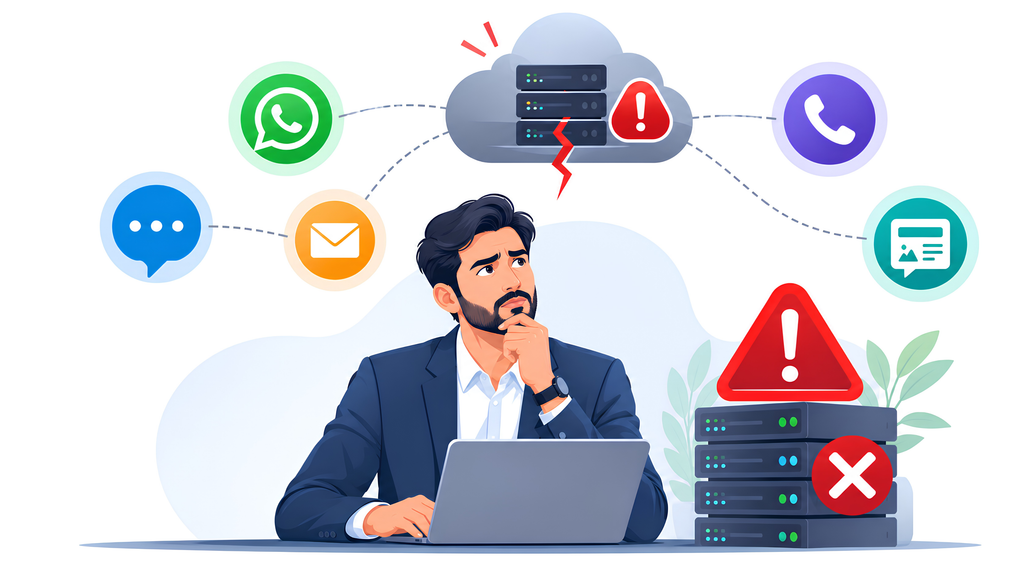
Most businesses rely on outside services to reach customers. These include messaging providers, voice services, APIs, telecom routes, cloud platforms, and the business applications tied to them. Under normal conditions, they all work quietly. That makes it easy to forget how much of the customer journey sits on top of them.
Three risks show up again and again.
A critical workflow, such as OTPs or payment alerts, depends heavily on one provider. If that provider slows down, nothing else can pick up the load.
Several services may run on the same network, region, or integration. One shared weak point can then affect many things at once. The July 2024 CrowdStrike outage cost the Fortune 500 a combined $5.4 billion in just a few days, a clear sign of how far one shared dependency can spread.
A backup provider or channel exists on paper but has never been configured, approved, or tested. When the primary fails, the backup is not ready to take over.
Using one provider is not automatically unsafe. The real risk depends on how much disruption the business can tolerate, how the provider is built, and whether tested recovery options exist.

Normal days rarely reveal weak spots. Peak days do. Traffic spikes can expose capacity limits, processing delays, rate limits, queue backlogs, and integration bottlenecks that stayed hidden for months.
Predictable high-demand periods include:
The stakes at these moments are high. E-commerce downtime can cost $1 million to $2 million per hour during high-traffic events, and large banks can face peak losses above $9.3 million per hour. The cost climbs further because unplanned incidents are chaotic. Unplanned downtime typically costs two to three times more per minute than planned downtime, because response is slower and teams are confused.
Failure also does not always mean a full outage. Messages may arrive late. API requests may time out. Delivery reports may take longer to update. This is the difference between availability and capacity. A service can stay technically available while struggling to process requests in the time a business needs.
Peak readiness therefore means testing the whole workflow, including the systems that create messages and the ones that read delivery updates.
A provider outage shows up in four ways.
Customers may not receive payment confirmations, OTPs, booking details, or order acknowledgements. Many retry the action or contact support to check what happened.
When people cannot find expected information, calls, chats, and tickets rise. Support teams are then under pressure during an already difficult incident.
An order system may record a successful sale while the notification workflow is still delayed. Internal teams may see different statuses in different tools.
Repeated or late updates make customers question whether the business is reliable. Splunk and Cisco’s 2026 research puts annual downtime losses across the Global 2000 at $600 billion, up from $400 billion two years earlier.
One distinction matters. A communication system failure does not always mean the underlying transaction failed. Businesses should avoid telling customers a payment or order failed unless the transaction system confirms it. Resilience protects customer experience and also the clarity teams need during an incident.
These three ideas are often mixed up.
Redundancy means having an alternative component, route, provider, or service that can support operations if the main one fails.
Failover is the process of switching to that alternative when a defined failure condition occurs. It can be automatic or require a person to trigger it.
Resilience is the broader ability to withstand disruption, recover within acceptable limits, and restore critical functions.
A business may have two messaging providers. But if the second one was never integrated or tested, it is not a practical fallback. Real communication infrastructure resilience also needs shared status tracking, clear recovery steps, enough capacity, monitoring, and checks that stop duplicate messages when the primary service returns. A backup provider is one part of resilience, not the whole strategy.
List the providers, APIs, networks, cloud services, and applications behind essential workflows. Note which ones share a common dependency.
An authentication message, a payment alert, and a promotion do not carry equal urgency. Prioritize by customer impact.
Set acceptable disruption and recovery targets for each critical workflow. Decide how long a message can be delayed before it loses its value.
Where supported, set up alternative providers or channels. Confirm the backup has enough capacity, the right approvals, valid credentials, and compatible message formats. A written communication failover strategy turns these choices into clear steps.
Track API errors, response times, delivery delays, queue growth, and provider status. Set clear thresholds for investigation, shifting traffic, or escalation.
Run controlled failover tests and simulate traffic spikes. Check that messages arrive, statuses stay consistent, and customers do not get duplicates.
Switching providers can change message identifiers, delivery reporting, sender setup, and routing behaviour. Find these differences during testing, not during a live incident.
Many businesses reach customers through SMS, WhatsApp, RCS, and voice. More channels help, but they do not guarantee resilience. If every channel depends on the same application, customer database, or integration, one problem can affect all of them.
A fallback message must also suit the customer’s consent, the urgency of the moment, and the security needs of the use case. Effective resilience combines channel variety with independent dependencies where practical, tested workflows, clear fallback rules, and reliable status tracking.
A Communications Platform as a Service connects messaging and voice through APIs and helps manage workflows across supported channels. Depending on its design and setup, it may also offer central visibility, routing options, integrations, and fallback workflows.
It does not remove provider dependencies or guarantee uninterrupted delivery. Businesses should check real redundancy, recovery methods, capacity limits, monitoring, and service commitments. Judge resilience by tested behaviour during failure, not by a feature list or an uptime figure.
FirstConnectt works as a communication infrastructure partner for enterprise messaging, WhatsApp Business API, RCS, voice, Conversational AI, and Agentic AI. Businesses can assess how these connected capabilities fit into their continuity plans, integrations, and customer workflows.
Planning for your next peak-demand period? Talk to FirstConnectt about building a communication strategy that supports your business as demand grows.
Reliable communication is about recovery, not just a good normal day. Map dependencies, prepare for communication system failure, build communication infrastructure resilience, and test a communication failover strategy before demand peaks.
Is your communication setup ready for its busiest day? Explore how FirstConnectt can support your business communication strategy.
It is the ability to keep critical messages flowing, or restore them quickly, when providers fail or traffic spikes. It covers planning, monitoring, fallback options, and testing.
Traffic spikes expose capacity limits, rate limits, queue backlogs, and integration bottlenecks. Messages may arrive late, or requests may time out even when no full outage occurs.
Redundancy is having a backup provider or route. Failover is the actual switch to that backup when a defined failure happens. A backup that was never tested may not work.
Map dependencies, rank workflows by importance, set recovery targets, configure fallback routes, monitor trigger signals, and run failover tests before real traffic peaks arrive.
No platform can prevent every failure. A CPaaS can improve visibility, routing, and fallback options, but results depend on architecture, configuration, capacity, and testing.
Share this article
Article
 Article
 Article
Ready to put these ideas to work? Talk to our team about your communication stack.
Get Started →