
 Article
October 27, 2026
7 min read
 FirstConnectt
Enterprise communication insights
FirstConnectt
Enterprise communication insights
Article · FirstConnectt Insights
Telecom services have become a crucial part of everyday life. Customers depend on mobile networks, broadband connections, messaging services, and voice calls for work, education, payments, entertainment, and staying connected. When a telecom service suddenly stops working, even a short disruption can create confusion and frustration. Customers immediately want to know what happened, whether their area is affected, and when service will return.
For telecom companies, the challenge during an outage is not only restoring the network. It is also keeping customers informed while the disruption is happening. If customers cannot receive information through the same channel that is affected, relying on one communication method can make the situation worse.
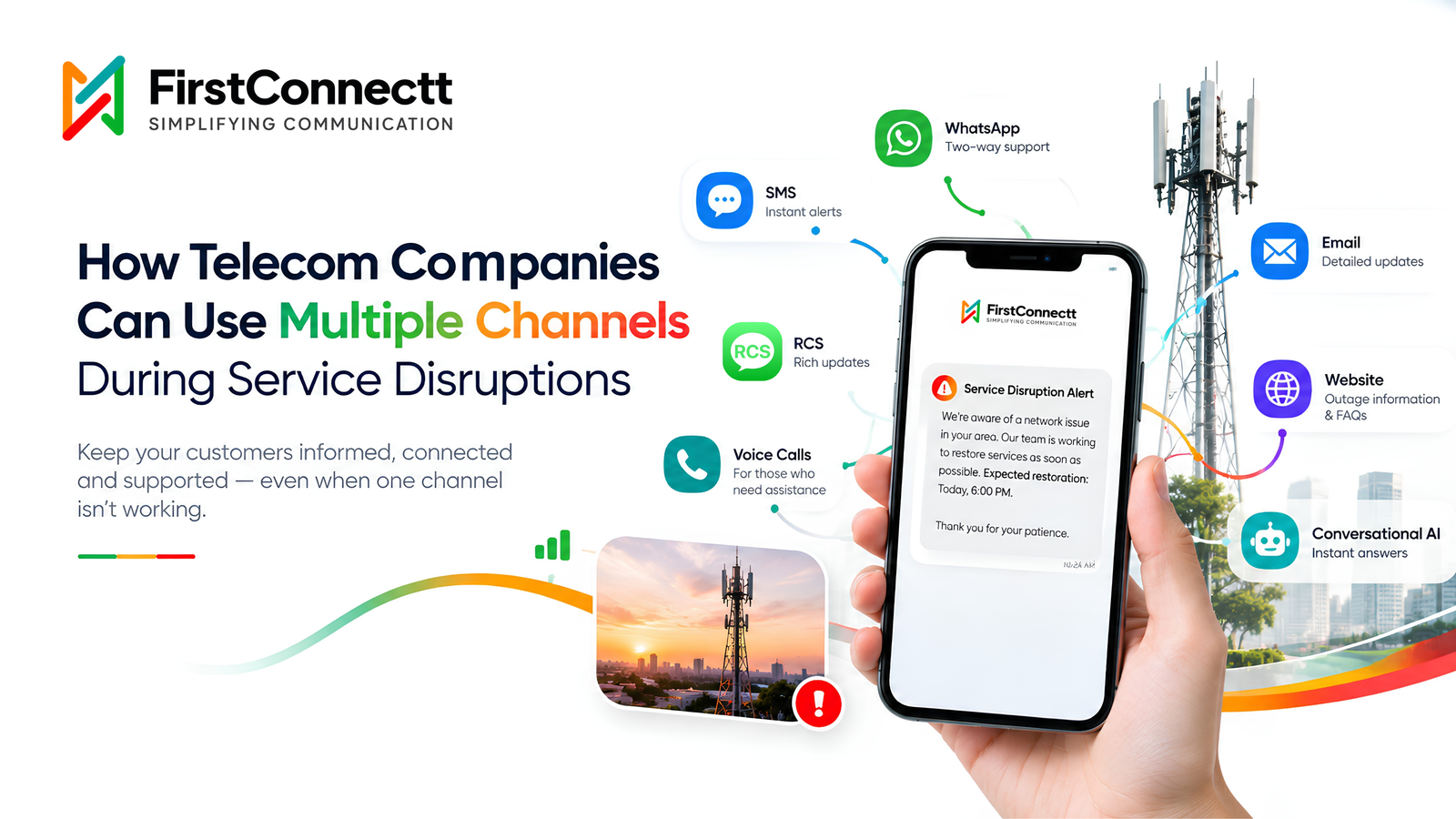
This is where a multichannel communication strategy becomes important. By using SMS, WhatsApp, voice calls, RCS, email, websites, and conversational AI together, telecom companies can provide timely updates, answer questions, and maintain customer communication even when one channel becomes unavailable.
To address these challenges effectively, telecom companies need a coordinated communication strategy that connects multiple channels and ensures customers continue receiving timely, reliable updates throughout a service disruption.
During an outage, customers usually have three immediate concerns: What is happening, how long the disruption may last, and what they should do. Silence can increase uncertainty and encourage customers to contact support repeatedly.
Clear communication helps set expectations. A simple message explaining the affected service, location, and estimated restoration time can prevent unnecessary calls and complaints. Outage updates should also be consistent across channels so that customers do not receive conflicting information.
Regulatory requirements can make accurate outage communication especially important in some markets and situations. For example, certain telecommunications providers may have specific obligations to communicate important outage information to customers and relevant authorities.
SMS remains useful when telecom companies need to send short, urgent notifications. Because SMS does not depend on a customer’s internet connection, it can be valuable when mobile data or broadband services are experiencing problems.
A telecom company can use SMS to notify customers that an outage has been detected, identify the affected region, and share an expected restoration window. Follow-up messages can communicate progress or confirm that services have been restored.
WhatsApp can provide a more interactive experience during a disruption. Customers can receive updates and ask questions without immediately calling a support center.
Telecom companies can create automated WhatsApp journeys for common outage-related questions. Customers could enter their location, select the affected service, and receive the latest available update. If a query requires human assistance, the conversation can be transferred to a support agent.
Voice communication remains important, particularly for customers who may not have trustworthy internet access or prefer speaking with a person. Automated voice notifications can communicate important updates, while interactive voice response systems can help customers check outage information without waiting for an agent.
Voice automation can also reduce pressure on customer support teams during periods when call volumes increase significantly.
RCS can provide a more interactive messaging experience than traditional SMS. Depending on device and network support, telecom companies can use rich cards, buttons, images, and other interactive elements to guide customers through service updates.
For example, an outage notification could provide buttons for checking restoration status, viewing troubleshooting steps, or contacting support. Because not every customer or situation will support RCS, it should be a part of a broader communication strategy.
Email and website updates are useful for detailed information. A telecom company’s outage page can provide broader information about affected regions, service categories, restoration progress, and frequently asked questions.
Email can be used for customers who need more context, especially for business accounts. Companies can explain the disruption, provide expected timelines, and share updates as the situation develops.
During major disruptions, support teams can become overloaded with repetitive questions. Conversational AI can help handle common requests such as, “ Is my area affected?”, “When will service return?”, or “What should I do after restoration?”
FirstConnectt’s Conversational AI platform can support customer conversations across multiple channels, helping businesses automate routine queries while maintaining a path to human support when necessary .
This can help customer service teams focus on more complex cases while customers receive immediate responses to common questions.
A multichannel strategy becomes more effective when channels work together instead of operating separately. If one communication route fails, the system can use another available route.
For example, a company could attempt to deliver an outage update through WhatsApp and use SMS as a fallback when appropriate. RCS can also fall back to SMS when RCS is unavailable.
Using multiple channels does not mean sending different information everywhere. Customers should receive the same core facts regardless of whether they use SMS, WhatsApp, voice, email, or a website.
Telecom companies should maintain a central source of outage information and connect communication workflows to it. Updates can then be distributed across selected channels without requiring teams to rewrite the same information repeatedly.
Consistency is particularly important when restoration estimates change. Every channel should reflect the latest verified information to reduce confusion.
Not every customer needs the same communication. Telecom companies can segment customers according to location, service type, account category, or communication preferences.
For example, residential customers might receive a brief restoration update, while business customers could receive more detailed information about service impact and expected targeted notifications rather than broad messages sent to an entire customer base.
This makes communication more relevant while reducing unnecessary messages.
After an outage, telecom companies should review both network recovery and communication performance. Useful metrics can include message delivery rates, response times, chatbot containment, escalation rates, customer questions, and resolution times.
Delivery analytics can show whether messages reached customers successfully. Support data can reveal which questions were repeated most often. These insights can help companies improve future outage workflows.
Effective outage communication starts before a disruption occurs. Telecom companies should map customer journeys, identify channels for different outage scenarios, prepare approved message templates, and establish clear escalation rules.
Teams should also test fallback routes regularly. A communication plan tested in advance is easier to activate under pressure, especially when network and support teams are handling an incident.
This preparation can improve consistency, reduce delays, and help customers receive information sooner.
Telecom companies need communication infrastructure that can connect different channels without creating disconnected workflows. FirstConnectt provides a CPaaS platform supporting WhatsApp Business API, RCS, SMS, Voice, Conversational AI, and other communication capabilities.
Its platform brings channels under a unified communication layer, enabling businesses to orchestrate conversations, monitor delivery, and use fallback routing. FirstConnectt also supports analytics and live-agent handoffs, helping organizations combine automation with human assistance.
For telecom companies, this approach can create a new connected customer communication experience during service disruptions.
Service disruptions are difficult for both telecom companies and their customers, but poor communication can make the experience even more frustrating. A multichannel approach gives companies more ways to reach customers, provide updates, and manage support demand.
SMS can deliver urgent alerts, WhatsApp can enable two-way conversations, voice can support customers who prefer calls, RCS can provide interactive updates, websites and email can offer detailed information, and conversational AI can handle routine questions. Intelligent fallback and consistent information can connect these channels into one coordinated communication experience.
The key is to plan these workflows before an outage occurs. With the right CPaaS infrastructure, telecom companies can turn outage communication from a reactive support task into a structured customer experience strategy.
➢ Multiple channels increase the chances of reaching customers when one communication route is unavailable. They also let customers choose how they receive updates and help distribute support demand across different channels.
➢ SMS, WhatsApp, Voice, RCS, email, website, and conversational AI can all support outage communication. The appropriate mix depends on the affected service, customer preferences, urgency, and channel availability.
➢ Conversational AI can answer common questions, provide verified outage information, guide customers through basic troubleshooting, and transfer complex cases to human agents with conversation context.
Yes. Businesses can use different channels for different stages of an outage workflow and establish fallback routes when a preferred channel cannot deliver a time-sensitive message.
CPaaS, or Communications Platform as a Service, allows businesses to integrate communication capabilities such as messaging, voice and conversational experiences into their applications and workflows through APIs and communication infrastructure.
Share this article
Article
 Article
 Article
Ready to put these ideas to work? Talk to our team about your communication stack.
Get Started →