
 Article
October 16, 2026
8 min read
 FirstConnectt
Enterprise communication insights
FirstConnectt
Enterprise communication insights
Article · FirstConnectt Insights
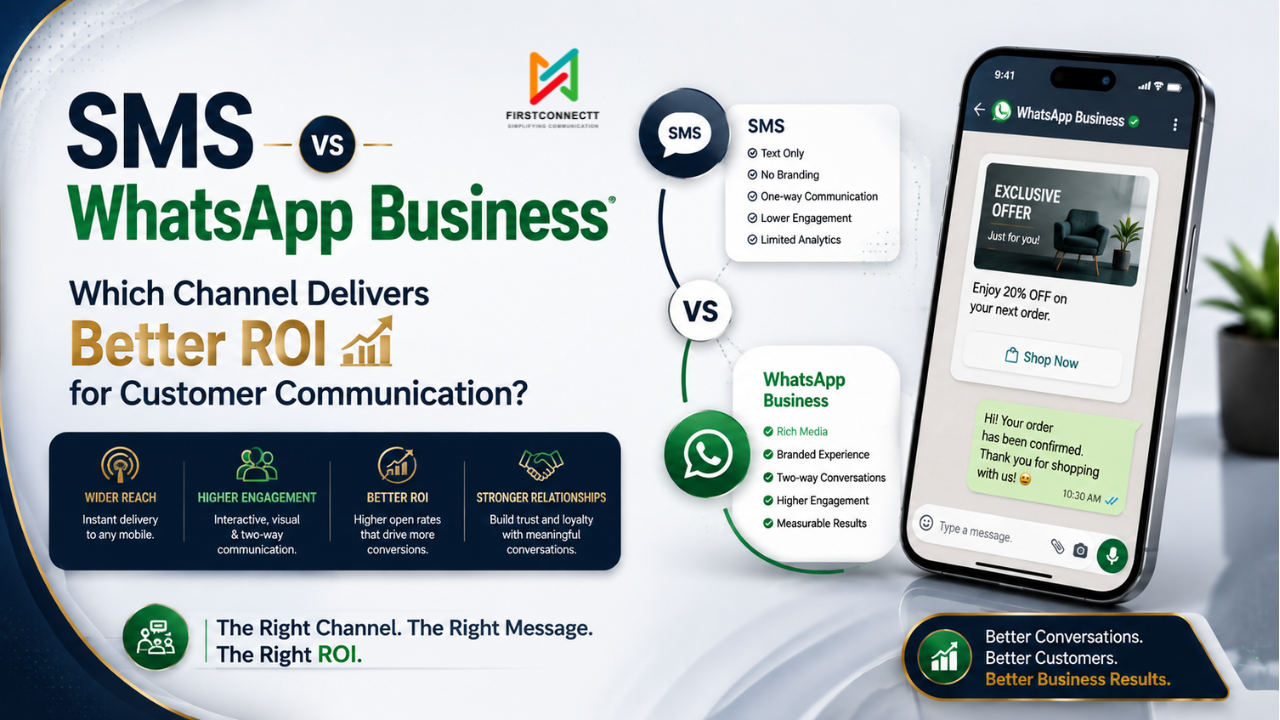
Every business wants the same thing: spend less, reach more customers, and generate better results. But when it comes to business messaging, one question keeps surfacing: Should you invest in SMS or WhatsApp Business?
At first glance, SMS feels familiar. It’s been around for decades and reaches almost every mobile phone on the planet. WhatsApp Business, on the other hand, offers rich conversations, multimedia, automation, and interactive customer experiences.
The real question isn’t which platform is newer. It’s which one actually delivers a better return on investment (ROI).
The answer depends on what you’re trying to achieve. If you’re sending one-time passwords (OTPs), the answer may differ from running marketing campaigns or providing customer support.
In this guide, we’ll break down the strengths, weaknesses, costs, engagement metrics, and real-world use cases of SMS vs WhatsApp Business, helping you choose the right channel based on measurable business outcomes rather than assumptions.
Before comparing channels, it’s important to define ROI. In messaging, ROI isn’t just about how much a message costs. It measures the value generated from every message sent.
That includes:
A channel that costs slightly more but generates significantly higher conversions often delivers far better ROI than a cheaper alternative.
Aside from this, several real-world campaigns highlight just how powerful WhatsApp Business can be in driving ROI compared to SMS. For instance, Skullcandy India achieved an astonishing 150x ROI, while Hatke reported 21x ROI and Give India saw 15x ROI through WhatsApp-driven engagement. Global brands echo similar success: Waterdrop recorded 19.3x ROI, and Luxusbetten24 reached an unprecedented 3,743x ROI. These figures demonstrate that WhatsApp’s interactive features, such as product catalogs, quick-reply buttons, and integrated support, translate into far higher conversions and revenue.
In contrast, SMS rarely delivers comparable ROI due to its limited engagement capabilities, proving that richer customer experiences consistently outperform plain text notifications.
But both roles are quite different. It’s necessary to understand it for your business. So let us move with it.
Beyond measuring delivery rates, businesses should also evaluate how efficiently their messaging platform integrates with existing CRM systems, supports automation, and scales with growing customer interactions. These are some of the factors enterprise organizations consider when implementing communication solutions with providers like FirstConnectt.
| Feature | SMS | WhatsApp Business |
|---|---|---|
| Internet Required | No | Yes |
| Multimedia Support | Limited | Images, Videos, PDFs, Audio, Documents |
| Read Receipts | No | Yes |
| Two-way Conversations | Basic | Rich Interactive Chat |
| Buttons & Quick Replies | No | Yes |
| Verified Business Profile | No | Yes |
| Automation | Limited | Advanced |
| Customer Support | Basic | Excellent |
| Message Personalization | Limited | High |
| Analytics | Minimal | Detailed |
While SMS focuses on delivering text quickly, WhatsApp Business is designed for ongoing customer conversations.
However, both SMS and WhatsApp Business boast impressive open rates of around 98%. This ensures that messages are almost always seen by customers. This universal visibility makes both channels highly reliable for initial reach, even though their engagement outcomes differ significantly.
Rather than replacing one channel with another, successful businesses increasingly adopt an omnichannel communication strategy. Platforms like FirstConnectt enable organizations to manage SMS, WhatsApp Business, Voice, and RCS from a single platform, ensuring customers receive messages through the channel best suited to each interaction.
Despite newer communication channels, SMS remains incredibly valuable. And according to studies, there are ~30% conversational reply rates of SMS’s. There are several reasons businesses continue investing in SMS marketing and transactional messaging.
Almost every mobile phone can receive SMS. Customers don’t need an internet connection or a specific app installed. So this is ideally needed for banks. Because not everyone is using smartphones, especially older age grouped individuals. Overall, SMS ideal for:
SMS messages are delivered directly through mobile carriers. Even in areas with weak internet connectivity, SMS often succeeds where app-based messaging cannot.
SMS doesn’t require customers to take any extra steps.
FirstConnectt’s A2P Messaging solutions help enterprises deliver critical SMS notifications such as OTPs, banking alerts, appointment reminders, and transactional updates with high reliability and enterprise-grade scalability.
Although reliable, SMS has clear limitations.
Plain text messages struggle to capture attention. As a result, you can’t include:
Mass SMS campaigns often become expensive as volumes increase. Businesses may also pay for messages that customers never interact with.
Replies are often inconvenient. Most conversations quickly shift to phone calls or emails.
WhatsApp Business has transformed business messaging from simple notifications into interactive customer experiences. Also, there are 40–60% reply rates in promotional contexts. So, instead of sending messages, businesses build conversations. That difference matters. Here is why whatsapp is ideal for every business.
Imagine promoting a new product. With SMS, customers receive: “Check out our latest collection.” With WhatsApp Business, they receive:
The difference in engagement is substantial. Customers don’t need to imagine the product. They can see it instantly.
WhatsApp allows businesses to answer questions immediately. Customers can ask:
Instead of forcing customers to switch channels, the entire buying journey stays inside one conversation. That reduces friction and increases conversions.
WhatsApp Business supports:
Every click requires less effort. Less effort often means more sales.
Verified business profiles reassure customers they’re speaking with the official brand. Trust becomes especially important for:
People are far more likely to engage when they know the sender is genuine.
Although SMS often appears cheaper per message, its low click-through rates and hidden costs for longer texts make the overall cost per lead significantly higher. In contrast, WhatsApp Business, despite slightly higher per-message rates, delivers 3 to 11 times lower cost per click. Thanks to its interactive features and stronger engagement.
All in all, businesses spend less to generate meaningful customer actions. This makes WhatsApp far more cost-efficient in practice.
Aside from this, when implemented effectively, the WhatsApp Business API becomes much more than a messaging tool. Through FirstConnectt, businesses can automate conversations, integrate customer support workflows, connect CRM systems, and deliver personalized experiences at scale while maintaining compliance with WhatsApp Business policies.
Winner: WhatsApp Business
Rich media consistently outperforms plain text because customers experience products instead of merely reading about them.
Winner: SMS
When internet access isn’t guaranteed, SMS remains the safest choice for authentication. Many businesses even combine both channels for higher delivery success.
Winner: WhatsApp Business
Support teams benefit from:
Customers also appreciate continuing conversations whenever they’re ready.
Winner: Combination
Many businesses use:
Customers receive richer tracking experiences while maintaining reliability.
Many businesses assume SMS is always cheaper. That’s not necessarily true. A cheaper message with lower conversions often becomes more expensive per sale. Consider this simplified example.
| Metric | SMS | WhatsApp Business |
| Campaign Cost | $200 | $250 |
| Customers Reached | 10,000 | 10,000 |
| Purchases | 40 | 140 |
| Revenue | $2,000 | $7,000 |
| ROI | Lower | Significantly Higher |
The WhatsApp campaign costs slightly more but produces over three times the revenue.
That’s the difference between measuring cost and measuring ROI.
Imagine an online fashion retailer launching its festive collection.
New arrivals are here. Visit our website.
Customers must:
Several opportunities exist for customers to abandon the process.
Customers receive:
Purchasing becomes much simpler. Fewer steps usually translate into higher conversion rates.
SMS and WhatsApp serve different purposes. Sending identical campaigns to both channels rarely delivers the best results.
Some customers prefer SMS. Others actively engage on WhatsApp. Offering communication choices improves customer satisfaction.
Frequency matters. Too many messages reduce engagement regardless of the platform. Focus on relevance instead of volume.
Customers respond better when messages feel relevant. Personalized recommendations, names, previous purchases, and location-based offers significantly improve engagement.
Another common mistake is treating communication as a standalone function instead of integrating it with customer experience. Experienced communication providers help businesses design messaging workflows that support the entire customer journey rather than individual campaigns.
The highest-performing businesses rarely rely on just one communication platform. Instead, they build a messaging strategy where each channel complements the other.
For example:
This omnichannel approach improves customer experience while maximizing ROI.
Customer expectations are changing. People no longer want one-way notifications. They expect conversations.
Businesses that combine automation with human support, rich media, and personalized experiences are likely to outperform competitors relying solely on traditional messaging.
SMS will continue to play a vital role for transactional communication, but WhatsApp Business is increasingly becoming the preferred platform for customer engagement, relationship building, and revenue generation.
The most successful organizations won’t choose one over the other. They’ll use each channel where it performs best.
The debate around SMS vs WhatsApp Business isn’t about declaring a universal winner.
It’s about matching the right channel to the right objective. If your priority is instant, universal delivery for authentication or urgent alerts, SMS remains indispensable.
If your goal is higher engagement, richer customer experiences, stronger relationships, and better marketing performance, WhatsApp Business often delivers superior ROI through interactive conversations and higher conversion potential.
Ultimately, businesses that measure outcomes rather than message costs will make smarter communication investments. By combining the reliability of SMS with the engagement capabilities of WhatsApp Business, you can create a messaging strategy that improves customer satisfaction while maximizing long-term returns.
Whether you’re exploring WhatsApp Business API, enterprise SMS, RCS Messaging, Voice solutions, or omnichannel customer engagement, FirstConnectt helps businesses build communication strategies that are scalable, secure, and customer-first. Because every meaningful customer relationship begins with a conversation.
In many cases, yes. WhatsApp Business supports multimedia, interactive buttons, catalogs, and two-way conversations, which can improve customer engagement and conversions compared to text-only SMS.
SMS is ideal for OTPs, emergency alerts, appointment reminders, and other critical notifications where internet access cannot be assumed.
Absolutely. Many organizations adopt an omnichannel messaging strategy, using SMS for critical notifications and WhatsApp Business for customer engagement, support, and marketing.
Yes. It enables real-time conversations, media sharing, automation, and chat history, making issue resolution faster and more convenient for customers.
For customer engagement and marketing, WhatsApp Business generally delivers stronger ROI due to richer interactions and higher conversion potential. For transactional messaging, SMS remains highly effective because of its broad reach and reliability.
Share this article
Article
 Article
 Article
Ready to put these ideas to work? Talk to our team about your communication stack.
Get Started →