
 Article
October 16, 2026
8 min read
 FirstConnectt
Enterprise communication insights
FirstConnectt
Enterprise communication insights
Article · FirstConnectt Insights
Imagine sending a text message that feels as interactive as a modern app, without asking customers to download anything new. That’s exactly where RCS messaging is changing the game.
For decades, SMS has been the backbone of business communication. It delivered OTPs, promotional offers, appointment reminders, and alerts with remarkable reliability. But customer expectations have evolved. People now expect rich visuals, instant responses, branded experiences, and seamless conversations. Traditional SMS simply wasn’t designed for that world.
Enter Rich Communication Services (RCS), a messaging technology that’s redefining how businesses connect with customers. If SMS was the digital equivalent of a handwritten note, RCS is an interactive storefront that lives directly inside your messaging app.
This guide explains everything you need to know about RCS messaging, why it’s becoming the future beyond SMS, and how businesses can use it to create more meaningful customer experiences.
RCS (Rich Communication Services) was introduced by GSMA in 2008 as a successor to SMS/MMS. It is the next generation of mobile messaging that enhances traditional SMS with modern communication features.
Unlike SMS, which only supports plain text and limited multimedia, RCS enables businesses and individuals to exchange rich, interactive messages through the default messaging application on compatible Android devices.
Instead of sending a simple text saying: “Your order has been shipped.” An RCS message can include:
The result is a messaging experience that feels much closer to a mobile application than a traditional text message. And partners like FirstConnectt ensure businesses get that result seamlessly!
SMS has served businesses exceptionally well, but its limitations have become increasingly obvious.
Traditional SMS supports only text and basic links. Businesses cannot display:
Every interaction often requires customers to leave their messaging app and visit a website.
Anyone can send a text message from an unknown number. Customers frequently receive phishing attempts and fraudulent messages, making them hesitant to trust unfamiliar senders.
SMS offers minimal visibility. Businesses rarely know whether:
This limits campaign optimization.
RCS functions through internet connectivity instead of relying solely on traditional cellular messaging. When supported by both the carrier and device, messages are delivered using RCS.
If RCS isn’t available, communication can automatically fall back to SMS, ensuring message delivery. This hybrid approach makes adoption easier for businesses because customers continue receiving messages regardless of device capability. Open rates are up to 98%, and click-through rates are 15–30%
Businesses can include:
Instead of describing a product, companies can simply show it.
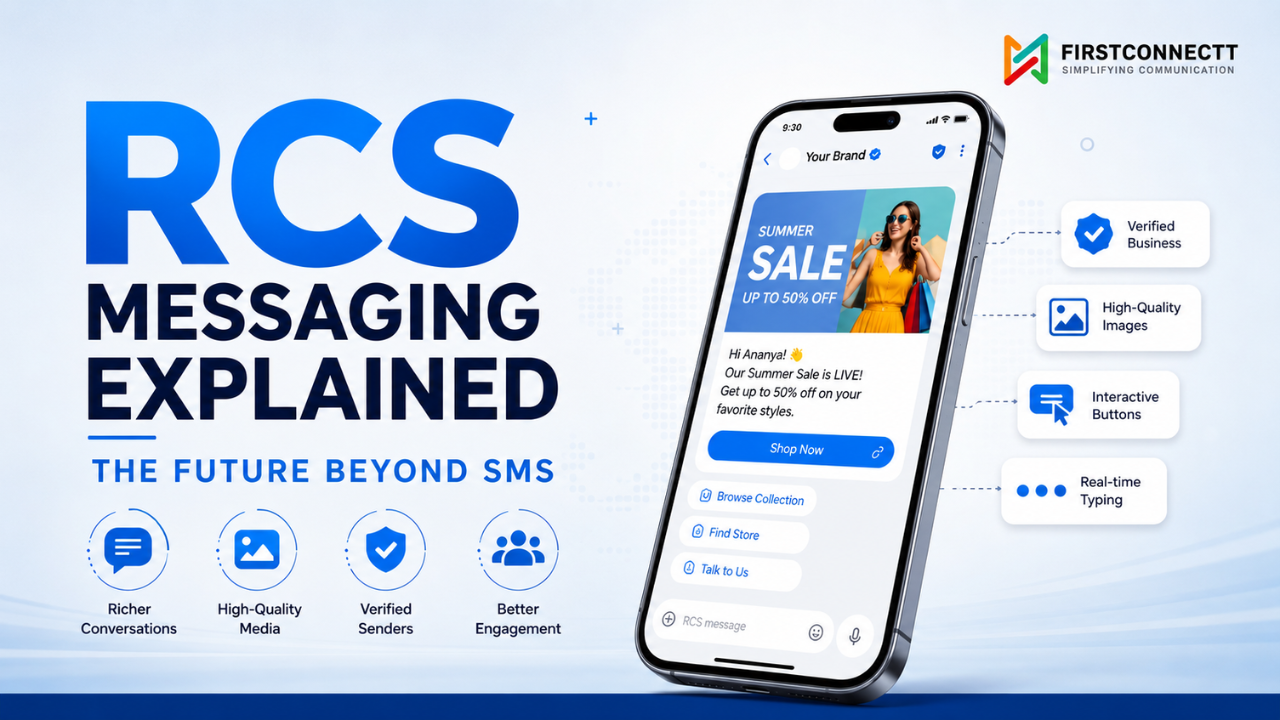
One of RCS’s strongest features is sender verification. Customers see:
This dramatically increases trust and reduces fraud concerns.
Customers no longer need to type lengthy responses. Businesses can provide buttons like:
One tap completes the action.
Instead of typing, “I’d like to know more about pricing.” Customers simply tap:
This reduces friction and increases engagement.
Businesses can display multiple products in swipeable cards. Each card may contain:
It’s like browsing a mini eCommerce store inside a messaging app.
Businesses know:
This provides valuable campaign insights unavailable in traditional SMS.
Just like modern chat apps, users can see when someone is typing, creating more natural conversations during customer support interactions.
These were the features of RCS messaging. And a reliable CPaaS company like FirstConnectt simplifies communication with your customers with such features!
| Feature | SMS | RCS Messaging |
| Plain Text | Yes | Yes |
| Images | Limited | High Resolution |
| Videos | Basic MMS | Rich Video |
| Interactive Buttons | No | Yes |
| Brand Verification | No | Yes |
| Read Receipts | No | Yes |
| Typing Indicators | No | Yes |
| Carousels | No | Yes |
| Product Catalogs | No | Yes |
| Suggested Replies | No | Yes |
| Analytics | Limited | Advanced |
Interactive experiences naturally encourage users to explore products and respond to messages. Instead of ignoring another promotional SMS, customers interact with visual content.
Reducing customer effort increases conversions. Imagine receiving a restaurant promotion. Instead of: “Visit our website.” You simply tap: Reserve Table
The booking is completed within seconds. Less friction leads to better results.
Verified branding reassures customers that messages genuinely originate from the company. In an era of phishing scams, this trust is invaluable.
Businesses can tailor messages based on:
Personalization makes conversations more relevant and effective.
Support teams can:
Customers resolve issues faster without switching apps.
Retailers can showcase:
Customers browse products directly inside the conversation.
Banks use RCS for:
Verified sender profiles improve customer confidence.
Hospitals and clinics can send:
Interactive confirmations reduce missed appointments.
Airlines and travel companies can provide:
Travelers receive everything in one conversation.
Restaurants can share:
Customers stay informed from order placement to delivery.
RCS marketing campaigns are proving far more effective than SMS, with global adoption surging after Apple’s iOS 18 support. Engagement rates are dramatically higher, open rates near 98%, and click-through rates up to 30%. This makes RCS one of the most powerful channels for promotions, loyalty programs, and interactive customer engagement. Popular campaign ideas include:
Since customers don’t need to install another application, participation rates can be significantly higher.
Like every technology, RCS has limitations.
Although Android support continues to grow, availability depends on device, messaging app, and carrier support. Apple’s support for RCS has expanded cross-platform compatibility, but feature availability can still vary.
Unlike SMS, RCS generally requires a mobile data or Wi-Fi connection to deliver its full feature set.
Brands must complete verification processes before sending verified RCS messages. This adds an extra onboarding step but significantly improves customer trust.
However, at FirstConnectt, we ensure seamless RCS implementation. So, your business doesn’t have to face such challenges.
Customers engage more when messages solve problems instead of simply selling products.
Avoid difficult users with too many buttons or choices.
Relevant content consistently performs better than generic broadcasts.
Large files can affect loading times. Use high-quality but optimized images and videos.
Track:
Use these insights to refine future campaigns.
Many organizations treat RCS like a prettier version of SMS. That misses its biggest advantage. Avoid these mistakes:
The best RCS experiences feel conversational, not promotional.
RCS is not replacing SMS outright; SMS still dominates for universal reach, but RCS is rapidly expanding with billions of users and much higher engagement rates. By 2026, RCS monthly active users are projected to reach 3.8 billion globally. Yet SMS continues to deliver over 5 trillion messages annually, especially for alerts and regions with limited RCS penetration.
Aside from this, many businesses prefer a hybrid strategy:
The right channel depends on your audience, message type, and customer journey.
Customer communication is steadily becoming richer, more personalized, and more interactive. Consumers increasingly expect businesses to communicate with the same convenience they experience in modern messaging apps.
RCS bridges the gap between standard text messaging and app-like experiences without requiring additional downloads.
As support continues to grow, businesses that invest in RCS today position themselves to deliver more engaging customer experiences while maintaining the reliability that made SMS indispensable.
RCS messaging represents one of the most significant advancements in mobile communication since the introduction of SMS. It combines the universal familiarity of text messaging with the rich, interactive experiences customers have come to expect from today’s digital services.
For businesses, the opportunity extends far beyond sending attractive messages. RCS enables trusted branding, richer customer interactions, actionable analytics, and smoother journeys from discovery to conversion.
The future of business messaging is not about choosing between SMS and RCS. It’s about using each channel where it delivers the greatest value. Organizations that choose this approach will be better equipped to build stronger customer relationships in an increasingly mobile-first world.
At FirstConnectt, we help businesses unlock the full potential of RCS Messaging alongside SMS, WhatsApp, and Voice solutions. We create seamless, secure, and engaging customer experiences across every touchpoint.
RCS (Rich Communication Services) is a next-generation messaging protocol that upgrades traditional SMS with features such as rich media, verified business profiles, read receipts, interactive buttons, and suggested replies.
For interactive communication, yes. RCS offers a richer user experience, improved branding, engagement tracking, and multimedia support. SMS remains valuable for universal reach and basic text-based communication.
Yes. RCS typically uses mobile data or Wi-Fi. If RCS is unavailable, many messaging platforms can fall back to SMS for delivery.
RCS offers stronger security features than SMS, and verified business profiles help reduce impersonation and phishing. The level of encryption depends on the messaging apps involved.
Absolutely. Businesses use RCS for promotions, product launches, customer support, appointment reminders, order tracking, loyalty programs, and personalized campaigns.
Support has expanded through Apple’s adoption of the RCS standard, improving messaging between iPhone and Android devices. However, available features may differ depending on the device, operating system, carrier, and messaging application.
Share this article
Article
 Article
 Article
Ready to put these ideas to work? Talk to our team about your communication stack.
Get Started →