
 Article
October 16, 2026
8 min read
 FirstConnectt
Enterprise communication insights
FirstConnectt
Enterprise communication insights
Article · FirstConnectt Insights
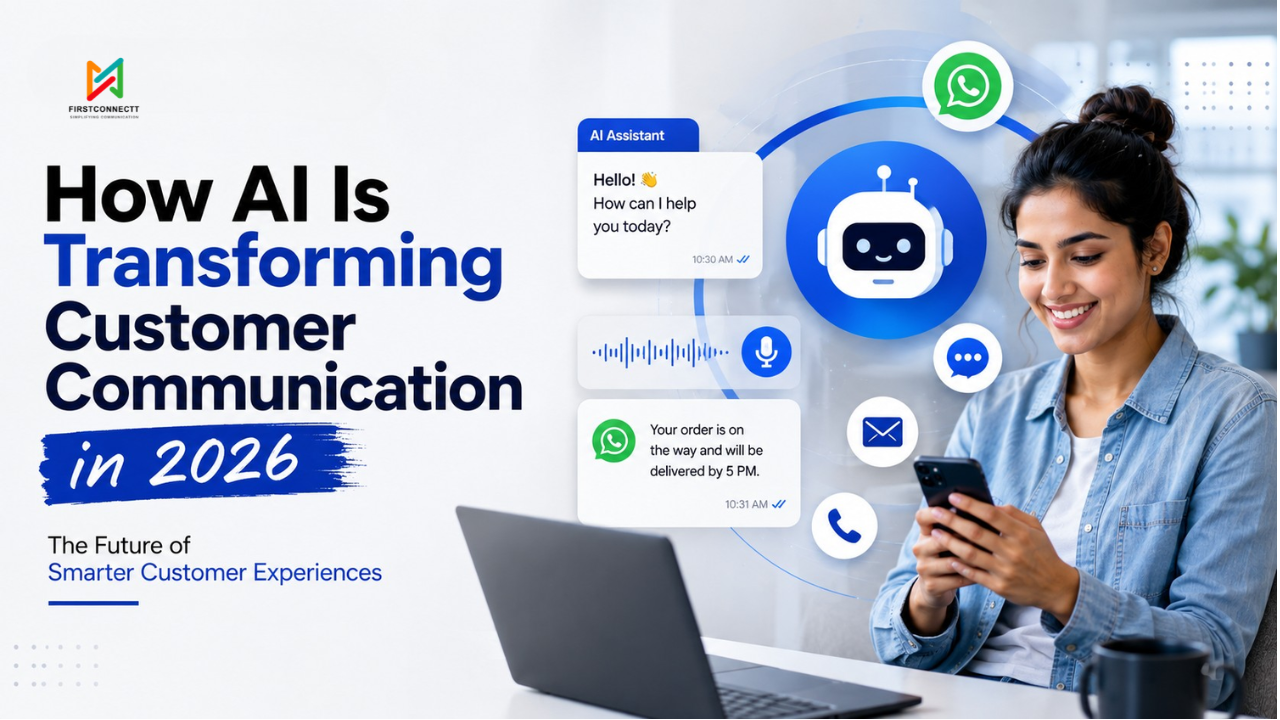
Customer communication has never stood still. It evolved from face-to-face conversations to emails, then social media, live chat, messaging apps, and voice assistants. In 2026, another major shift is underway. Artificial intelligence is no longer just supporting customer service. It is becoming the engine that powers every interaction between businesses and customers.
Here’s the surprising part.
The companies winning customer loyalty today are not necessarily the ones with the biggest support teams. They are the ones responding faster, understanding customers better, and delivering personalized experiences at scale.
Consumers have grown accustomed to instant answers, seamless conversations across channels, and recommendations that actually make sense. Businesses that cannot meet these expectations risk losing customers long before a sales conversation even begins.
This is where AI is transforming customer communication in ways that seemed impossible just a few years ago. Also, businesses adopting AI need the right communication infrastructure. FirstConnectt helps organizations combine AI with channels like WhatsApp Business, SMS, Voice, and RCS to create seamless customer conversations across every touchpoint.
Let us move on to how AI is transforming customer communications in 2026.
AI-powered customer communication refers to using artificial intelligence technologies to automate, personalize, analyze, and improve interactions between businesses and customers via many communication channels.
These channels include:
Instead of treating every customer the same, AI analyzes context, behavior, purchase history, sentiment, and previous conversations to deliver responses that feel relevant and timely. FirstConnectt helps businesses unify these interactions into one connected customer journey instead of managing multiple disconnected tools.
The result is communication that becomes faster, smarter, and more customer-centric.
Customer expectations have changed dramatically. People no longer compare your customer experience only with competitors. They compare it with the fine digital experiences they have anywhere. Also, studies suggest AI agents resolve up to 75% of queries in nearly half of all service interactions, and CX leaders enjoy up to 6× higher revenue growth than laggards.
If a food delivery app responds instantly, then customers expect the same from their bank. If an online retailer remembers preferences, then customers expect healthcare providers and airlines to do the same. Several trends are driving this transformation:
Businesses now need communication that is available 24/7 without compromising quality.
74% of customers expect 24/7 availability from brands. Thus, waiting on hold has become one of the fastest ways to frustrate customers. AI chatbots now control up to 70% of routine queries, cutting average response times by 60%. They provide immediate responses to common questions such as:
Rather than replacing human agents, AI handles repetitive conversations while routing complex issues to specialists.
This dramatically reduces response times while allowing support teams to focus on high-value interactions.
With FirstConnectt’s Conversational AI and enterprise messaging solutions, businesses can automate routine conversations while ensuring complex queries are seamlessly transferred to human agents with complete conversation context.
Companies using advanced personalization see 20% higher customer satisfaction scores. So, the custom messages have moved beyond simply inserting someone’s first name into an email. AI can now understand:
Imagine two customers asking the exact same question. One is a loyal customer who has spent thousands over several years. The other is visiting your website for the first time. AI enables businesses to respond differently to each person without requiring manual intervention.
Early chatbots followed rigid scripts. Today’s AI-powered conversational assistants understand intent, context, and follow-up questions. They have achieved 85% intent recognition accuracy, compared to <50% for rule‑based bots. Instead of forcing customers through endless menus, they can manage natural conversations like: “I ordered yesterday but entered the wrong address.” The AI recognizes multiple intents:
It can resolve the issue within seconds or transfer everything to a human agent with complete conversation history. Customers no longer need to repeat themselves.
Predictive analytics reduces churn by up to 20%, which is AI’s biggest advantage. It prevents problems before customers even report them. Examples include:
Instead of waiting for complaints, businesses reach customers first. That small difference often creates a significantly better customer experience.
91% of companies now use sentiment analysis to prioritize support tickets. Why? Because not every customer says, “I’m unhappy.” Sometimes frustration appears through subtle wording. AI analyzes conversations to identify emotions such as:
Support teams can prioritize high-risk conversations before they escalate into negative reviews or customer churn.
Businesses increasingly serve global audiences because AI translation tools now support 100+ languages in real time. Hiring support agents for dozens of languages isn’t always practical. AI now provides real-time translation across multiple channels while preserving conversational context. Customers can convey in their preferred language while businesses maintain consistent service quality.
Customers frequently move between channels. This can boost customer lifetime value by 30%. A typical journey might look like this: Website → WhatsApp → Email → Phone Call
Without AI, these interactions often become disconnected. With AI-powered omnichannel communication:
The experience feels like one continuous conversation rather than separate interactions. Rather than managing each channel separately, FirstConnectt helps businesses orchestrate omnichannel communication from a single platform, ensuring every interaction remains consistent and connected.
Voice technology has improved dramatically. It is projected to reach $30 billion globally by 2030. AI voice assistants now understand:
Businesses use intelligent voice systems for:
Voice interactions are becoming significantly more conversational than traditional IVR systems.
Retailers use AI to:
Customers receive faster service while businesses increase conversion rates.
Banks automate:
AI improves both security and customer convenience. From OTPs and fraud alerts to account notifications and customer support, FirstConnectt enables secure and reliable communication for financial institutions at enterprise scale.
Healthcare providers use AI for:
This reduces administrative workload while improving patient engagement.
Hotels and airlines use AI to provide:
Customers receive assistance before, during, and after their journeys.
Businesses adopting AI communication strategies typically experience several measurable improvements.
Customers receive answers within seconds rather than waiting in long queues.
Quick, personalized support creates more positive experiences.
Automation reduces repetitive manual work.
AI identifies trends, frequently asked questions, and emerging issues.
Support teams spend more time solving meaningful customer problems and less time on repetitive tasks.
Every customer receives accurate and standardized information across channels.
AI is powerful, but successful implementation requires thoughtful planning.
Not every conversation should be automated. Sensitive issues often require empathy that only human agents can provide. The best customer experiences combine AI efficiency with human expertise.
Businesses must protect customer information while complying with evolving privacy regulations. Transparency builds trust. Customers should understand when AI is assisting them and how their data is being used.
Many businesses operate multiple communication tools. Connecting CRM systems, messaging platforms, analytics, and AI requires careful planning. Poor integration creates fragmented customer experiences.
Customer expectations evolve rapidly. AI systems require ongoing training, monitoring, and optimization to remain accurate and relevant.
Many organizations adopt AI but fail to maximize its potential.
Common mistakes include:
Technology alone does not create great communication.
Strategy always comes first.
Businesses achieving the best results typically follow these principles:
Don’t implement AI simply because competitors are doing it. Solve genuine customer pain points first.
Customers should always have an easy way to reach a human agent.
Use customer data to improve experiences without becoming intrusive.
Ensure messaging remains consistent whether customers contact you through WhatsApp, email, SMS, live chat, or voice.
Track metrics such as:
Businesses looking to build stronger customer relationships should focus on long-term communication strategies rather than isolated automation projects.
Consider these priorities:
Organizations that treat AI as a relationship-building tool rather than a cost-cutting exercise will be better positioned for sustained growth.
Customer communication is becoming more intelligent, proactive, and personalized. In the coming years, AI is expected to deliver:
The businesses that adapt early will create experiences customers remember for the right reasons. After all, technology may automate conversations, but trust remains deeply human.
AI is transforming customer communication in 2026 by making interactions faster, more personalized, and more connected than ever before. From intelligent chatbots and predictive support to multilingual conversations and seamless omnichannel experiences, businesses now have the tools to serve customers with greater efficiency while maintaining meaningful relationships.
Success, however, depends on balance. The most effective strategies combine the speed and scale of AI with the empathy, creativity, and judgment of human teams. Organizations that focus on improving customer experiences rather than simply increasing automation will be the ones that earn loyalty, strengthen their brands, and stay ahead in an increasingly competitive marketplace.
Customer communication has entered a new era. The question is no longer whether AI should be part of your strategy, but how thoughtfully you choose to use it.
At FirstConnectt, we help businesses combine AI, automation, WhatsApp Business, SMS, Voice, RCS, and omnichannel communication into one seamless customer engagement strategy. If you’re ready to build faster, smarter, and more meaningful customer conversations, connect with FirstConnectt and transform the way your business communicates.
AI is improving customer communication through automation, personalization, predictive support, sentiment analysis, multilingual conversations, and seamless omnichannel experiences that help businesses respond faster and more accurately.
Key benefits include faster response times, 24/7 customer support, personalized interactions, lower operational costs, improved customer satisfaction, and better business insights through data analysis.
No. AI is best suited for handling repetitive and routine interactions. Complex, emotional, or high-value conversations still benefit from human expertise, empathy, and decision-making.
Retail, e-commerce, banking, healthcare, travel, telecommunications, education, insurance, and SaaS companies are among the industries seeing significant improvements through AI-powered customer communication.
Omnichannel customer communication provides a consistent experience across multiple channels, such as email, WhatsApp, live chat, SMS, phone, and social media, while preserving conversation history and customer context.
It can be, provided businesses follow strong cybersecurity practices, comply with data privacy regulations, use secure infrastructure, and maintain transparent data handling policies.
Share this article
Article
 Article
 Article
Ready to put these ideas to work? Talk to our team about your communication stack.
Get Started →