
 Article
October 27, 2026
7 min read
 FirstConnectt
Enterprise communication insights
FirstConnectt
Enterprise communication insights
Article · FirstConnectt Insights
Every Order Has a Communication Journey.
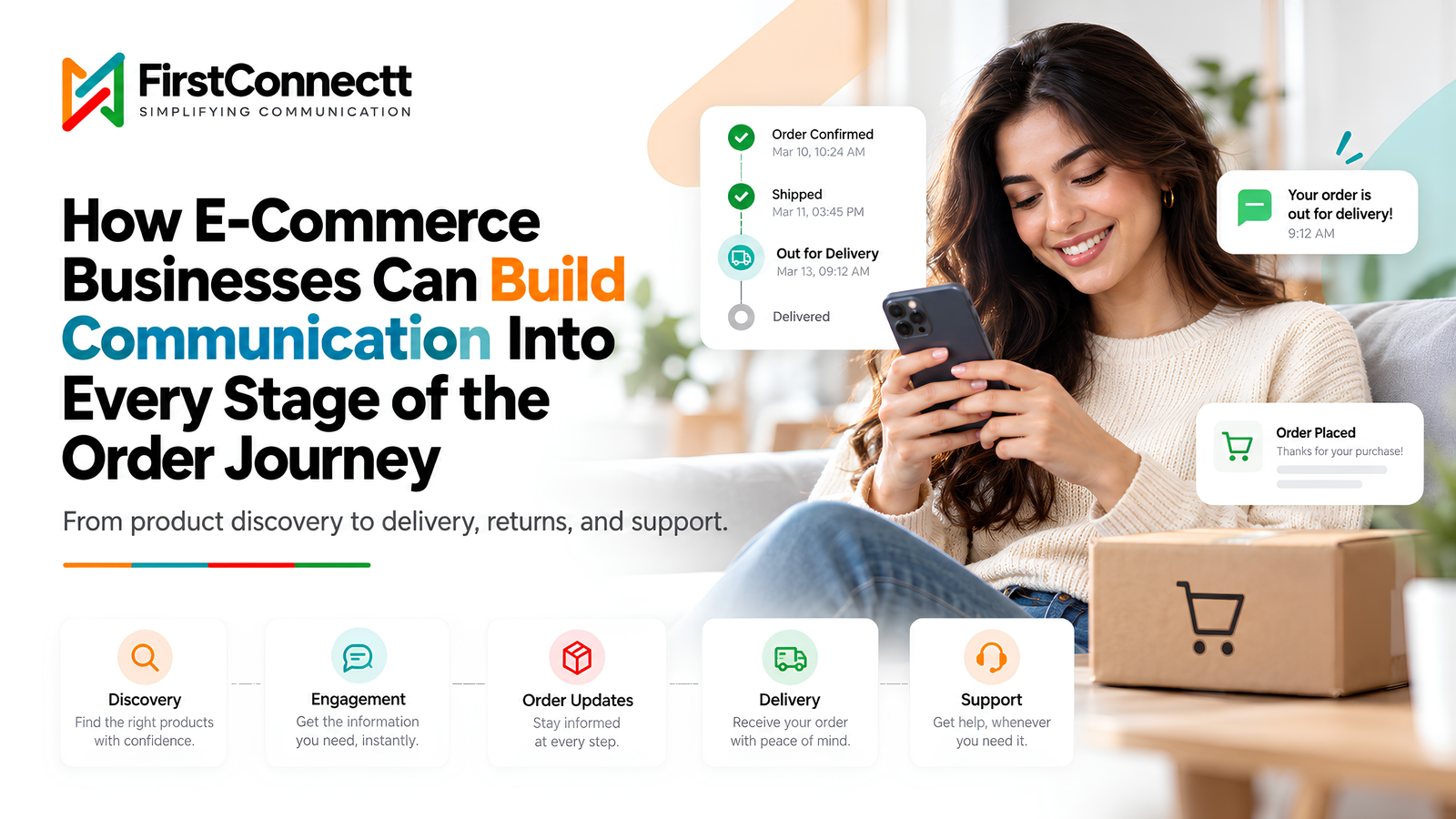
An order doesn’t begin at checkout and end at delivery. A customer finds a product via an ad, asks a question on WhatsApp, gets a confirmation, tracks a shipment, then reaches out again after it arrives. Gaps anywhere along that path create delays, repeated questions, or silence when something goes wrong. E-commerce customer communication needs to cover the whole journey, not just the moments a business finds convenient.
Here’s how that looks stage by stage.
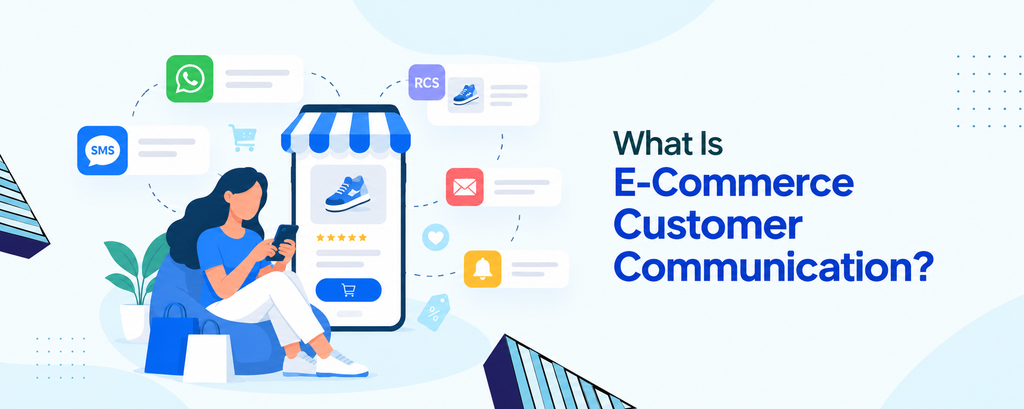
E-commerce customer communication covers every message and interaction a business shares across the order journey: product discovery, availability and pricing questions, cart reminders, order confirmations, payment updates, dispatch and delivery notifications, and returns or support.
Customers expect this information to be accurate, timely, and easy to find. There’s a real difference between sending required notifications and building an actual connected journey.
A business can technically send every message on the checklist and still deliver a poor experience if those messages arrive late, feel irrelevant, or ignore what the customer already told them. Communication should support whatever the customer needs to do next, not simply add another notification to their inbox.
Communication starts long before checkout. Customers discover products through social media, search engines, digital ads, brand websites, and increasingly, WhatsApp conversations themselves.
A customer might click a product ad and land straight in a WhatsApp chat. The business can share product details, answer basic questions, send relevant links, and guide the customer toward a decision, all inside that thread. This is conversational commerce in practice: helping customers decide, rather than pushing them across five disconnected platforms.
Consistency matters here too. Product details, prices, and offers on the website need to match what a customer hears through the WhatsApp Business API or any other channel. A mismatch at this stage erodes trust before the order even exists.
Not every visitor checks out immediately. Businesses use automated messages for abandoned cart reminders, availability alerts, offer updates, and checkout assistance. Studies put the global average cart abandonment rate at just over 70%, based on 49 aggregated studies.
Timing matters as much as the message itself. WhatsApp cart recovery campaigns typically recover 12 to 18% of abandoned carts, compared with 5 to 8% for email, according to multiple 2025 e-commerce messaging benchmarks. But repeated reminders after a customer has already checked out, or decided against buying, just create frustration.
Connected systems can check whether an order was actually completed before sending the next reminder, so the message stops the moment it’s no longer needed.
Order confirmation might be the single most important message in the entire journey. After placing an order, customers want to know it was received, payment went through or is pending, the products and quantities are correct, delivery details are recorded, and there’s a reference number to hold onto.
Businesses can share these details through SMS, WhatsApp, email, or a mix of channels, as long as the message stays clear and skips unnecessary promotional content. A typical message journey looks like this: order placed, payment confirmation, order reference, then expected delivery information.
Communication infrastructure can trigger these messages automatically the moment an order status changes, and it should also account for failed payments, duplicate orders, and payment verification issues through defined workflows.
Once an order is placed, customers usually want to know whether it’s been packed, dispatched, where it currently is, when it’ll arrive, and whether anything has been delayed. Timely order notifications and tracking updates cut down on repetitive support queries almost immediately.
Businesses can send updates as an order gets packed, shipped, out for delivery, or delayed. WhatsApp works well for tracking links and written detail, while other channels suit urgent, time-sensitive notifications better.
Updates should reflect the real order status. Inaccurate or late updates damage customer confidence faster than no update at all. A typical journey runs: confirmed, packed, dispatched, in transit, out for delivery, delivered. Connecting logistics systems directly with communication platforms keeps these updates tied to real events, not guesswork.
Communication shouldn’t stop the moment a package arrives. Post-delivery touchpoints can include delivery confirmation, product usage information, feedback requests, review invitations, warranty details, and relevant recommendations.
Timing and relevance both matter here. A feedback request fits better a few days after delivery, while support information is more useful right after the purchase. Piling on promotional messages immediately after delivery tends to backfire.
Done well, this stage moves a business past completing a transaction and toward building actual trust. The order might be finished, but the relationship with that customer is just getting started.
Communication matters most when something goes wrong: damaged products, delayed deliveries, return requests, refund delays, payment disputes, or general product questions. Customers get frustrated fast when they have to explain the same issue across three different channels.
A connected setup might look like this: a customer raises a return request on WhatsApp, automation confirms it’s been received, the system shares next steps and a timeline, Voice AI handles simple status questions, and a human representative steps in once the issue needs real judgment or detailed handling.
Automation should never make it harder to reach an actual person. Good e-commerce customer communication provides clarity during problems just as much as it does during a smooth, successful transaction, maybe more.
There’s a real difference between using multiple channels and actually connecting them. Multichannel communication means a business uses several channels that mostly operate separately. Omnichannel communication means those channels stay connected, so the journey feels consistent no matter where the customer shows up.
Picture a customer who gets an order update on WhatsApp, clicks a tracking link, then calls support later. The support team should already see the relevant order details, so the customer doesn’t explain everything again from scratch.
This means connecting SMS, the WhatsApp Business API, RCS, voice, email, conversational AI, and human support into one system. Which channel fits best depends on the customer’s urgency and the type of information being shared at that moment.
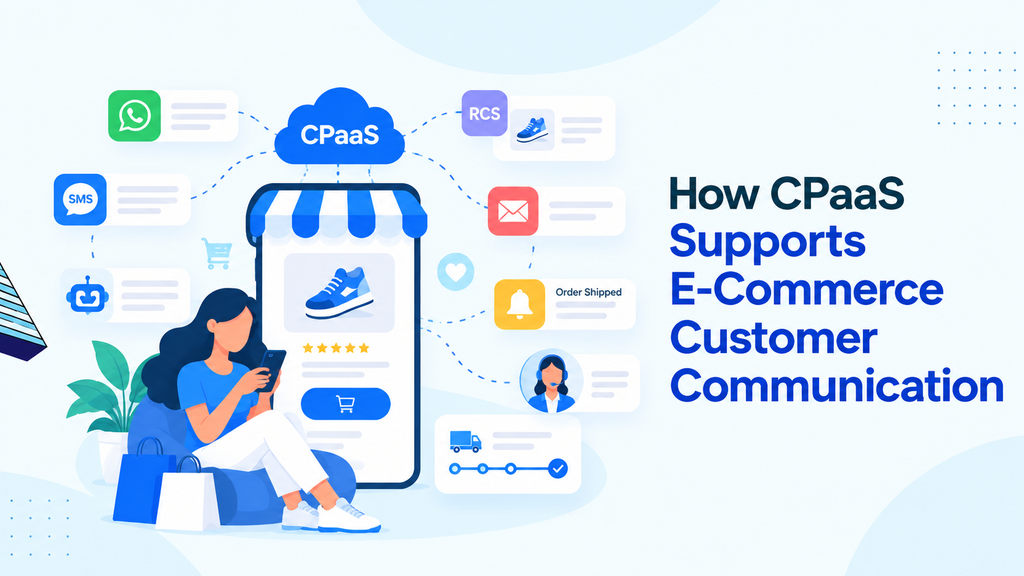
CPaaS acts as the communication infrastructure connecting different channels and workflows through APIs. For e-commerce businesses, this typically means integrating messaging with existing systems, triggering order notifications automatically, connecting WhatsApp and voice interactions, automating repetitive communication, and managing conversations across channels at scale.
CPaaS is a technology layer, not a replacement for good customer service processes. Businesses still need accurate data, clear workflows, customer consent, ongoing monitoring, and human support standing by.
FirstConnectt helps businesses build connected communication journeys through its CPaaS ecosystem, bringing messaging, automation, voice, and AI capabilities together. This infrastructure can support everything from order confirmation and delivery updates to customer queries and post-purchase interactions. It’s worth being clear that this is about connected communication capabilities and scalable infrastructure, not a guarantee of delivery or customer satisfaction on its own.
A few patterns show up again and again. Sending too many notifications wears customers down. Disconnected platforms force repeated explanations. Delayed or inaccurate order updates damage trust. Automating complex complaints without a clear path to a human frustrates people further. Ignoring customer preferences and consent creates real risk, not just annoyance. And skipping monitoring of delivery and response workflows means problems go unnoticed until customers complain.
Communication quality ultimately depends on how well technology, customer data, teams, and processes work together, not on any single tool.
E-commerce customer communication runs across the complete order journey, not just a handful of checkpoints. Product discovery, purchase assistance, order confirmation, dispatch, delivery, returns, and support all shape how a customer feels about the business. The goal throughout is communication that’s timely, relevant, consistent, connected, and easy to understand. WhatsApp, SMS, voice, AI, and other channels each support different needs, but only when they work together through the right infrastructure. FirstConnectt helps businesses connect these communication capabilities through a scalable CPaaS ecosystem. The order may end with delivery, but the relationship continues through every conversation that follows.
It includes messages, updates, and support shared throughout discovery, ordering, delivery, returns, and post-purchase engagement.
They keep customers informed about payment, dispatch, and delivery status, reducing uncertainty about what happens next.
It helps automate messages, share order updates, answer routine questions, and support conversations at scale.
It connects touchpoints so businesses give consistent information without customers repeating themselves.
CPaaS connects channels and systems through APIs, supporting automated, scalable communication workflows.
Share this article
Article
 Article
 Article
Ready to put these ideas to work? Talk to our team about your communication stack.
Get Started →