
 Article
October 14, 2026
6 min read
 FirstConnectt
Enterprise communication insights
FirstConnectt
Enterprise communication insights
Article · FirstConnectt Insights
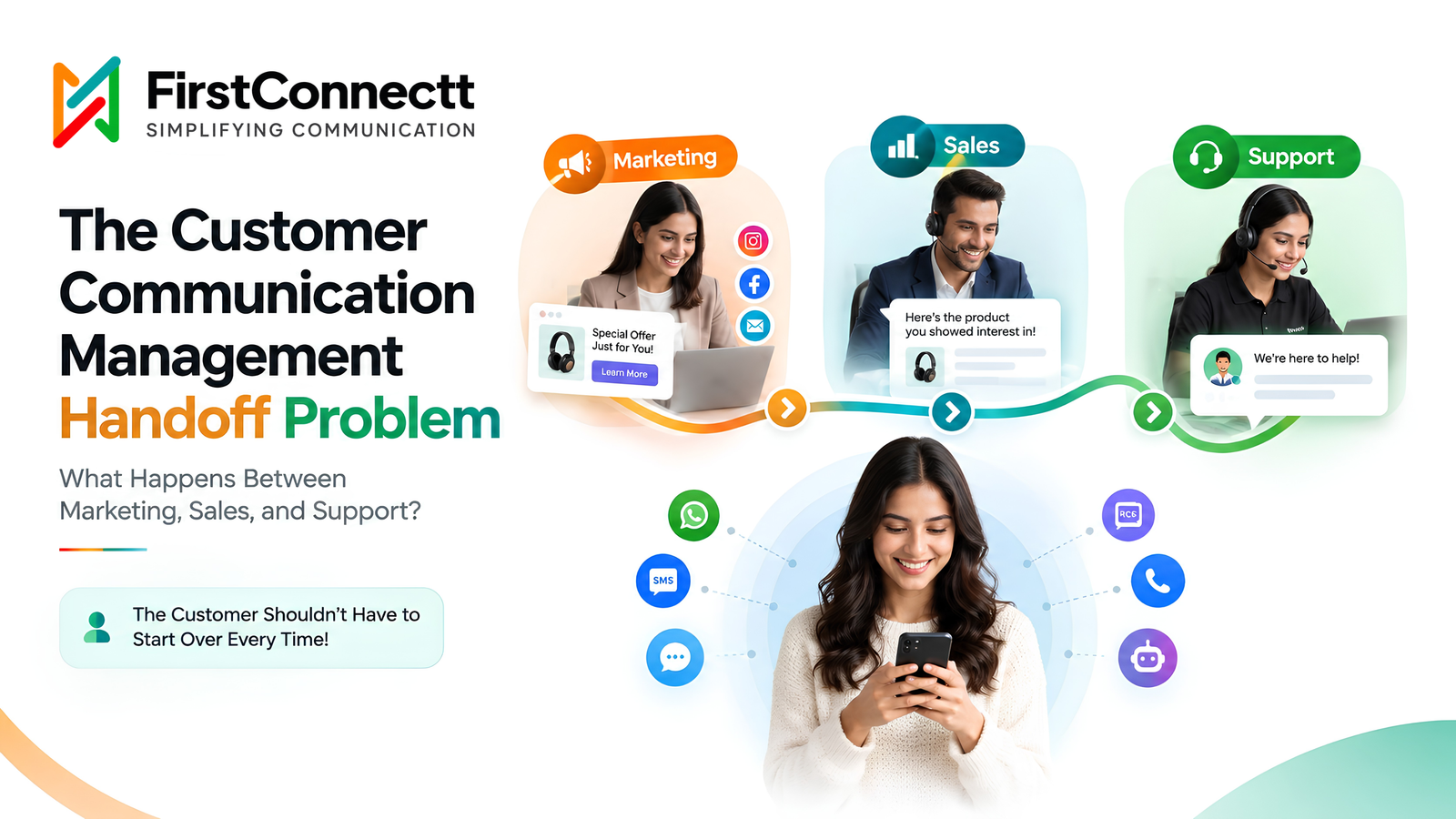
The Customer Shouldn’t Have to Start Over Every Time!
Think about buying something online. You click an ad, talk to a sales rep, pay, and later message support. Each team does its job. But when you reach support, they ask the same questions again.
Marketing knows what attracted them. Sales knows what was promised. Support knows what’s wrong now. Nobody holds the full picture. Customer communication management ties those interactions together across teams and channels.
This gap is the communication handoff problem, and here’s where it starts.

A communication handoff happens when responsibility for a customer interaction moves from one team, person, or system to another. Common examples include marketing passing a lead to sales, sales passing a new customer to onboarding, onboarding passing an issue to technical support, and support escalating a complaint to another department.
Handoffs are necessary because each team has different responsibilities. Problems begin when the receiving team lacks the context to continue. A salesperson may promise a follow-up that support never hears about. A customer may explain an issue to one representative, then repeat it to another.
The handoff should transfer context, not just responsibility.
Each team plays a different role, and each can do its job well while the overall experience stays fragmented.
Marketing attracts prospects through campaigns, ads, email, social media, and messaging. It often knows which campaign generated a lead and what content caught the customer’s attention.
Sales carries the conversation forward through qualification, product discussions, demonstrations, and follow-ups. It needs to understand the customer’s interest, expectations, and earlier interactions.
Support helps customers after a purchase or when they need assistance. It handles troubleshooting, complaints, billing questions, and service requests.
The trouble shows up when these teams work from disconnected information. Marketing may keep sending acquisition messages after someone becomes a customer. Sales may not know about a new complaint. Support may lack details about what was discussed before the purchase.

Marketing collects information through forms, ads, landing pages, or messaging. Sales then receives the lead and continues the conversation. But important details can disappear on the way: which campaign generated the lead, what product interested them, what they’ve already received, and whether they asked a specific question or requested a callback.
The numbers show how common this is. According to stats, 53% of companies have a broken handoff, with sales following up on fewer than 35% of marketing-engaged prospects.
Picture a prospect who requests a demonstration after viewing a product-specific campaign. The sales representative calls with no record of what drew them in. The conversation starts from zero, even though the customer already shared useful information. A good handoff helps the next team continue customer communication management instead of restarting it.
After a purchase, responsibility often moves from sales to onboarding or customer support. This transition causes problems when the receiving team lacks key details.
A salesperson might discuss a particular feature, explain an implementation timeline, or agree to a follow-up. The customer later contacts support expecting that information to be on file. If it was never recorded or shared, support may give a different answer or ask the customer to explain everything again. That frustrates people even when the support representative is trying hard to help.
A structured handoff should include commitments, customer requirements, previous conversations, and unresolved questions. The customer communication management shouldn’t feel like a gap simply because the business moved them between departments.
Information also needs to travel back from support. Suppose a customer complains about a delayed service response. While the issue stays open, marketing keeps sending promotional offers. Or a customer shows interest in another product during a support chat, but that interest never reaches the right team.
Communication has to work in both directions. An unresolved complaint may mean pausing or adjusting promotions. A genuine sales opportunity should be recorded for suitable follow-up.
Businesses should set clear rules for how customer interactions influence other departments. A handoff should be part of a continuous feedback loop, not a one-way transfer.
Most businesses run separate platforms for marketing automation, CRM and lead management, SMS and WhatsApp messaging, voice and cloud telephony, support tickets, and conversational AI. Each tool may work fine alone. But if data isn’t synchronized, employees lack what they need to continue an interaction.
The results are familiar: duplicate messages, inconsistent customer information, repeated questions, missed follow-ups, slower issue resolution, and limited visibility across channels. Salesforce research found that 56% of customers have to repeat or re-explain information to different representatives.
Adding more tools doesn’t create a connected experience. Connecting the systems and workflows that need to share information does. Strong customer journey management depends on those links, not on tool count.
Poor handoffs make customers feel the business doesn’t remember them. They repeat their requirements, explain the same complaint several times, or correct conflicting information. That adds effort and reduces confidence.
The impact reaches beyond satisfaction. Repeated interactions raise support workload, delay responses, and make follow-ups harder to manage. Strong customer support communication depends on having the right history at the right moment.
Not every handoff causes trouble, of course. Handoffs are necessary. The challenge is making sure they carry the right information and have clear ownership. Customers judge the business by how continuous their experience feels, not by how its departments are organized.
Identify where interactions move between marketing, sales, onboarding, and support.
Decide which details the next team needs: customer intent, previous interactions, commitments, and unresolved issues.
Specify which team owns the next action and when the handoff counts as complete.
Use CRM integration to link customer communication management platforms and support workflows, so key information stays accessible.
A qualified lead can route to sales, while a newly opened complaint triggers a support workflow. Business communication automation keeps this consistent.
Where appropriate and permitted, make relevant interaction history accessible across SMS, WhatsApp, voice, and other channels.
Track missed follow-ups, repeated questions, response times, and open cases to see where the process needs work. Marketing and sales alignment improves when both teams see the same numbers.
A customer might discover a product through an ad, get a follow-up on WhatsApp, speak with a sales representative, and later call support. The channels differ, but the experience should stay consistent. That’s the idea behind omnichannel communication.
Studies found only 13% of contact centers could keep customer context while moving someone between channels.
CPaaS, or Communications Platform as a Service, helps businesses add messaging and voice into their applications and workflows through APIs. It can support SMS, WhatsApp Business API, RCS, and voice. Linked with CRM and support systems, it can trigger messages, route interactions, and support connected workflows.
CPaaS doesn’t solve every handoff problem alone. Businesses also need accurate records, suitable integrations, clear ownership, and well-designed processes.
Modern businesses need customer communication management infrastructure that connects more than individual messages. It should support the workflows that move customer interactions forward.
FirstConnectt offers a CPaaS ecosystem spanning A2P messaging, WhatsApp Business API, RCS, voice and cloud telephony, Conversational AI, and Agentic AI. With relevant systems integrated and clear handoff rules in place, these capabilities help businesses coordinate updates, route interactions, and keep continuity across touchpoints. The goal is to make communication work together, even when responsibility changes hands.
Don’t Make Customers Manage Your Internal Handoffs
Marketing, sales, and support have different jobs, but customers experience one business. When information gets lost between departments, customers repeat themselves, receive conflicting messages, or wait longer. Better handoffs need clear ownership, relevant context, connected systems, and consistent workflows. Technology helps, but businesses must still decide what information moves and who acts next. Strong customer communication management makes that possible. FirstConnectt helps businesses connect messaging, voice, automation, and AI through its omnichannel communication ecosystem. The customer journey should keep moving forward, even when the conversation changes hands.
It happens when responsibility for a customer interaction moves between teams, employees, or systems, and relevant information must move with it.
Common causes include disconnected systems, missing customer context, unclear ownership, inconsistent processes, and missed follow-ups.
They can define handoff responsibilities, standardize information sharing, connect relevant systems, automate routine workflows, and monitor open interactions.
It makes customer records and interaction history accessible across connected workflows, so teams continue conversations with better context.
CPaaS connects channels and business applications through APIs. This helps coordinate messaging, voice, and automated workflows, leading to seamless customer communication management.
Share this article
Article
 Article
 Article
Ready to put these ideas to work? Talk to our team about your communication stack.
Get Started →