
 Article
October 22, 2026
6 min read
 FirstConnectt
Enterprise communication insights
FirstConnectt
Enterprise communication insights
Article · FirstConnectt Insights
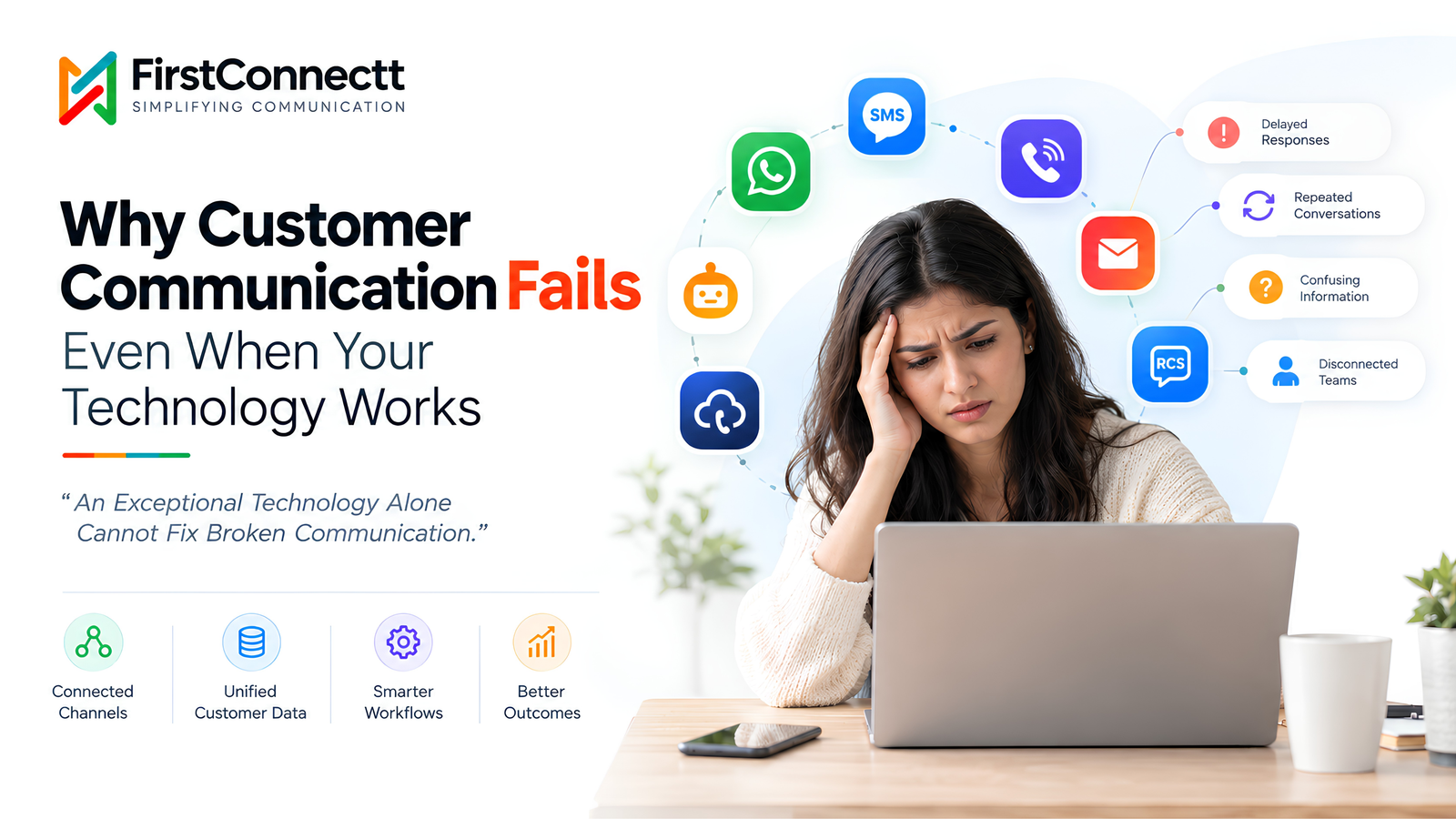
“An Exceptional Technology Alone Cannot Fix Broken Communication.”
Your business runs on modern tools. Messages are automated, teams use several platforms, and customer data lives across multiple systems. So why do customers still face delays, confusion, and repeated conversations? Technology rarely causes this on its own. A weak customer communication strategy usually sits behind it, tying channels, teams, and workflows together poorly.
Here’s what actually breaks down, and where the real fix begins.

Customer communication covers every interaction a business has, from the first enquiry to post-purchase support. This includes marketing messages, OTPs, order confirmations, and follow-ups. Here is what effective customer communication looks like:
A business might use one platform for SMS, another for WhatsApp, a separate voice provider, and a different support system. Each tool works fine alone, but the customer experience still suffers. A customer asks something on WhatsApp, then calls support, and the voice team can’t see that conversation at all, so the issue gets explained twice.
How businesses can improve: Connect channels with relevant customer records and CRM systems, so tools work together instead of sitting apart.
A message can be written correctly and triggered on time, and still arrive late because of poor routing. Routing affects which provider handles a message, which channel gets used, whether a fallback exists, and whether a request reaches the right team. An urgent notification sent through an underperforming route, or a support request landing in the wrong department, both create avoidable delays.
How businesses can improve: Use infrastructure with routing visibility, monitoring, and defined escalation paths.
Customers expect a business to remember their situation, especially after they’ve already reached out once. Studies found that 56% of customers have to repeat or re-explain information to different representatives. Also, only 13% of contact centers could preserve customer context while moving someone between channels. Without shared context, customers repeat their name, order number, or complaint every time they switch teams.
How businesses can improve: Connect customer information across systems, with appropriate privacy and access controls in place.
Automation helps manage repetitive communication, but fixed triggers cause problems when they ignore what the customer already did. A customer pays a bill, then still gets a payment reminder because the workflow never checked. The same pattern shows up in promotional messages sent after a complaint, or reminders sent after a cancellation.
How businesses can improve: Connect automation to real business events and recent customer actions, not just a fixed schedule.
A payment issue might touch support, finance, and technical teams all at once. Without clear ownership, the request moves between departments with nobody responsible for the next step, leading to delayed responses and conflicting answers.
How businesses can improve: Define who receives a request, who owns the resolution, and when escalation kicks in, so nothing sits unanswered.
Marketing focuses on campaigns, sales on conversion, support on resolution, and operations on fulfillment. These goals differ, but the customer experiences the business as one entity. Marketing might send a promotion while support is still handling that same customer’s unresolved complaint.
How businesses can improve: Build shared communication standards and connect relevant customer information across departments.
Tracking messages sent or calls completed feels productive, but it doesn’t show whether communication actually worked. A campaign can reach thousands of people and still generate limited engagement, or a chatbot can handle many conversations without resolving anything.
How businesses can improve: Track resolution, satisfaction, conversion, and drop-offs alongside basic delivery numbers.
When channels, teams, and workflows don’t connect, customers notice quickly.
None of this usually comes from one failed message. It builds from several small gaps across the full journey.
A few focused changes can close most of these gaps.
1. Map the complete customer journey: Identify every touchpoint, from discovery and onboarding through transactions and support.
2. Connect relevant communication channels: Bring SMS, WhatsApp, RCS, voice, and AI into workflows that actually share data.
3. Centralize customer context: Make relevant information available to the teams and systems that need it.
4. Define communication ownership: Assign clear responsibility for receiving, resolving, and escalating each customer request.
5. Build context-aware automation: Connect automated messages to real customer actions and transaction status.
6. Establish communication standards: Set consistent guidelines for tone, timing, information, and escalation.
7. Measure outcomes: Track resolution, conversion, and satisfaction alongside delivery and response metrics.
A strong strategy combines technology, people, processes, and steady improvement.
Managing connected customer journeys takes more than individual tools. Businesses need an infrastructure layer bringing channels, APIs, workflows, automation, and analytics together.
CPaaS, or Communication Platform as a Service, can support integration across SMS and A2P messaging, the WhatsApp Business API, RCS, voice and cloud telephony, conversational AI, agentic AI, CRM systems, and business applications. This helps businesses build connected communication workflows across different touchpoints.
CPaaS alone isn’t a complete solution, though. Businesses still need clear processes, the right integrations, proper data governance, and defined service responsibilities. Infrastructure creates the foundation, but people still have to design what runs on it.
Modern businesses need infrastructure that supports more than message delivery. They need connected channels, reliable workflows, and communication capabilities that adapt to changing customer expectations.
FirstConnectt helps enterprises connect communication across A2P messaging, SMS, the WhatsApp Business API, RCS, voice and cloud telephony, conversational AI, and agentic AI. This supports authentication, alerts, engagement, support, and automation through one connected infrastructure.
A customer might get an SMS notification, continue on WhatsApp, connect with Voice AI, or reach a human agent when more help is needed. FirstConnectt brings these capabilities together with greater flexibility, visibility, and scalability.
Customer communication doesn’t usually fail because businesses lack technology. The problem is often how channels, teams, data, and workflows work together. A business can run modern messaging platforms and AI tools while still delivering a fragmented experience. The fix starts with a stronger customer communication strategy: connect relevant channels, share customer context, define clear ownership, build context-aware automation, and measure real outcomes. CPaaS and communication infrastructure support this work, but technology still needs well-designed processes behind it. FirstConnectt helps enterprises connect messaging, voice, and AI through one infrastructure, so communication becomes more reliable and consistent, not simply more frequent.
It often comes from disconnected channels, poor routing, missing context, and unclear ownership, not the tools themselves.
They cause repeated questions, delayed responses, inconsistent information, and difficulty switching between touchpoints.
By mapping journeys, connecting channels, sharing context, defining ownership, and measuring real outcomes.
CPaaS connects channels, APIs, and business systems, supporting more integrated communication workflows.
Through shared customer information, clear escalation paths, reliable routing, and consistent standards.
Share this article
Article
 Article
 Article
Ready to put these ideas to work? Talk to our team about your communication stack.
Get Started →