
 Article
October 14, 2026
6 min read
 FirstConnectt
Enterprise communication insights
FirstConnectt
Enterprise communication insights
Article · FirstConnectt Insights
Communication has quietly become one of the biggest competitive advantages in business.
A customer waiting for a bank transaction alert. A shopper expecting delivery updates. A patient waiting for a doctor’s appointment reminder. In every case, the quality and speed of communication often determine whether the experience feels effortless or frustrating.
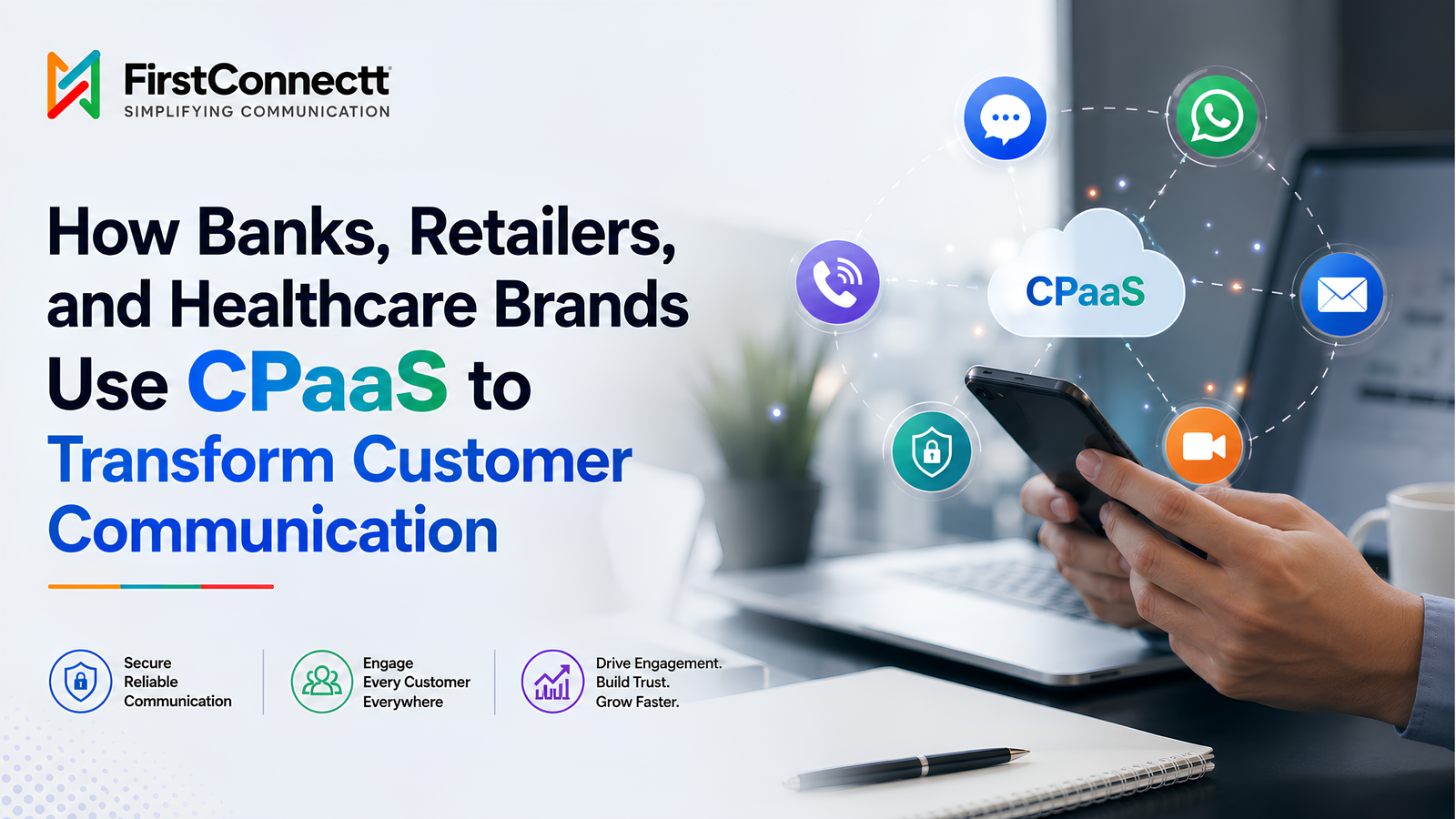
This is exactly where Communications Platform as a Service (CPaaS) is changing industries. Instead of relying on disconnected communication systems, a CPaaS company in India helps organizations embed messaging, voice, video, and authentication directly into their applications and customer journeys.
Banks are preventing fraud in real time. Retailers are recovering abandoned carts with personalized messaging. Healthcare providers are reducing missed appointments and improving patient care through automated communication.
Let’s explore how different industries are using CPaaS to create seamless customer communication experiences and also operational efficiency.
What if you could add SMS, WhatsApp, Voice, and Email to your app without building everything from scratch? That’s possible with CPaaS (Communications Platform as a Service). It is a cloud-based platform. It enables businesses to integrate communication features such as:
Instead of building these systems from scratch, developers integrate APIs into existing applications to create seamless communication experiences.
The result is faster deployment, lower infrastructure costs, and highly personalized customer interactions.
Today’s customers expect businesses to communicate instantly.
Whether they’re checking a bank balance, tracking an order, or confirming a medical appointment, delays reduce trust.
CPaaS enables organizations to communicate at the right time through the customer’s preferred channel.
Common benefits include:
Now let’s examine how three major industries are putting CPaaS into action.
As communication needs grow, businesses need connected infrastructure rather than isolated tools. FirstConnectt, a global CPaaS company in India, helps bring multiple communication channels into a more unified customer journey.
Banking has evolved far beyond physical branches. Customers expect every financial interaction to happen securely and instantly. CPaaS helps banks deliver exactly that.
Every successful payment, ATM withdrawal, or credit card purchase can trigger an instant notification through:
Immediate alerts increase transparency while helping customers identify unauthorized transactions quickly.
Security remains one of banking’s highest priorities.
Banks use CPaaS APIs to send One-Time Passwords (OTPs) for:
Because delivery happens in seconds, the authentication process remains both secure and convenient.
Imagine someone attempts to use your card in another country.
Within seconds, the bank can:
Rapid communication significantly reduces fraud losses.
Banks also automate customer communication throughout the lending process.
Examples include:
This keeps customers informed without overwhelming support teams.
CPaaS enables banks to send targeted offers based on customer behavior.
Examples include:
Instead of generic campaigns, communication becomes relevant and timely.
From OTPs to transaction alerts, banking communication needs speed and reliability. Thus, a CPaaS company in India, like FirstConnectt can help you build connected communication flows for critical customer interactions.
Retail thrives on customer engagement. The faster retailers communicate, the more likely customers are to complete purchases and remain loyal.
Immediately after checkout, customers receive:
Reducing uncertainty increases customer satisfaction.
One of retail’s most valuable CPaaS applications involves recovering abandoned carts.
Instead of losing potential sales, retailers send personalized reminders through:
Adding limited-time discounts often increases conversion rates.
Retail brands launch personalized marketing campaigns using customer data.
Examples include:
Because messages arrive through preferred channels, engagement improves significantly.
Customers increasingly prefer messaging instead of waiting on hold.
Retailers use CPaaS-powered chat solutions to answer:
When automation cannot solve the issue, conversations smoothly transition to human agents.
For retailers offering store pickup, CPaaS automates communication throughout the process.
Customers receive:
This creates a smoother omnichannel shopping experience.
Orders, promotions, support, and delivery updates create multiple customer touchpoints. The CPaaS company in India, FirstConnectt helps retailers connect these interactions across relevant communication channels.
Healthcare communication requires accuracy, privacy, and reliability. Missed appointments, delayed reports, and poor communication can directly affect patient outcomes. A CPaaS company in India helps healthcare organizations maintain continuous communication while improving operational efficiency.
One of the most common applications involves automated reminders. Patients receive notifications before appointments through:
Reminder automation significantly reduces no-show rates.
Healthcare providers integrate video APIs directly into patient portals. Patients can:
Without switching between multiple applications.
Patients often forget medication schedules. Healthcare organizations send:
This improves treatment adherence.
Instead of waiting for phone calls, patients receive secure notifications when:
Communication becomes faster while reducing administrative workload.
Hospitals can instantly broadcast important information during emergencies, including:
Fast communication improves patient confidence.
Overall, healthcare communication demands timely and reliable interactions. FirstConnectt helps businesses connect notifications, messaging, and voice into smoother communication workflows.
Although every industry has unique requirements, several CPaaS capabilities are universally valuable.
Businesses communicate across:
Customers choose their preferred channel instead of businesses forcing one.
Communication automatically triggers based on customer actions. Examples include:
Automation reduces manual effort while improving consistency.
AI-powered chatbots answer common questions instantly before transferring complex issues to human agents.
Organizations measure:
These insights continuously improve communication strategies.
Organizations adopting CPaaS often experience measurable improvements.
Customers receive timely, relevant communication instead of generic updates.
Automated messaging eliminates unnecessary waiting.
Automation reduces repetitive manual work for support teams.
Customers interact more frequently through familiar channels like WhatsApp and SMS.
Businesses can communicate with thousands or even millions of customers without investing in additional communication infrastructure.
While CPaaS offers significant advantages, implementation requires planning.
Industries such as healthcare and banking must comply with regulations governing customer data and communication.
Not every customer prefers the same communication method. Businesses should offer multiple options.
Sending excessive notifications reduces engagement. Communication should remain valuable rather than intrusive.
Connecting CRM platforms, ERP systems, mobile apps, and existing software requires careful integration planning.
Organizations achieve better results when they follow proven strategies.
Many businesses fail to maximize CPaaS because they overlook customer experience. Avoid these common mistakes:
Imagine an online pharmacy using CPaaS. A customer places an order for prescription medication. Within minutes, they receive:
Every interaction feels connected, proactive, and helpful without requiring manual intervention.
CPaaS is evolving beyond simple messaging. Emerging capabilities include:
As customer expectations never stay limited, organizations will increasingly embed communication directly into every digital experience rather than treating it as a separate function.
CPaaS enables businesses to integrate messaging, voice, video, authentication, and communication APIs into applications without building communication infrastructure from scratch.
Banks use CPaaS for OTP authentication, transaction alerts, fraud notifications, customer support, loan updates, and personalized financial communication.
Retailers use CPaaS for order tracking, abandoned cart recovery, promotional campaigns, customer support, delivery notifications, and loyalty engagement.
Healthcare organizations use CPaaS for appointment reminders, telemedicine, prescription notifications, lab result updates, and emergency communication.
Most enterprise-grade CPaaS providers offer encryption, secure APIs, authentication mechanisms, and compliance features. However, businesses must also implement proper security practices and comply with applicable regulations.
Whether it’s preventing banking fraud, helping shoppers track purchases, or reminding patients about life-saving appointments, CPaaS has become a critical part of modern customer communication.
Its true value extends beyond sending messages. It connects every stage of the customer journey with timely, personalized, and secure interactions. Organizations that embrace CPaaS are better positioned to improve customer satisfaction, streamline operations, and adapt to evolving communication preferences.
As communication becomes more intelligent and personalized, the right strategy from an exceptional CPaaS company in India matters. FirstConnectt helps businesses stay connected across evolving channels and customer experiences. Are you ready to enable CPaaS for your business? Happy to help you!
Share this article
Article
 Article
 Article
Ready to put these ideas to work? Talk to our team about your communication stack.
Get Started →