
 Article
September 17, 2026
6 min read
 FirstConnectt
Enterprise communication insights
FirstConnectt
Enterprise communication insights
Article · FirstConnectt Insights
India’s Business Communication Is Entering a New Phase.
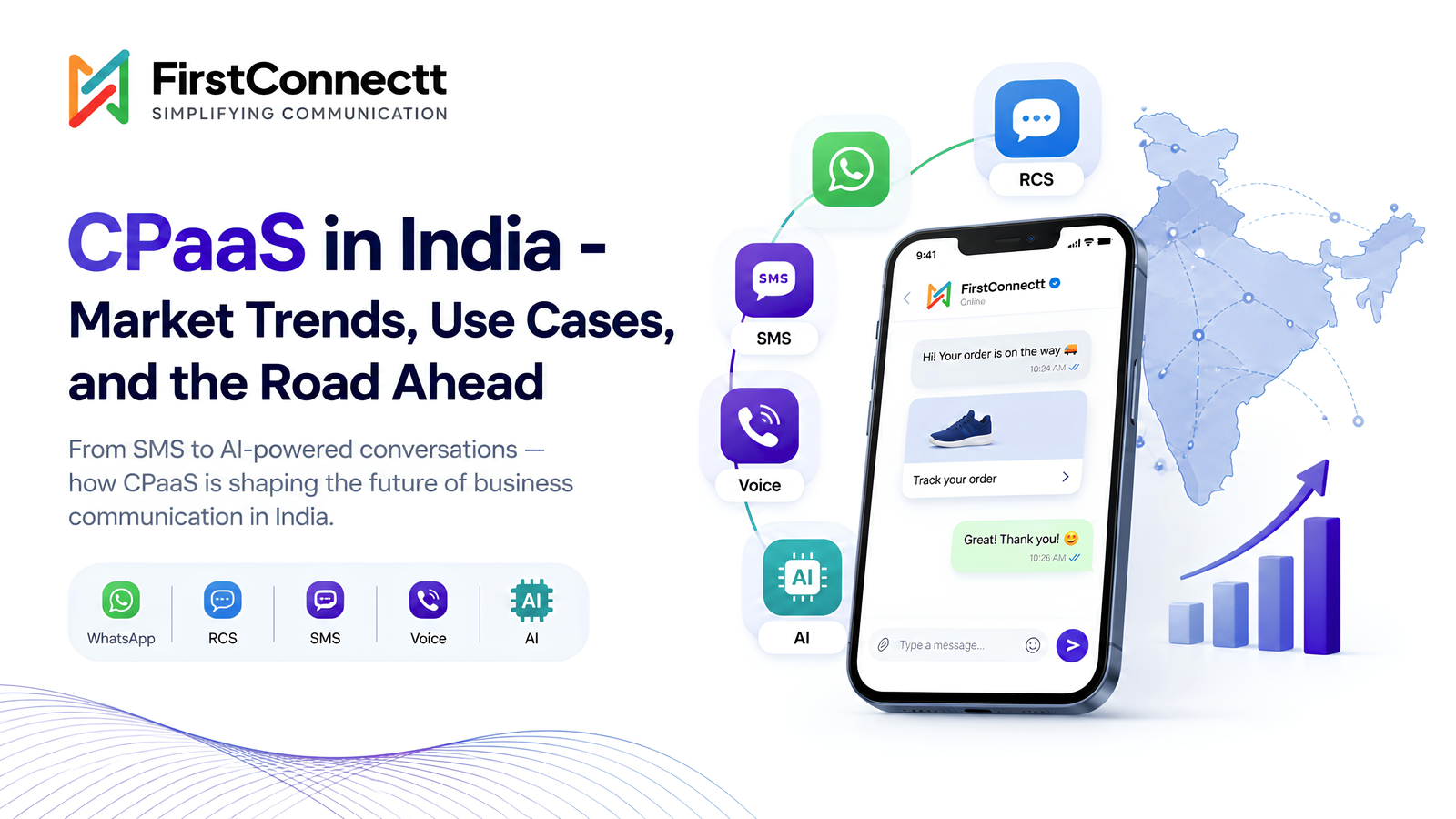
Indian businesses once relied almost entirely on SMS and voice calls for OTPs, alerts, and reminders. Customers now expect brands to show up on WhatsApp, RCS, apps, and AI-powered chat, all at once. The real challenge isn’t reaching customers anymore. It’s connecting every interaction into one journey. CPaaS in India is stepping into that gap, turning separate messaging tools into shared infrastructure.
Here’s where that shift currently stands, and where it’s headed next.
CPaaS is a platform that powers modern business communication. It stands for Communications Platform as a Service. Instead of building communication infrastructure from scratch, businesses use APIs and platform capabilities to add it directly into their existing applications and workflows. A CPaaS platform can connect SMS and A2P messaging, the WhatsApp Business API, RCS, voice and cloud telephony, conversational AI, agentic AI, automation, and analytics. It typically sits between business systems and communication channels, so a CRM can trigger a message across WhatsApp, SMS, RCS, or voice without managing each channel separately. This lets businesses build communication workflows instead of independent, disconnected systems.
Market estimates vary depending on how researchers define and measure CPaaS, so it helps to look at direction rather than one fixed number. A 2025 analysis placed India’s CPaaS market at around $2.7 billion in 2024, projecting a 22% CAGR through 2030. A December 2025 IDC market perspective described India’s CPaaS market as entering a growth phase, with BFSI, retail, and healthcare leading adoption. The growth is driven by omnichannel engagement, WhatsApp and RCS adoption, AI-driven automation, and API-led innovation.
Beyond the numbers, India already has the foundation this growth needs: a large mobile user base, widespread digital payments, a growing e-commerce sector, and rising AI adoption. The opportunity comes from embedding communication directly into digital customer journeys.
SMS remains critical for OTPs, authentication, alerts, and transactional messages. But a typical customer journey increasingly moves through SMS, WhatsApp, RCS, voice, AI, and human support in sequence.
Each channel plays a different role: SMS for reach and critical alerts, WhatsApp for two-way conversations, RCS for rich messaging, voice for complex conversations, and AI for automation. The shift isn’t replacing SMS. It’s connecting SMS with everything else, which is exactly why CPaaS is becoming an infrastructure layer rather than just an SMS API.
According to stats, RCS interactions in India grew 108% between H1 2025 and H1 2026, with finance and fintech accounting for more than three-quarters of that traffic.
RCS brings rich media, verified business identity, suggested replies, buttons, and carousels into everyday messaging, supporting use cases across banking, e-commerce, travel, and appointment reminders. RCS doesn’t necessarily replace SMS. It expands what business messaging can actually do.
Businesses increasingly use WhatsApp for customer support, product discovery, order updates, appointment bookings, and conversational commerce, well beyond simple marketing broadcasts. Infobip’s 2026 India messaging report recorded 20% WhatsApp growth on its platform, highlighting WhatsApp and RCS as central to India’s shift toward conversational engagement.
WhatsApp becomes more powerful connected to other channels: discovery on WhatsApp, OTPs on SMS, rich product interaction on RCS, and complex support through voice, creating one connected journey instead of a WhatsApp-only strategy.
Earlier CPaaS focused mainly on delivering messages. AI is now becoming part of the communication layer itself.
Conversational AI understands customer questions and automates common interactions without needing a human on every reply.
Voice AI supports natural-language conversations over voice, moving beyond fixed IVR menus.
Agentic AI goes further, executing multi-step workflows like checking an order, scheduling an appointment, or triggering a follow-up.
This shifts CPaaS from simply sending a message toward understanding the customer, deciding what happens next, and taking action.
Businesses want communication capabilities built directly into the systems they already use: an e-commerce platform triggering order notifications, a CRM starting a WhatsApp conversation, or a banking system sending an OTP. CPaaS APIs let these systems trigger communication without separate infrastructure for every channel.
The next phase will focus on easier integrations, better orchestration, real-time data, and low-code options, so communication becomes something businesses build in rather than manage separately.
These trends show up clearly across a few core Indian industries.
CPaaS supports OTPs, transaction alerts, payment notifications, fraud alerts, and conversational banking. A2P messaging matters most here: Studies estimates India’s A2P messaging market to reach $2.44 billion in 2025, projected to reach $3.31 billion by 2034.
Common use cases include order confirmation, delivery updates, abandoned-cart communication, product discovery, and conversational commerce that keeps customers engaged through the same thread.
CPaaS supports appointment reminders, patient notifications, follow-ups, and report updates, with the focus staying on communication rather than medical decision-making.
Businesses use CPaaS for booking confirmations, travel alerts, check-in communication, customer support, and voice assistance during disruptions.
Communication connects the full delivery cycle: order, dispatch, tracking, delivery, and confirmation, wherever businesses need frequent, time-sensitive interactions.
Several forces are pushing this shift at once.
Customers increasingly expect businesses to communicate through the digital channels they already use daily.
India’s financial, e-commerce, and logistics ecosystems generate enormous volumes of customer interactions every day.
OTPs, payments, deliveries, and appointments often depend on communication that arrives without delay.
Not every customer wants to communicate through the same channel, or at the same time.
Businesses want to automate repetitive interactions while keeping human support available for complex situations.
Communication systems need to handle traffic spikes without businesses building their own telecom infrastructure.
This growth brings real challenges too.
Critical communications like OTPs and transaction alerts cannot depend on fragile infrastructure.
Businesses need to manage consent, message templates, data protection, and industry-specific rules.
Connecting multiple channels with existing CRM, ERP, and AI systems can get complicated fast.
Adding channels without proper orchestration can create more complexity instead of less.
Communication platforms handle sensitive customer and business information that needs real protection.
A setup built for thousands of interactions may need a different approach at millions.
A few directions stand out looking forward.
Businesses will move from one-way notifications toward genuine two-way interactions with customers.
AI will help understand intent, automate responses, and execute defined workflows automatically.
Messaging will increasingly include media, buttons, and full product experiences within the chat.
Voice AI will complement messaging for conversations that need more back-and-forth.
The value will come from deciding which customer, which channel, and which action, at the right moment. The opportunity ahead isn’t simply more communication. It’s better-connected communication.
FirstConnectt positions itself as a global CPaaS company in India and worldwide. It serves enterprise communication across conversational AI, the WhatsApp Business API, RCS, agentic AI, voice, and intelligent A2P messaging. Its platform reports supporting more than 100 billion conversations annually, over 100 enterprise clients, 750-plus telco connections, and reach across 120-plus countries.
The platform brings these channels together through one CPaaS stack, with APIs, analytics, integrations, and orchestration built around enterprise communication. For Indian enterprises, this reflects the broader shift from individual messaging tools toward connected infrastructure. FirstConnectt isn’t simply helping businesses send messages. It’s helping them connect communication across channels, workflows, AI, and customer journeys.
CPaaS in India is evolving alongside the country’s digital economy. SMS and A2P messaging still matter for authentication and alerts, while WhatsApp, RCS, voice, conversational AI, and agentic AI expand what business communication can look like. The next phase isn’t about choosing one channel over another. It’s about connecting them. As customer journeys become more digital, businesses need infrastructure that supports different channels, automation, and rising volumes. CPaaS can become more than a communication tool. It can become the infrastructure layer behind the customer journey, and FirstConnectt is building toward exactly that future.
It’s cloud-based communication infrastructure that lets businesses integrate SMS, WhatsApp, RCS, voice, and AI through APIs.
Growth comes from digital payments, e-commerce, mobile-first journeys, conversational channels, and rising AI adoption.
Common cases include OTPs, transaction alerts, WhatsApp engagement, RCS messaging, appointment reminders, and automated journeys.
AI is expanding CPaaS from message delivery toward conversational support, intelligent routing, and agentic workflows.
It’s likely to focus on omnichannel communication, richer messaging, API-led integration, and connected customer journeys.
Share this article
Article
 Article
 Article
Ready to put these ideas to work? Talk to our team about your communication stack.
Get Started →