
 Article
September 16, 2026
8 min read
 FirstConnectt
Enterprise communication insights
FirstConnectt
Enterprise communication insights
Article · FirstConnectt Insights
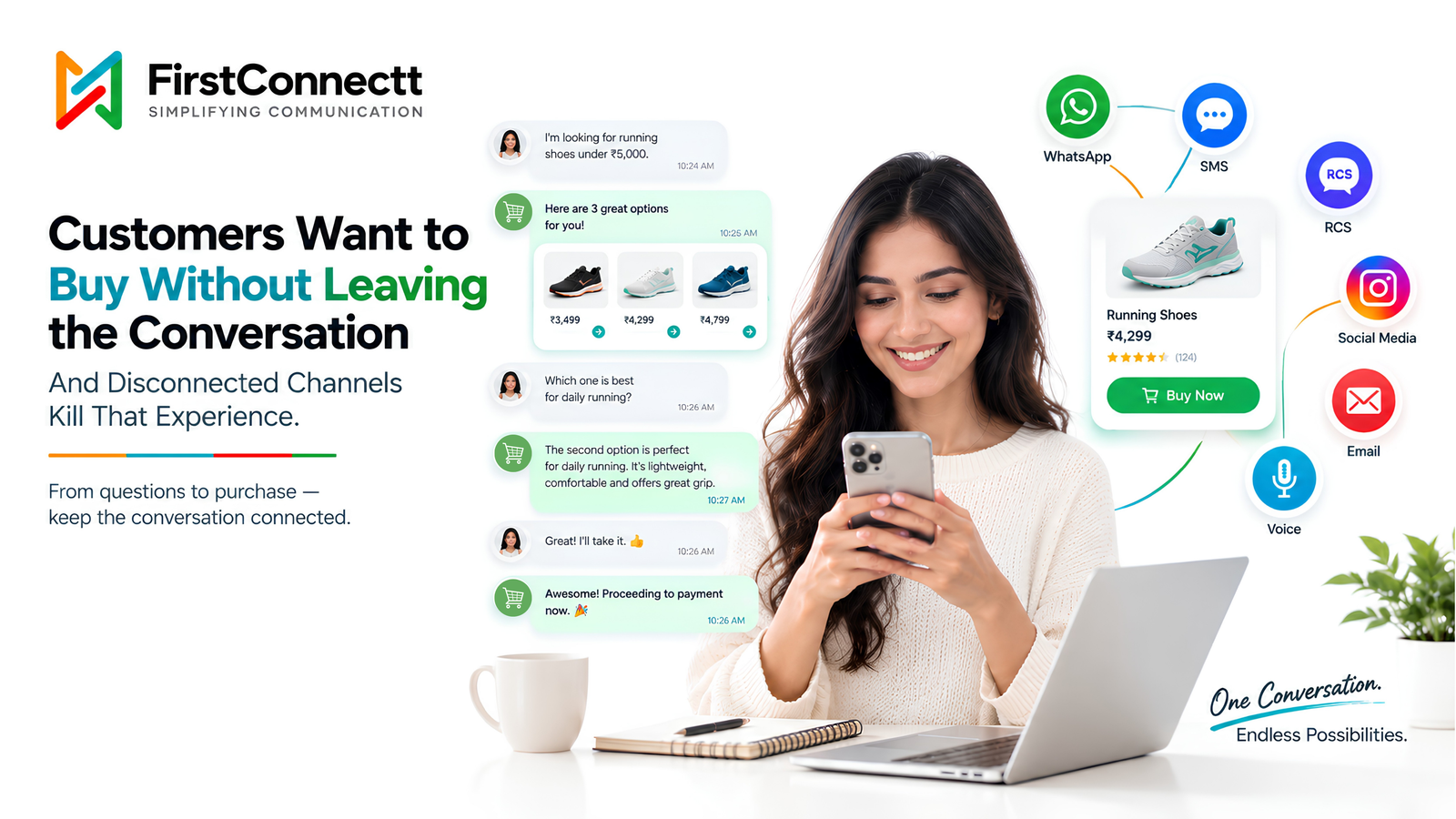
A customer asks about a product, gets an answer, then has to switch to a website to actually buy it. That extra step breaks the moment. People no longer separate browsing from buying, and this shift explains why conversational commerce keeps expanding across messaging platforms. Businesses assume the technology already exists to support this, and often it does. The real issue sits elsewhere. Disconnected communication channels still interrupt the customer journey, even when the right tools are in place.
Here’s what causes that gap, and how businesses can close it.
Conversational commerce means buying and selling through real conversations, not just browsing static pages. It uses chat, messaging apps, and even voice assistants to support the entire purchase path. Customer communication has slowly moved from being a support function to becoming a sales channel in its own right.
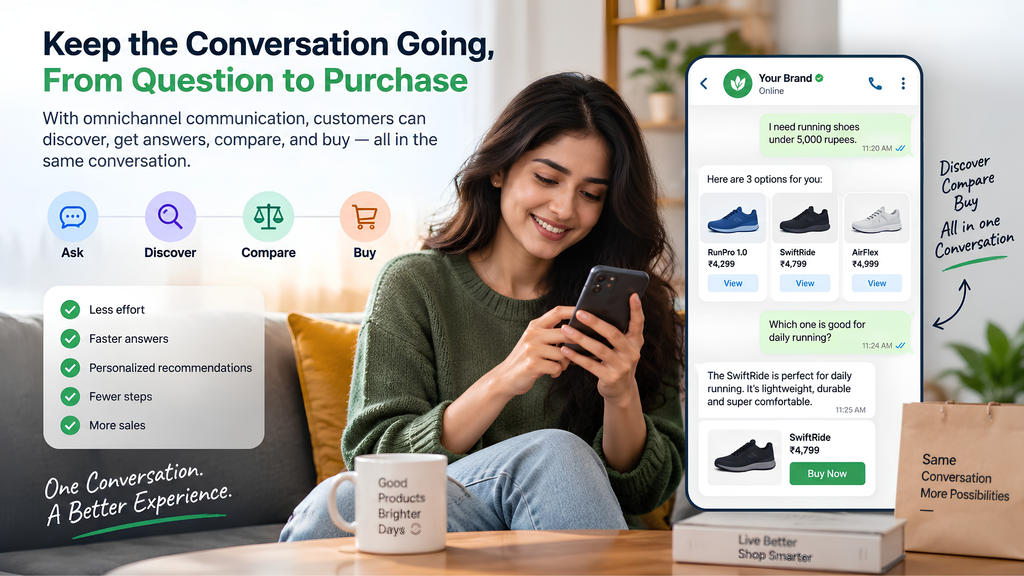
Picture a short exchange. A customer asks, “I need running shoes under 5,000 rupees.” A business shares three options. The customer asks which one suits daily running. The business recommends one. The customer picks it and continues toward payment, all inside the same thread.
This is different from older business messaging, which mostly sent one-way alerts like delivery updates. Now the conversation itself can carry discovery, comparison, and purchase together. The customer never has to restart the process somewhere else, because the same thread holds the entire journey.
Customers avoid repeating themselves. When they already explained what they need, doing it again on a new platform feels pointless. This single frustration drives much of the demand for connected conversations today.
People expect fast answers about products and services, not a wait that stretches across days. A business that replies within minutes wins more attention than one that replies within hours.
Customers expect a business to remember what they asked before, not treat every message like a first contact. When a brand loses that context, the interaction feels colder and less useful.
Every extra click or app switch adds a chance for the customer to give up.
Fewer steps mean fewer chances to lose them. None of this means customers want more communication. They want communication that requires less effort from their side.

Most businesses run several channels at once. SMS handles alerts. WhatsApp handles support questions. RCS Business Messaging adds richer product cards and buttons. Email sends receipts. A website chat box handles quick questions, and a call center steps in when things get complicated.
Picture a typical path. A customer sees an ad on social media, checks the website, messages on WhatsApp, waits for an email reply, then finally calls support. At each step, they may need to repeat their name, their order details, or the issue they already explained once.
This creates problems on the business side too. This includes:
Customer information remains scattered.
Different teams may send different messages.
Businesses struggle to understand the complete customer journey.
Teams spend time moving information between systems.
The conversation doesn’t continue naturally across channels.
The effects show up in several ways. These follows:
Customer effort rises first, since people must move between platforms or repeat information they already gave. This alone pushes some customers to simply give up partway through.
Drop-off risk grows next. Every additional step, form, or app switch gives a customer one more reason to abandon the purchase. A business rarely sees this loss directly. It just shows up as a lower conversion rate.
A customer may get one answer from a chatbot and a different answer from a human agent later. These small contradictions add up, and they make a business look less reliable than it actually is.
Support resolution slows down too, since agents often lack access to the customer’s full interaction history. They ask questions the customer already answered elsewhere, which stretches out simple issues.
Perhaps the highest cost is missed sales. A customer asking a buying question is often ready to purchase right then. A disconnected experience interrupts that momentum, and the moment rarely returns.
Multichannel communication means a business shows up on several platforms at once. SMS, WhatsApp, RCS, email, and voice all exist side by side. The catch is that each one often runs separately, with its own data and its own rules.
Omnichannel communication works differently. These same channels operate as one connected system instead of separate silos. A customer might discover a product on social media, ask a question over chat, get a recommendation, complete the purchase, receive a confirmation, and later request support, all without repeating their story.
The channel can change from message to call to email. What stays fixed is the context behind the conversation. Nothing resets just because the customer picked up the phone instead of typing a message.
Being present on many channels was once enough to impress customers. Now it barely registers. What actually earns trust is a connected experience, where every interaction builds on the last one instead of starting over.
A Communications Platform as a Service, or CPaaS, gives businesses a shared infrastructure to connect these channels through APIs. Instead of managing five separate systems, a business manages one connected layer that every channel plugs into.
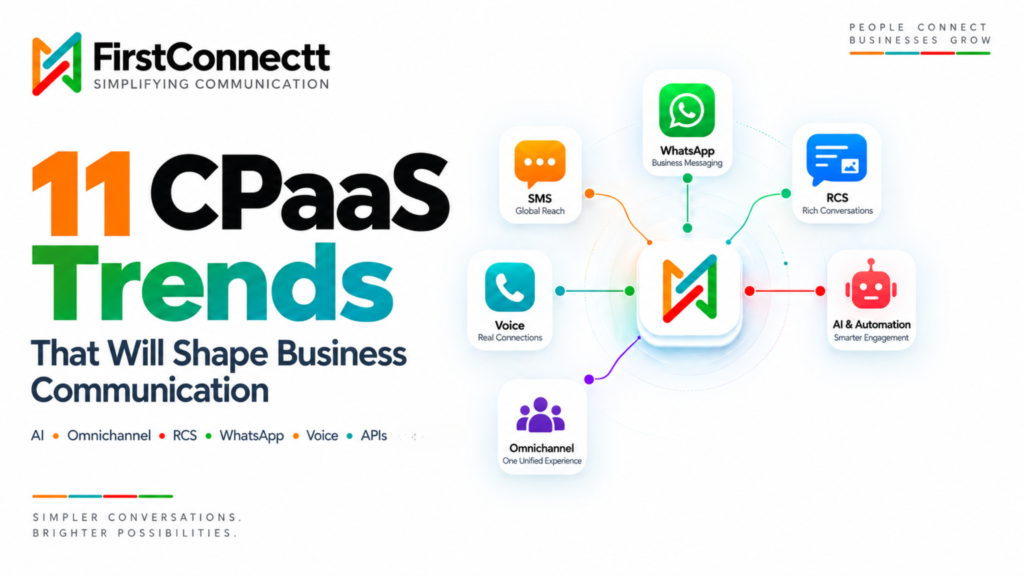
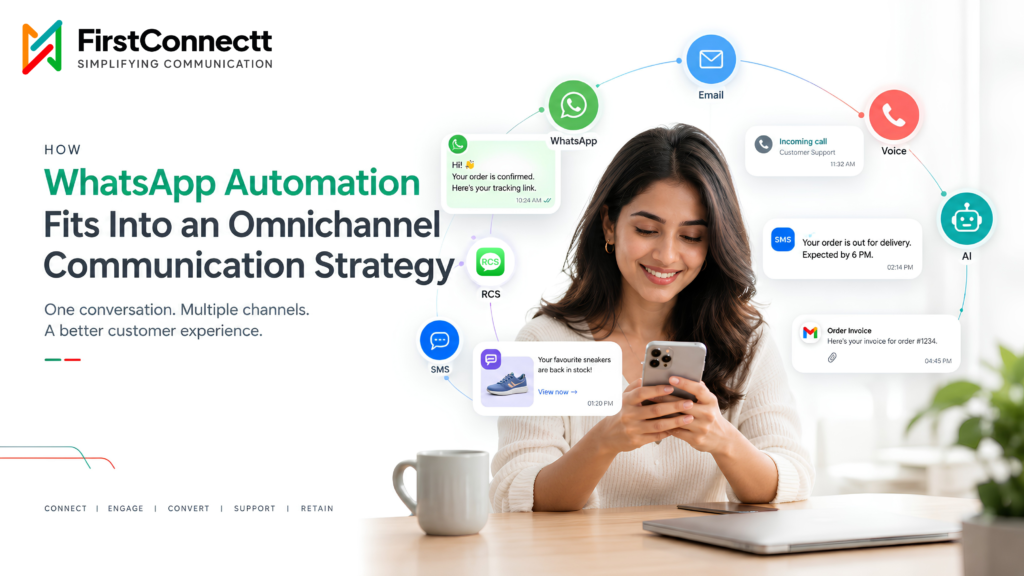
SMS still handles quick alerts and one-time passwords. The WhatsApp Business API supports full conversations, from product questions to order updates, inside an app customers already use daily. RCS Business Messaging adds richer visuals, like carousels and buttons, directly inside standard text messaging. Voice remains available for situations that need a real person. AI-driven chat handles routine questions automatically, freeing human agents for harder issues.
The value isn’t any single channel. It’s the coordination behind them. A CPaaS setup means a customer’s history, preferences, and current conversation travel with them, no matter which channel they use next.
Platforms such as FirstConnectt help businesses bring these channels into one connected communication infrastructure, supporting customer interactions across messaging, voice, and AI without forcing teams to stitch systems together manually.
Here is the practical framework to build a connected conversational commerce journey.
Know what the customer is trying to accomplish.
Use SMS, RCS, WhatsApp, voice, or AI based on the interaction.
Customer information should travel with the conversation.
Minimize unnecessary redirects and repeated steps.
The conversation shouldn’t end after the transaction.
Track engagement, conversion, response, and drop-off.
Retail brands use connected messaging for product discovery, personalized recommendations, order updates, and returns. Banks use it for account queries, transaction alerts, and support that doesn’t require a branch visit.
Travel companies handle bookings, schedule changes, and travel updates inside a single thread. Healthcare providers send appointment reminders and follow-ups that patients can actually respond to, instead of a one-way notification.
E-commerce brands combine all of this: product discovery, cart recovery, order tracking, and support, connected across whichever channel the customer picks. The details shift by industry, but the goal stays the same everywhere, keep the conversation whole instead of cutting it into pieces.
AI, automation, RCS, WhatsApp, voice, and CPaaS are converging into a single communication layer rather than separate tools. Juniper Research expects global spending through conversational commerce channels to reach $135 billion by 2027, up from around $39 billion a few years earlier, and a recent Gorgias study found that 79% of brands already report higher sales from AI-driven conversations.
Communication is moving past simply delivering information. The next interaction looks like ask, discover, decide, buy, track, and support, all inside one connected experience. As businesses build toward this, FirstConnectt helps connect the channels behind it.
Customers don’t want to jump between platforms for a simple task. They want one conversation, less friction, more context, and faster action. Conversational commerce isn’t a chatbot bolted onto WhatsApp. It’s communication, data, and systems working as one. FirstConnectt helps businesses build that connected layer, so conversations move naturally from first contact to final action.
Conversational commerce enables customers to discover, compare, purchase, and receive support through messaging or conversational interfaces.
Disconnected channels create repetition, delays, inconsistent information, and unnecessary steps, making customer interactions frustrating.
Multichannel uses several channels separately, while omnichannel connects them into one continuous customer experience.
CPaaS connects communication channels through shared infrastructure, helping businesses deliver more consistent and connected customer interactions.
FirstConnectt helps businesses connect messaging, voice, and AI channels, creating smoother customer journeys from first interaction to final action.
Share this article
Article
 Article
 Article
Ready to put these ideas to work? Talk to our team about your communication stack.
Get Started →