
 Article
October 14, 2026
6 min read
 FirstConnectt
Enterprise communication insights
FirstConnectt
Enterprise communication insights
Article · FirstConnectt Insights
Customer expectations have changed immensely over the last few years. People want instant responses, personalized interactions, and seamless support across every channel. Businesses, on the other hand, are expected to deliver all of this while keeping costs under control.
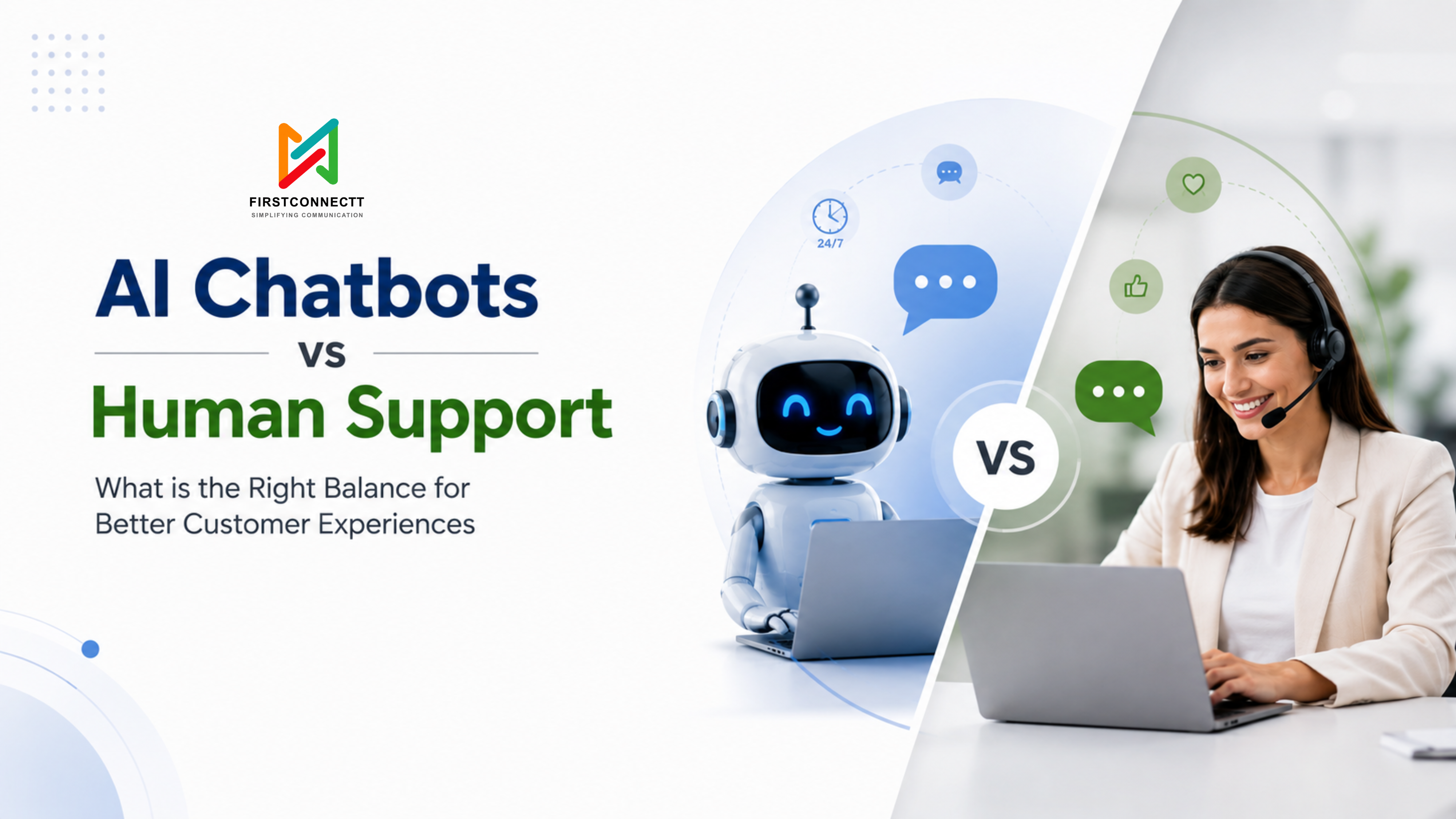
That’s where the debate begins: AI chatbots vs human support.
Some companies rush to automate everything. Others refuse to replace human agents, believing technology can never match empathy and critical thinking. The truth lies somewhere in between. The businesses delivering exceptional customer experiences aren’t choosing one over the other. They’re building a support system where both work together.
Let’s explore how to find that balance.
Customers don’t judge your support based on the technology you use. They judge it by how quickly and effectively their problems get solved.
Imagine ordering a product online. You only need tracking information, so an instant chatbot response feels perfect. But if your package arrives damaged, speaking to someone who understands your frustration becomes much more valuable.
The best customer support strategy depends less on the tool and more on the situation.
The right communication layer makes this balance easier to manage. FirstConnectt helps businesses create connected customer communication experiences across different interaction points.
AI chatbots are intelligent virtual assistants designed to answer questions, guide users, and automate repetitive conversations.
Unlike traditional scripted bots, modern chatbots understand intent, learn from interactions, and can provide contextual responses across multiple channels. These include websites, mobile apps, and messaging platforms.
For businesses handling thousands of customer interactions daily, chatbots dramatically reduce response times.
As automated conversations grow, dependable communication becomes important. FirstConnectt can help businesses support these customer interactions with scalable messaging and communication infrastructure.
Despite rapid advancements in automation, people remain irreplaceable in situations that require judgment, emotional intelligence, or creative problem-solving.
Human agents excel when conversations become complicated.
Examples include:
Customers often remember how a support representative made them feel more than how quickly they received an answer.
| Feature | AI Chatbots | Human Support |
| Availability | 24/7 | Limited by working hours |
| Response Time | Instant | May involve waiting |
| Cost | Lower over time | Higher staffing costs |
| Emotional Understanding | Limited | Excellent |
| Complex Issues | Moderate | Excellent |
| Consistency | Very High | Varies by individual |
| Personalization | Data-driven | Emotion-driven |
| Scalability | Easily scalable | Requires hiring |
Neither option wins every category. That’s exactly why the smartest businesses combine both.
Customers no longer want to wait several minutes for basic information. Chatbots can instantly answer common questions, reducing frustration and improving satisfaction.
Unlike human agents, chatbots never take breaks. Whether it’s midnight or a holiday, customers receive immediate assistance.
Automating repetitive tasks allows businesses to handle higher support volumes without proportionally increasing staffing costs. Support teams can then focus on conversations that truly require human expertise.
Every customer receives the same accurate information, reducing errors caused by inconsistent communication.
Whether supporting 100 customers or 100,000, chatbots can manage growing demand without significant delays.
When customers are frustrated, confused, or disappointed, empathy matters. A well-trained support representative can calm emotions in ways automation cannot.
Certain issues require analyzing multiple factors before offering the right solution. Examples include:
Exceptional service often creates lifelong customers. Human conversations create trust that automated responses rarely achieve on their own.
Trying to replace every human interaction with automation usually frustrates customers. People want options.
One of the biggest chatbot mistakes is trapping customers in endless conversation loops. Customers should always have an easy way to reach a human agent.
A chatbot that gives inaccurate answers creates more work instead of less. Continuous improvement is essential.
Customers don’t want generic responses. Support systems should remember previous interactions, purchase history, and preferences whenever appropriate.
Overall, these challenges become harder as customer conversations increase. With FirstConnectt, businesses can build a more structured communication layer without losing sight of the customer experience.
Instead of asking whether chatbots should replace humans, successful organizations ask a different question: Which conversations should automation handle, and which require people? A hybrid support model typically works like this:
The chatbot greets customers, identifies their issue, and gathers essential information.
Routine tasks are completed immediately without human intervention. Examples include:
If the issue requires empathy, judgment, or negotiation, the chatbot transfers the conversation along with all collected context. Customers don’t have to repeat themselves. This creates a much smoother experience.
All in all, a hybrid model works best when communication flows smoothly between automated and human interactions. FirstConnectt helps businesses support connected messaging journeys across these different touchpoints.
Consider an airline.
A traveler wants to know whether their flight is delayed.
The chatbot checks live flight status and responds instantly.
Later, the same traveler misses a connection because of the delay.
Now the conversation changes.
The customer needs alternative flights, hotel arrangements, and reassurance.
This situation calls for a skilled support representative.
Automation solved the simple request.
Humans solved the emotional one.
Together, they created a better experience.
Identify which requests are repetitive and which require human expertise. Avoid overlap that confuses customers.
Customers should never have to restart the conversation after escalation. Transfer chat history automatically.
Analyze failed conversations. Update responses regularly based on customer behavior and feedback.
Track metrics such as:
These insights help refine the balance between automation and human support.
Some customers prefer self-service. Others want to speak with someone immediately. Providing both options improves overall satisfaction.
You may benefit from expanding chatbot capabilities if:
Human support deserves greater investment if:
Customer support is becoming increasingly collaborative rather than fully automated. Businesses are using intelligent assistants to support agents behind the scenes by:
Instead of replacing support professionals, technology is helping them resolve issues faster and deliver better experiences.
Not entirely. Chatbots excel at speed, availability, and handling repetitive tasks, while human agents are better at solving complex problems and providing empathy.
Escalation should occur when conversations involve complaints, emotional situations, payment disputes, technical issues, or repeated unsuccessful responses.
Yes. Even small businesses can automate FAQs, appointment scheduling, lead capture, and basic customer inquiries, allowing owners to focus on higher-value work.
Support roles are evolving rather than disappearing. Human agents remain essential for situations requiring critical thinking, relationship building, and nuanced decision-making.
A hybrid approach that combines chatbot efficiency with human expertise typically delivers the best customer experience while improving operational efficiency.
The future of support will involve both technology and people. FirstConnectt helps businesses strengthen the communication layer that connects automated interactions with meaningful customer conversations.
The question isn’t whether businesses should choose AI chatbots or human support. It’s about knowing when each delivers the greatest value.
Automation provides speed, consistency, and scalability. Human agents contribute empathy, trust, and problem-solving skills. Together, they create a customer support experience that is both efficient and genuinely helpful.
As a result, organizations that thoughtfully combine intelligent automation with human expertise will be better positioned to build stronger relationships, improve satisfaction, and grow sustainably.
Share this article
Article
 Article
 Article
Ready to put these ideas to work? Talk to our team about your communication stack.
Get Started →