
 Article
September 22, 2026
6 min read
 FirstConnectt
Enterprise communication insights
FirstConnectt
Enterprise communication insights
Article · FirstConnectt Insights
Imagine a customer trying to reset their password. Within seconds, he/she receives an OTP via SMS. A few minutes later, they get a WhatsApp notification confirming the password change. The next day, an email welcomes them back with personalized recommendations.
It feels effortless.
Behind these seamless interactions isn’t a massive communication infrastructure built from scratch. It’s CPaaS, one of the fastest-growing technologies helping businesses communicate with customers across multiple channels without the complexity of building telecom systems themselves.
Aside from this, according to industry reports, the global CPaaS market is expected to exceed $100 billion by 2030. This stats is driven by rising demand for digital customer engagement, cloud communications, and AI-powered interactions.
Whether you are a startup sending appointment reminders or a global enterprise handling millions of customer conversations every day, CPaaS makes modern business communication faster, smarter, and remarkably scalable.
In this guide, you’ll learn exactly what CPaaS is, how it works, why businesses are adopting it, and how to choose the right platform for your organization.
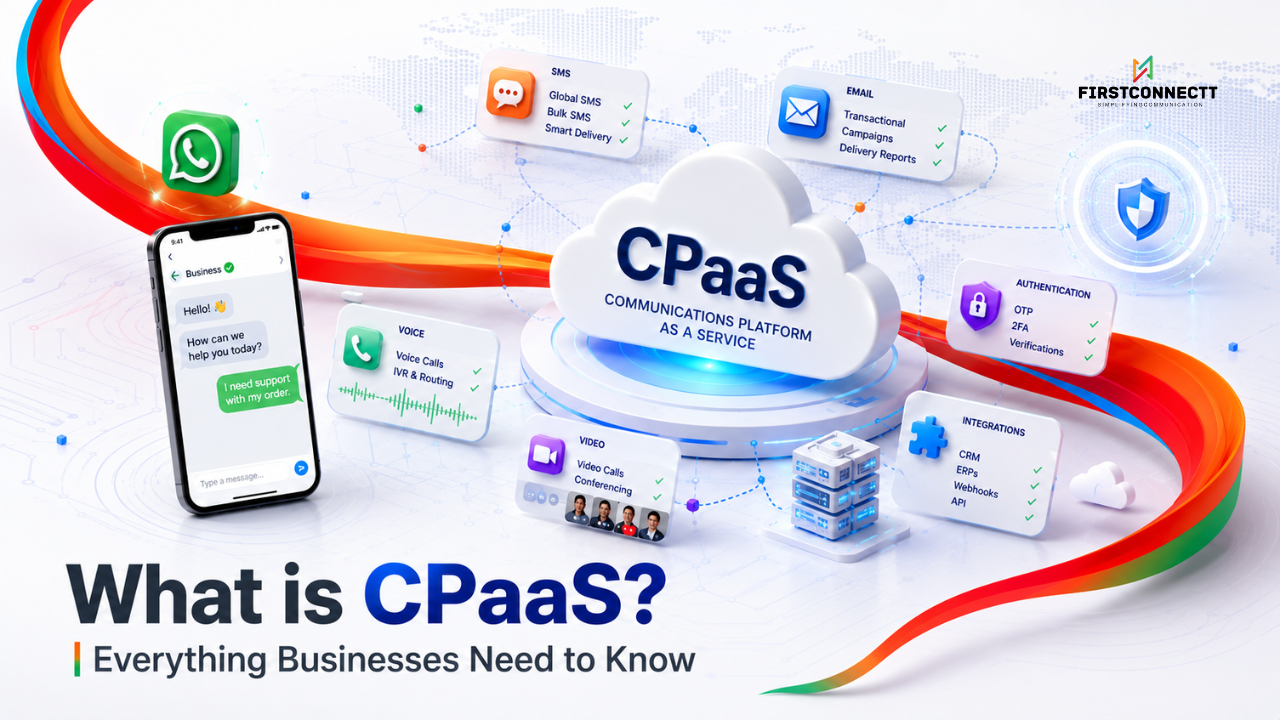
CPaaS, known as Communications Platform as a Service, is a cloud-based platform that allows businesses to add communication features like SMS, voice calls, WhatsApp messaging, email, video, chat, and authentication directly into their websites, mobile apps, and business software through API’s.
Instead of building expensive communication infrastructure from scratch, businesses simply integrate APIs provided by a CPaaS provider.
Think of CPaaS as the communication engine that powers customer interactions behind thousands of digital experiences.
Common communication channels include:
At its core, CPaaS connects your application with global communication networks.
Here’s a simplified workflow:
For example:
A customer places an online order.
Your system automatically:
All of this happens automatically through APIs.
Customer expectations have changed dramatically. In fact, studies show that nearly 73% of consumers prefer messaging businesses over standard communication channels. Also, most customers expect responses within minutes rather than hours.
As a result, people no longer want to wait on hold or repeatedly check their email inbox. They expect businesses to communicate instantly through the channels they already use every day.
That’s exactly where CPaaS excels.
Several factors are driving adoption:
Businesses that communicate faster generally provide better customer experiences.
While features vary by provider, most enterprise-grade CPaaS solutions include the following capabilities.
Send transactional messages, OTPs, delivery alerts, reminders, promotional campaigns, and notifications globally.
Examples:
Enable secure customer conversations on WhatsApp.
Businesses can:
Automate voice communication including:
Useful for industries requiring face-to-face interactions.
Popular use cases include:
Integrate transactional email services for:
Security-focused communication services including:
Enable real-time conversations inside mobile apps and websites.
Ideal for:
Businesses can launch communication features within days instead of months.
No telecom infrastructure is required.
Developers integrate APIs instead of building messaging systems from scratch.
This significantly reduces engineering effort.
Research consistently shows that proactive communication can significantly reduce customer support inquiries while improving overall customer satisfaction and retention.
That means fewer support calls and greater satisfaction.
Whether you’re sending 500 messages or 50 million, cloud infrastructure scales automatically.
Every day, billions of business messages are exchanged globally through SMS, WhatsApp, email, and app notifications, making scalable communication infrastructure a necessity rather than a luxury for modern enterprises.
Reach customers through:
without managing separate vendors.
Automate repetitive communication such as:
Enterprise CPaaS providers offer:
ensuring critical communications reach customers.
Although both improve communication, they serve different purposes.
| Feature | CPaaS | UCaaS |
| Purpose | Embed communication into applications | Business communication platform |
| Users | Developers & businesses | Employees |
| APIs | Yes | Usually No |
| Customization | High | Limited |
| Examples | OTP APIs, WhatsApp API, SMS API | Team calling, video meetings, messaging |
Simply put:
CPaaS powers customer communication.
UCaaS powers employee communication.
Traditional communication systems often require:
CPaaS replaces these with cloud-based APIs that are:
Nearly every industry can benefit, but adoption is especially strong in:
While CPaaS offers significant advantages, businesses should plan carefully to avoid common pitfalls.
Enterprise buyers often evaluate additional factors beyond pricing. This includes message deliverability, carrier relationships, onboarding support, compliance capabilities, and the provider’s ability to scale during peak traffic periods. These considerations can significantly impact customer experience and operational reliability.
Many organizations also underestimate the complexity of integrating communication workflows with existing CRM, ERP, and customer support platforms. Experienced implementation partners like FirstConnectt can help reduce deployment risks and accelerate time-to-value.
For many businesses, selecting a CPaaS provider is not simply a technology decision. It is a customer experience decision. Beyond technical capabilities, organizations should assess how effectively a provider can support implementation, compliance, scalability, and long-term communication strategy.
Sending messages across every available channel can overwhelm customers.
Instead, communicate thoughtfully and based on customer preferences.
To maximize results:
Before selecting a platform, evaluate these factors.
Make your CpaaS provider supports:
Businesses operating across multiple regions should also evaluate routing quality. This involves local carrier partnerships, message delivery performance, and regulatory expertise in each market. These factors often influence reliability more than coverage alone.
Well-documented APIs reduce implementation time and improve developer productivity.
Industries such as banking, healthcare, and insurance may require additional compliance considerations. Understanding how a provider handles data security, consent management, and regulatory requirements can help avoid future operational challenges.
Robust dashboards help track:
Understand:
Trustworthy technical support from FirstConnectt can make a significant difference during implementation and scaling. The offerings include dedicated onboarding assistance, solution consulting, and proactive support to help optimize communication performance over time. And enterprise organizations often prioritize that!
CPaaS is evolving rapidly.
Businesses are increasingly combining communication APIs with artificial intelligence, automation, analytics, and customer data platforms to create richer, more personalized customer experiences.
Industry data confirms that AI-powered customer interactions are rapidly expanding. The global enterprise conversational AI market is projected to grow from about $15.5 billion in 2026 to nearly $50 billion by 2030, with a CAGR above 30%. AI-driven customer service is expected to reduce contact center labor costs by $80 billion by 2026. This shows how central automation and conversational platforms are becoming.
Emerging trends include:
As expectations of customers rise, businesses that treat communication as a strategic advantage will be better positioned to build stronger relationships and drive long-term growth.
The organizations that stand out won’t simply send more messages. They’ll send the right message, on the right channel, at the right moment. Achieving that consistently requires more than APIs alone. It requires thoughtful channel selection, reliable delivery infrastructure, compliance awareness, and a communication strategy aligned with customer expectations. These are often the factors that separate successful CPaaS implementations from unsuccessful ones.
Looking to build a communication strategy that scales with your business? Connect with FirstConnectt to explore what’s possible.
CPaaS is short for Communications Platform as a Service. It is a cloud-based platform that enables businesses to integrate messaging, voice, video, email, and authentication capabilities into their applications using APIs.
SaaS provides ready-to-use software applications. In contrast, CPaaS provides APIs and communication tools that developers integrate into their own applications.
No. CPaaS works for businesses of all sizes. From startups to multinational organizations, every business can use CPaaS to automate customer communication and improve engagement.
Yes. Many CPaaS providers offer integration with the WhatsApp Business API, enabling businesses to send notifications, automate conversations, and provide customer support.
Leading CPaaS providers implement encryption, authentication, compliance standards, and fraud prevention measures to help protect customer communications.
Retail, banking, healthcare, logistics, education, travel, insurance, and SaaS companies are among the largest adopters due to their need for timely and scalable customer communication.
Share this article
Article
 Article
 Article
Ready to put these ideas to work? Talk to our team about your communication stack.
Get Started →