
 Article
September 22, 2026
6 min read
 FirstConnectt
Enterprise communication insights
FirstConnectt
Enterprise communication insights
Article · FirstConnectt Insights
Want to turn WhatsApp into a scalable customer communication channel instead of just another messaging app? This guide explains everything enterprises need to know about the WhatsApp Business API in 2026, from features and pricing to implementation, automation, security, compliance, and best practices.
The Through Guide to WhatsApp Business API for Enterprises (2026 Edition)
A customer places an order on your website.
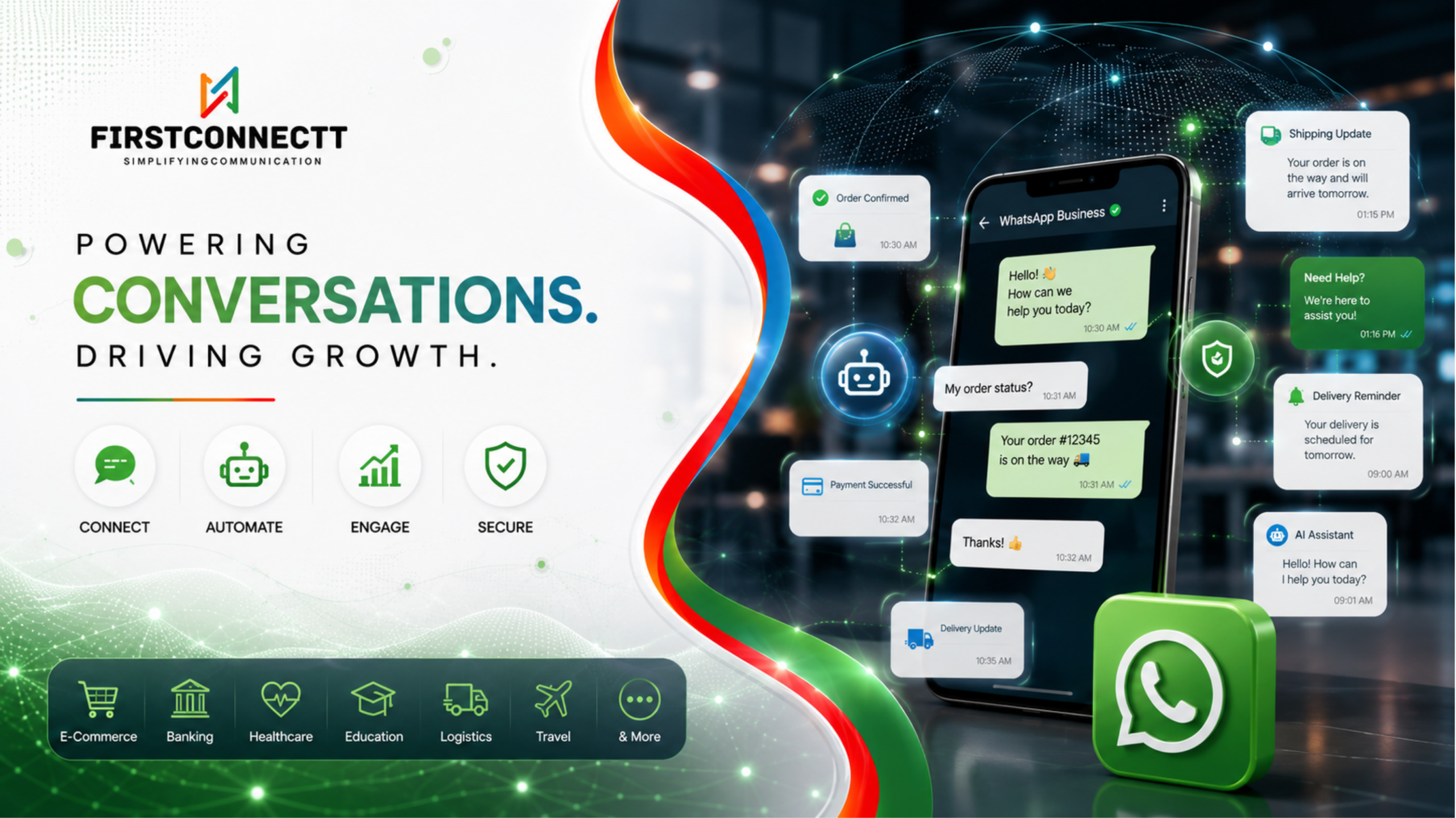
Within seconds, they receive an order confirmation on WhatsApp.
A few hours later, they get a shipping update.
The next day, a delivery reminder arrives.
If they have a question, an AI chatbot answers instantly. If the issue becomes complex, the conversation moves seamlessly to a human support agent without asking the customer to repeat anything.
This isn’t the future.
It’s how leading enterprises are already using the WhatsApp Business API to build faster, more personal, and more efficient customer experiences.
With more than two billion users worldwide and exceptionally high message engagement, WhatsApp has become the backbone of trusted business communication. In 2026, it is no longer just another customer support tool. It has evolved into a strategic platform for sales, marketing, customer service, authentication, and customer retention.
This guide explores everything enterprises need to know about the WhatsApp Business API. This includes how it works, why it matters, and implementation strategies. Also, we will cover pricing, automation, security, and best practices.
The WhatsApp Business API is an enterprise-grade messaging solution. It is designed for medium and large businesses that need to communicate with customers at scale.
Unlike the WhatsApp Business App, which is intended for small businesses managing conversations manually, the API allows organizations to integrate WhatsApp directly into their CRM, ERP, customer support platform, marketing automation tools, and business workflows.
This enables enterprises to:
The API itself has no user interface. Businesses access it through a WhatsApp Business Solution Provider (BSP) or integrate directly using Meta’s Cloud API.
| Feature | Business App | WhatsApp Business API |
| Best For | Small businesses | Medium & Enterprise organizations |
| Multi-Agent Support | Limited | Yes |
| CRM Integration | No | Yes |
| Automation | Basic | Advanced |
| Chatbots | Limited | Full AI Integration |
| Bulk Notifications | No | Yes |
| Scalability | Low | Enterprise Grade |
| Analytics | Basic | Advanced |
| API Access | No | Yes |
If your company handles hundreds or thousands of customer conversations daily, the API is the clear choice.
Customers expect instant responses.
They also expect businesses to remember previous conversations, personalize interactions, and be available across multiple touchpoints.
The WhatsApp Business API helps enterprises meet these expectations.
Compared with email and SMS, WhatsApp messages typically receive significantly higher response rates.
This means important updates are more likely to be seen and acted upon.
The API connects with client databases. This allows businesses to personalize every interaction using:
Personalization builds trust and increases conversion rates.
Customers no longer want to wait on hold.
Businesses can answer common questions instantly while escalating complex cases to human agents. This will be achievable using AI chatbots and intelligent routing.
The API is not just for support.
Sales teams use it to:
Automation reduces repetitive manual work.
Employees spend less time answering routine questions and more time solving complex customer issues.
Multiple support representatives can manage conversations simultaneously from one business number.
Businesses can automate:
Send much more than plain text. Supported formats include:
Modern AI assistants can:
Connect WhatsApp with:
This creates a unified customer profile across channels.
The API supports secure authentication workflows, including:
Nearly every industry benefits from conversational messaging.
The communication flow is simple.
Customer → WhatsApp → Business Platform → CRM → Agent or Chatbot → Customer
Behind the scenes, APIs connect customer data, automation engines, and support platforms to create a seamless conversation.
Pricing has evolved significantly over recent years. Costs generally depend on:
Common conversation categories include:
Enterprises should evaluate total ownership costs, including infrastructure, chatbot development, CRM integrations, and ongoing platform fees.
Resolve issues without requiring customers to call support centers.
Automatically notify customers about:
Perfect for:
Ask qualifying questions before routing prospects to sales teams.
With customer consent, businesses can:
Customers appreciate quick, convenient conversations.
Faster responses often translate into higher sales.
Automation handles repetitive inquiries efficiently.
Communicate with customers across countries using one familiar platform.
Integrate WhatsApp with:
No enterprise platform is without challenges.
Some organizations encounter:
Legacy systems may require custom development.
Businesses must obtain customer consent before sending promotional messages.
Pre-approved message templates are required for many outbound communications.
Without proper routing, large volumes of chats can overwhelm support teams.
Map every touchpoint before implementation.
Technology should support the customer experience, not dictate it.
People use WhatsApp for quick conversations.
Avoid lengthy paragraphs whenever possible.
Generic broadcasts perform poorly.
Use customer data responsibly to create relevant, timely messages.
Automation should accelerate service, not replace empathy.
The best customer experiences blend intelligent chatbots with skilled human agents.
Track key performance indicators such as:
Optimization should be continuous.
Think in terms of customer journeys rather than isolated notifications.
Buttons, quick replies, and list messages reduce friction and increase engagement.
Reserve human agents for conversations that require judgment or empathy.
The greater the integration between WhatsApp and your CRM, ERP, payment systems, and support platform, the more valuable your customer conversations become.
Experiment with message timing, templates, call-to-action buttons, and automation flows to improve engagement and conversion over time.
The platform continues to evolve rapidly.
Enterprise communication is moving toward:
Organizations that invest early will be better positioned to boost customer expectations without slowing down operations.
The API itself does not operate like the free WhatsApp Business App. Businesses typically incur costs based on message categories, usage, and the services provided by their chosen Business Solution Provider.
Yes, although many small businesses find the WhatsApp Business App sufficient until their communication needs become more complex.
Yes, businesses can send approved marketing and utility messages at scale. They follow WhatsApp’s policies and obtain customer consent.
Yes. It integrates with AI-powered chatbots, automation platforms, and conversational workflows to provide instant support and lead qualification.
Yes. Messages are protected using end-to-end encryption where applicable, and enterprises can implement additional security measures such as user authentication, access controls, and compliance processes.
Execution timelines for the WhatsApp API vary based on business complexity, integrations, and approval processes. A basic setup may take a few days. In contrast, enterprise deployments involving CRM, ERP, and chatbot integrations can take several weeks.
From isolated interactions to continuous conversations, the way customers communicate has shifted.
The WhatsApp Business API empowers enterprises to meet customers where they already spend their time. This includes delivering personalized experiences that are fast, secure, and scalable. The API serves as a powerful foundation for modern business communication.
Success, however, depends on more than simply adopting the technology. The organizations that see the greatest return are those that combine thoughtful customer journey design, intelligent automation, robust integrations, and ongoing optimization. As we enter the second half of 2026, customer expectations continue to rise; businesses that invest in conversational experiences today will be better equipped to build trust, improve efficiency, and create lasting competitive advantage.
Share this article
Article
 Article
 Article
Ready to put these ideas to work? Talk to our team about your communication stack.
Get Started →