
 Article
October 21, 2026
7 min read
 FirstConnectt
Enterprise communication insights
Article · FirstConnectt Insights
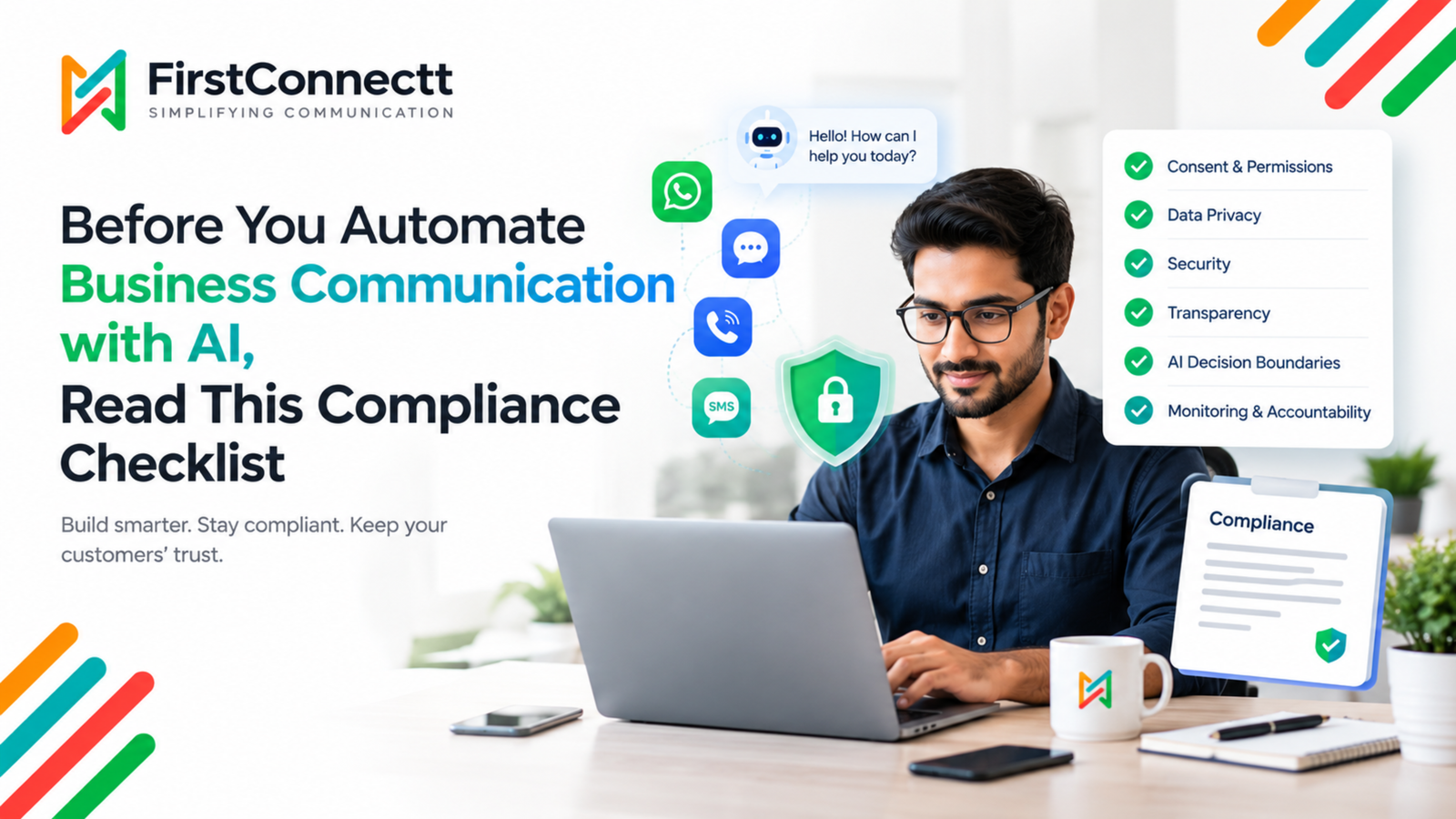
AI Can Automate Communication, but Can Your Business Do It Responsibly?
A company launches an AI voice assistant to answer calls and send reminders. It works fast, and customers notice. But nobody has decided how consent is recorded, what customer data the system can see, or when a person should step in. Business communication with AI compliance answers those questions before launch, not after a problem. Speed means little without clear rules.
Here’s a practical checklist to review before automating anything.
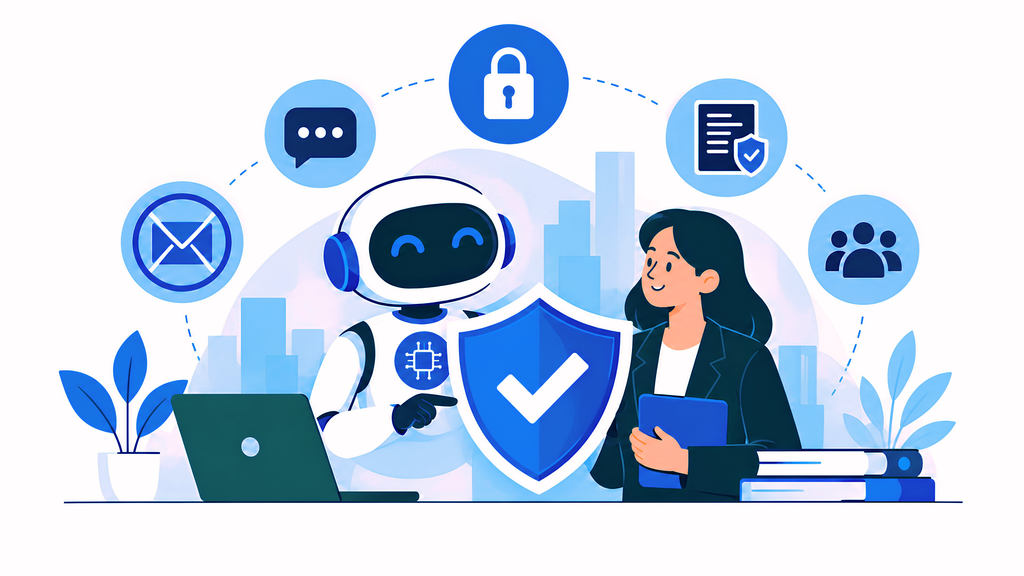
AI now handles automated calls, chatbots, WhatsApp chats, SMS flows, and customer support. That speed brings risk. Poorly governed automation can send promotions without the right consent, expose sensitive details in AI replies, and give wrong or misleading answers. It can also keep personal data longer than needed, take actions nobody approved, or fail to pass sensitive cases to a person.
Because automated customer communication works at scale, one mistake can reach thousands of customers in minutes. Compliance should be part of workflow design, not a final review after launch.
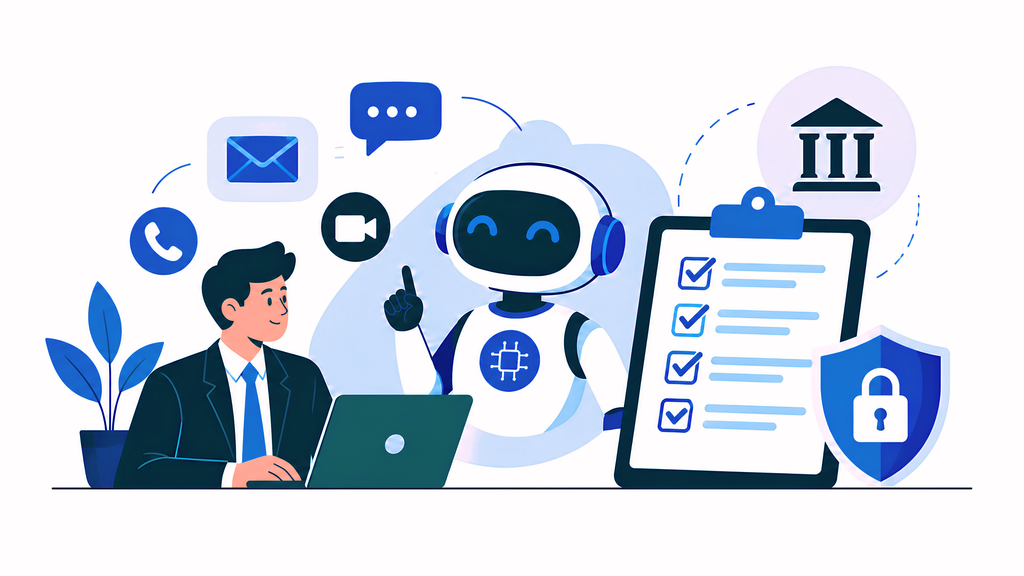
Six checks cover most of what a business should settle before going live.
Before launch, confirm you have permission for the message, the channel, and the purpose. Know whether each message is transactional, service-related, or promotional. Keep records of consent and preferences, and give customers a clear way to opt out.
Respect do-not-disturb preferences and channel rules for automated calls, SMS, and WhatsApp. Consent for one purpose or channel isn’t permission for everything. Strong customer consent management ties these records to each customer.
AI systems may handle names, contact details, transaction history, and support chats. Collect only what each workflow needs. Define how data is accessed, processed, and kept, and set deletion and retention steps.
Review what vendors and AI providers do with the data, and decide how customers can use their privacy rights. Indian businesses should check the Digital Personal Data Protection Act, 2023, and its Rules. Provisions start on different dates, so don’t assume one date fits everything. This is the core of AI data privacy.
Compliance needs real security controls. Limit data access by job role. Use encryption and secure integrations, and protect API keys and tokens. Check the security practices of every AI and communication vendor, and prepare an incident response plan before you need one.
Keep sensitive details out of AI prompts, logs, and automated summaries unless they’re truly needed. Good data protection in AI starts with limiting what the system can see.
Customers shouldn’t be misled about who or what they’re talking to. Decide when to tell them it’s an AI system. Don’t present AI statements as verified human decisions. Make sure messages identify your business and give customers an easy route to a person.
Exact disclosure rules depend on the law, the industry, and the channel, so check them. This matters most for AI voice calling compliance, where customers may assume a human is on the line.
AI should work inside defined permissions. Specify which questions it can answer alone, and limit record access by task. Require proper authorisation for important actions, set escalation rules for complaints and disputes, and test how the system behaves when information is missing.
For example, an assistant can explain how to check an order status. Changing account ownership or approving a payment needs proper verification and authorisation. These limits are the heart of AI governance for businesses.
Plan how to catch errors after launch. Review interaction logs and track complaints, wrong answers, and escalation rates. Document the system’s purpose, limits, and approved workflows.
Assign someone to review and update AI behaviour, and know how to pause an unsafe workflow. Compliance is an ongoing process, not a one-time approval.
Requirements differ by business, purpose, channel, and data type. Check current official sources and get legal advice before launch. These areas usually need review.
The DPDP Rules were notified in November 2025 and roll out in phases over about 18 months, with consent manager provisions starting in November 2026. Penalties can reach ₹250 crore for failing to keep reasonable security safeguards, and ₹200 crore for failing to notify a data breach.
The Telecom Commercial Communications Customer Preference Regulations of 2018 were amended in February 2025. They cover sender registration, templates, consent, and opt-outs for commercial SMS and calls.
Banking, healthcare, and insurance may carry added duties.
WhatsApp Business sets its own rules for templates and permitted use.
Vendor agreements and data-processing terms also shape how AI communication can be deployed. Business communication compliance usually spans all of these at once.
Treating marketing consent as consent for every purpose is a frequent slip. So is sending personal information in business communications to AI systems without reviewing how that data is handled. Some businesses let AI answer questions beyond its verified knowledge, or launch automation with no clear human escalation. Others assume a vendor’s compliance claims remove their own responsibility.
Here’s a simple example. A reminder system keeps contacting a customer after an opt-out request. That creates a poor experience and a possible compliance issue. Responsibility should be clearly shared between the business, its communication provider, and other technology vendors.
Follow five steps.
Step 1: Map the customer journey and mark where AI will communicate.
Step 2: Classify the data, permissions, and requirements for each workflow.
Step 3: Define approved AI actions, escalation conditions, and human responsibilities.
Step 4: Test normal cases, edge cases, opt-outs, and failures before launch.
Step 5: Monitor performance, review incidents, and update the workflow regularly.
Start with one limited use case before expanding across channels or departments. AI communication compliance works best when it’s built into the workflow from the start.
CPaaS provides the infrastructure that connects AI workflows with SMS, voice, WhatsApp, RCS, and business systems. Depending on the platform’s features and setup, it can support coordinated communication, workflow controls, and operational visibility.
But CPaaS compliance isn’t automatic. A platform doesn’t make every AI workflow compliant by itself. Businesses still need consent management, data governance, security controls, and human oversight.
FirstConnectt is a communication infrastructure partner for enterprise communication across A2P messaging, WhatsApp Business API, RCS, voice, Conversational AI, and Agentic AI. Connected capabilities help businesses design coordinated business communication with AI journeys, while compliance needs and safeguards must still be addressed within each implementation.
Planning to introduce AI into your customer communication? Explore how FirstConnectt can support your communication infrastructure strategy.
Business communication with AI can be faster, but speed isn’t the goal on its own. Consent, privacy, security, transparency, human oversight, and steady monitoring all need clear rules before launch. Strong AI communication compliance means every automated message is appropriate, secure, and in line with customer expectations, not just high in volume. Regulations change, so review current official requirements and take legal advice for your situation. FirstConnectt helps businesses connect messaging, voice, and AI through CPaaS infrastructure, supporting communication that is coordinated and well controlled. Automate with clear rules, and every conversation stays worth trusting.
It means making sure AI-powered messages and calls follow applicable laws, customer consent, privacy rules, security standards, and internal controls.
The Digital Personal Data Protection Act, 2023, and its Rules are central. Provisions start in phases, so check current official notifications.
It depends on the purpose, call type, and applicable rules. Promotional contact usually needs stricter consent and opt-out handling than service messages.
Limit access by role, collect only needed data, use encryption, vet vendors, and keep sensitive details out of prompts and logs.
No. CPaaS can support connected workflows and controls, but businesses remain responsible for consent, data governance, and oversight.
Share this article
Article
 Article
 Article
Ready to put these ideas to work? Talk to our team about your communication stack.
Get Started →