
 Article
October 3, 2026
7 min read
 FirstConnectt
Enterprise communication insights
FirstConnectt
Enterprise communication insights
Article · FirstConnectt Insights
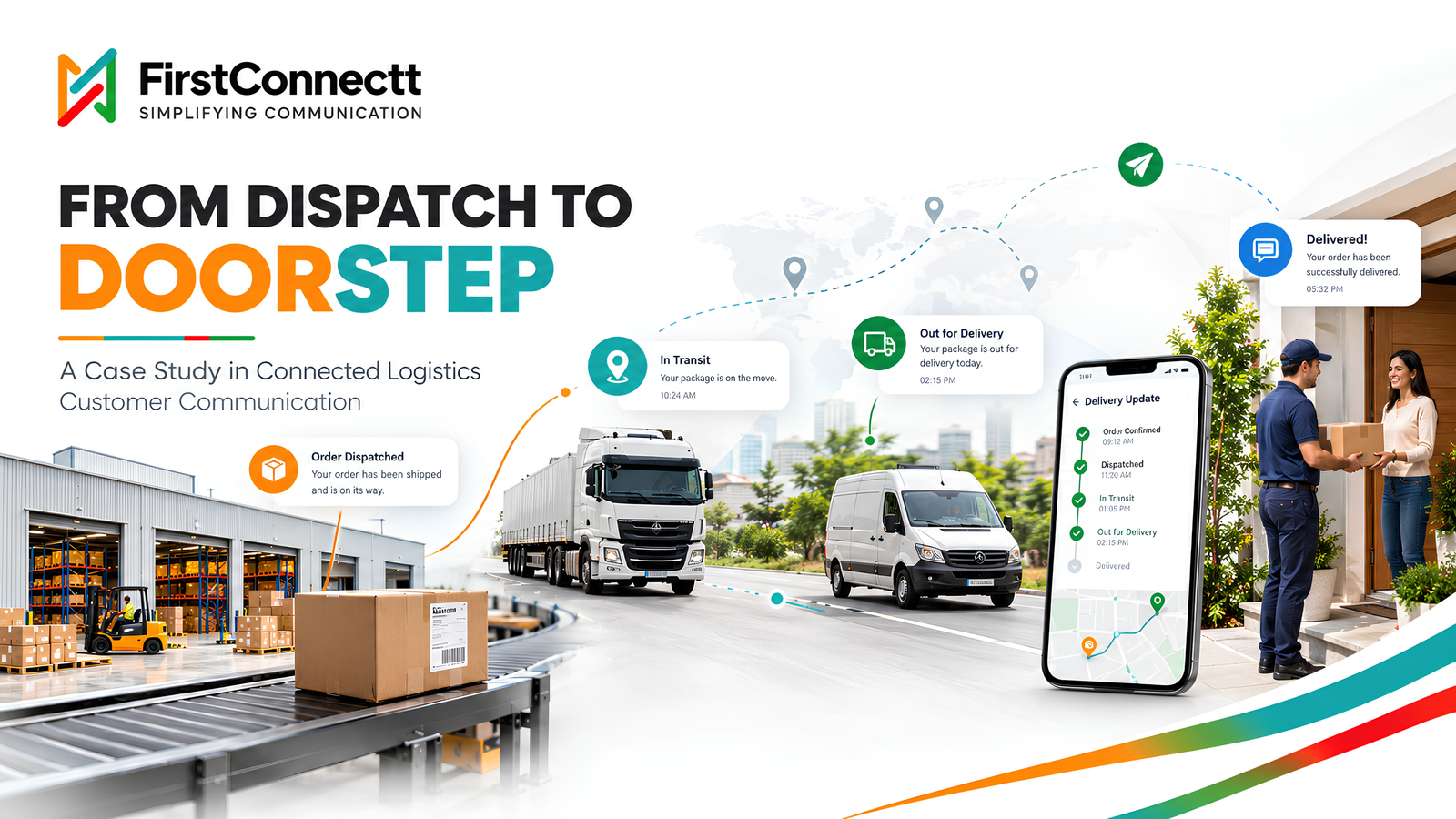
The Package Is Moving, But Is the Customer Informed?
A customer places an order. It gets confirmed, dispatched, and moved between facilities before reaching their city. From the warehouse’s perspective, everything is on track. The customer, meanwhile, is left wondering where the package actually is. Logistics customer communication is what closes that gap between a package physically moving and a customer actually knowing what’s happening.
Here’s a walk-through of what that connected journey can look like, from dispatch to doorstep.
Imagine a growing e-commerce logistics partner handling thousands of deliveries every single day. The company already runs shipment tracking, SMS notifications, WhatsApp communication, customer support, delivery agents, and automated workflows.
The catch is that none of these systems are fully connected. A shipment gets delayed, but the customer finds out late. Someone misses a delivery attempt and has to call support. A support agent picks up the call without the latest shipment status in front of them.
The problem here isn’t really a lack of technology. It’s that different parts of the logistics customer communication journey aren’t working together. That’s the gap this case walks through.
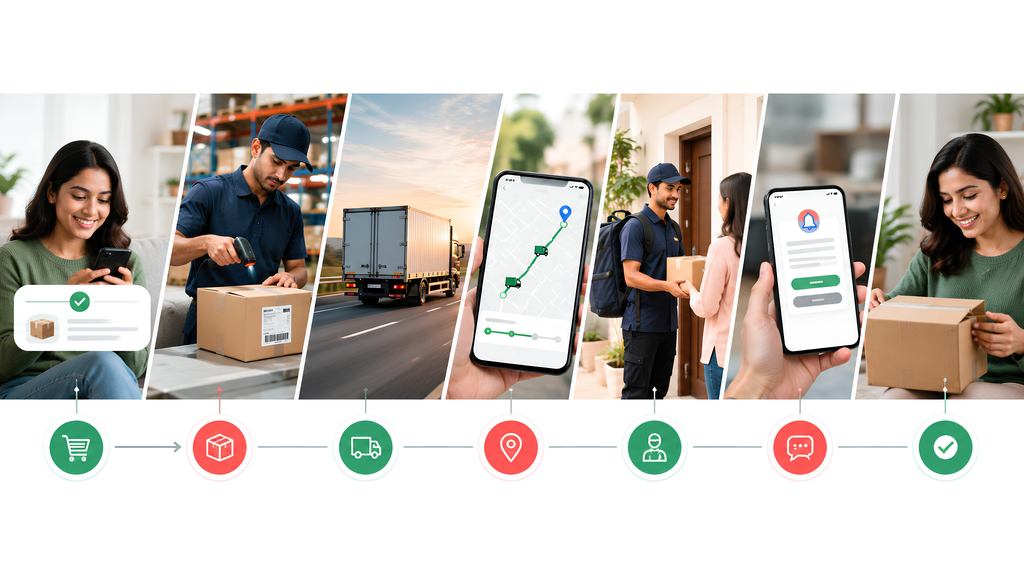
Once an order is placed, customers expect confirmation right away. A good message includes the order confirmation itself, an order ID, basic delivery information, an expected timeline, and tracking information where it’s already available.
This first interaction matters more than it looks. It tells the customer the business has actually received their order and knows what happens next. Communication automation makes this practical at scale: order placed, system receives order, confirmation triggered, customer informed, all without anyone manually sending a message. SMS or WhatsApp both work here, depending on the business’s broader logistics customer communication strategy.
The package gets packed and dispatched. This is where a dispatch notification matters: instead of customers repeatedly checking their order page, the business can proactively say, “Your order has been dispatched and is on its way,” with a tracking link attached.
Delivery notifications should be based on actual logistics events, not a countdown timer. If a package hasn’t actually been dispatched yet, the system shouldn’t send a dispatch message just because enough time has passed. This is where communication infrastructure connects internal business systems directly with customer-facing channels.
Good logistics customer communication is event-driven, not simply message-driven.
The package is now moving between facilities. The customer doesn’t need every internal logistics event, just enough to understand the delivery: dispatched, in transit, reached local facility, out for delivery.
WhatsApp can carry richer interactions here, including tracking links, delivery information, support options, and written instructions, while SMS handles concise, important alerts well. The goal isn’t more messages. It’s the right information at the right stage.
When customers already know what’s happening, they have far less reason to keep searching for updates or calling support to ask.
The package is finally out for delivery. This notification differs from earlier tracking updates because it may actually require something from the customer: being available, sharing delivery instructions, preparing for cash-on-delivery payment, or coordinating directly with the delivery agent.
A simple message, “Your order is out for delivery and is expected today,” gives useful context on its own. WhatsApp or other connected channels can make this more useful still, offering a direct path to support if the customer needs help right at that moment, rather than a dead-end notification.
The delivery agent arrives. Nobody’s home. Without connected communication, this usually plays out as: failed delivery, customer finds out later, customer calls support, support checks the shipment, a rescheduling request gets made, then a new attempt happens. Each step adds friction.
A connected approach looks different: delivery attempt, customer notified immediately, rescheduling option offered, new preference captured, delivery workflow updated, confirmation sent. Messaging handles the simple version of this exchange well, while voice fits better when the situation needs a more conversational back-and-forth.
This is a clear example of SMS, WhatsApp, and voice working together, not as separate, disconnected channels.
Say the shipment gets delayed by an operational issue. The logistics company probably can’t prevent that delay, but it can control how it gets communicated.
Without proactive communication: the customer waits, the expected time passes, they contact support, frustration builds. With connected communication: delay detected, customer notified, updated timeline shared, support available if needed.
Industry research on delivery communication has found that proactive updates can reduce customer complaints by around 40% and raise satisfaction by roughly 85%. Technology doesn’t eliminate logistics problems. It helps businesses communicate those problems more clearly, while they still get solved.
Now say a customer has an actual problem: the package is delayed, damaged, or delivered to the wrong address. They start on WhatsApp. Automation collects the basic details. A straightforward issue gets an automated response right there.
Anything that needs a real conversation moves to Voice AI or a human representative. The important part is continuity: the customer shouldn’t have to repeat their order number, shipment status, or problem description more than once.
The flow looks like: WhatsApp, automation, voice or human support, resolution, follow-up message. This is why connected communication beats simply having more channels.
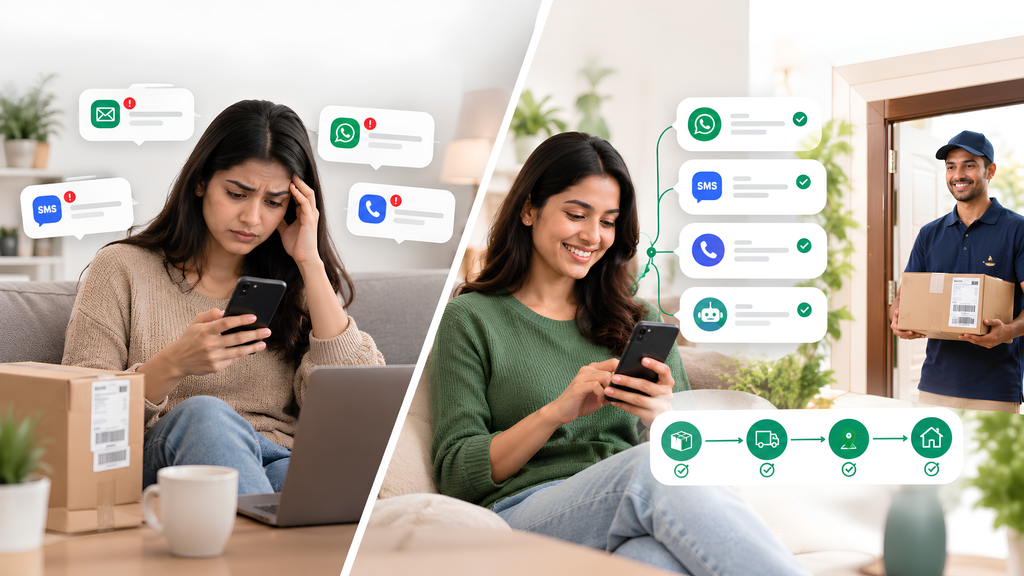
Before connecting the journey, the picture looked like this: disconnected channels, delayed updates, manual coordination, repeated customer questions, limited visibility across interactions, and more pressure landing on support teams.
After connecting it: event-based delivery notifications, SMS and WhatsApp working from the same data, easier rescheduling, voice support for conversational needs, better continuity between channels, and more structured communication workflows overall.
The real shift here is in the process, not a single headline number. Logistics customer communication changes how reliably information moves, not just how much of it gets sent.
Communications Platform as a Service (CPaaS) provides the infrastructure connecting messaging, voice, APIs, automation, and business systems. For a logistics business, the architecture might look like: logistics platform, CPaaS, SMS/WhatsApp/voice, customer.
When a shipment status changes, the relevant communication workflow triggers automatically. When a customer responds, that reply becomes part of the next step in the journey, rather than sitting in a separate inbox somewhere. This lets communication become part of the logistics workflow itself, instead of operating off to the side.
A trustworthy CPaaS partner like FirstConnectt helps businesses connect messaging, voice, automation, and AI through a scalable CPaaS ecosystem. This enables communication journeys that actually move with the customer, not just alongside them.
The same approach applies to any logistics business, not just this example.
Map every customer touchpoint – Identify where customers need information from dispatch to delivery.
Connect shipment events with communication – Use actual order and delivery events to trigger relevant updates.
Match channels to customer needs – SMS for concise alerts, WhatsApp for richer interactions, voice for conversational support.
Build clear escalation paths – Know exactly when automation should hand off to a human.
Keep customer context connected – Customers shouldn’t repeat information when moving between channels.
Monitor communication – Track failed messages, responses, support requests, and workflow gaps.
The package started at a warehouse. It got dispatched, tracked, moved between facilities, reached the local network, went out for delivery, and finally arrived at the door. But another journey ran alongside it the whole time: the logistics customer communication journey. Every notification, tracking update, rescheduling interaction, support conversation, and confirmation shaped how the customer actually experienced it. The goal was never more notifications. It’s about making logistics customer communication timely, relevant, connected, and genuinely useful. FirstConnectt helps businesses build these connected journeys through messaging, voice, automation, and AI, backed by scalable CPaaS infrastructure. The package reaches the doorstep either way. Communication decides how that feels.
It includes shipment updates, delivery notifications, tracking, rescheduling, and support throughout the delivery journey.
By connecting shipment events to communication workflows, triggering timely SMS or WhatsApp updates based on real delivery stages.
It supports shipment updates, tracking links, customer responses, delivery coordination, rescheduling, and richer two-way support.
It handles routine conversational interactions, with complex issues transferred to human representatives.
CPaaS connects communication channels with business systems through APIs, enabling automated, connected workflows.
Share this article
Article
 Article
 Article
Ready to put these ideas to work? Talk to our team about your communication stack.
Get Started →