
 Article
October 6, 2026
7 min read
 FirstConnectt
Enterprise communication insights
FirstConnectt
Enterprise communication insights
Article · FirstConnectt Insights
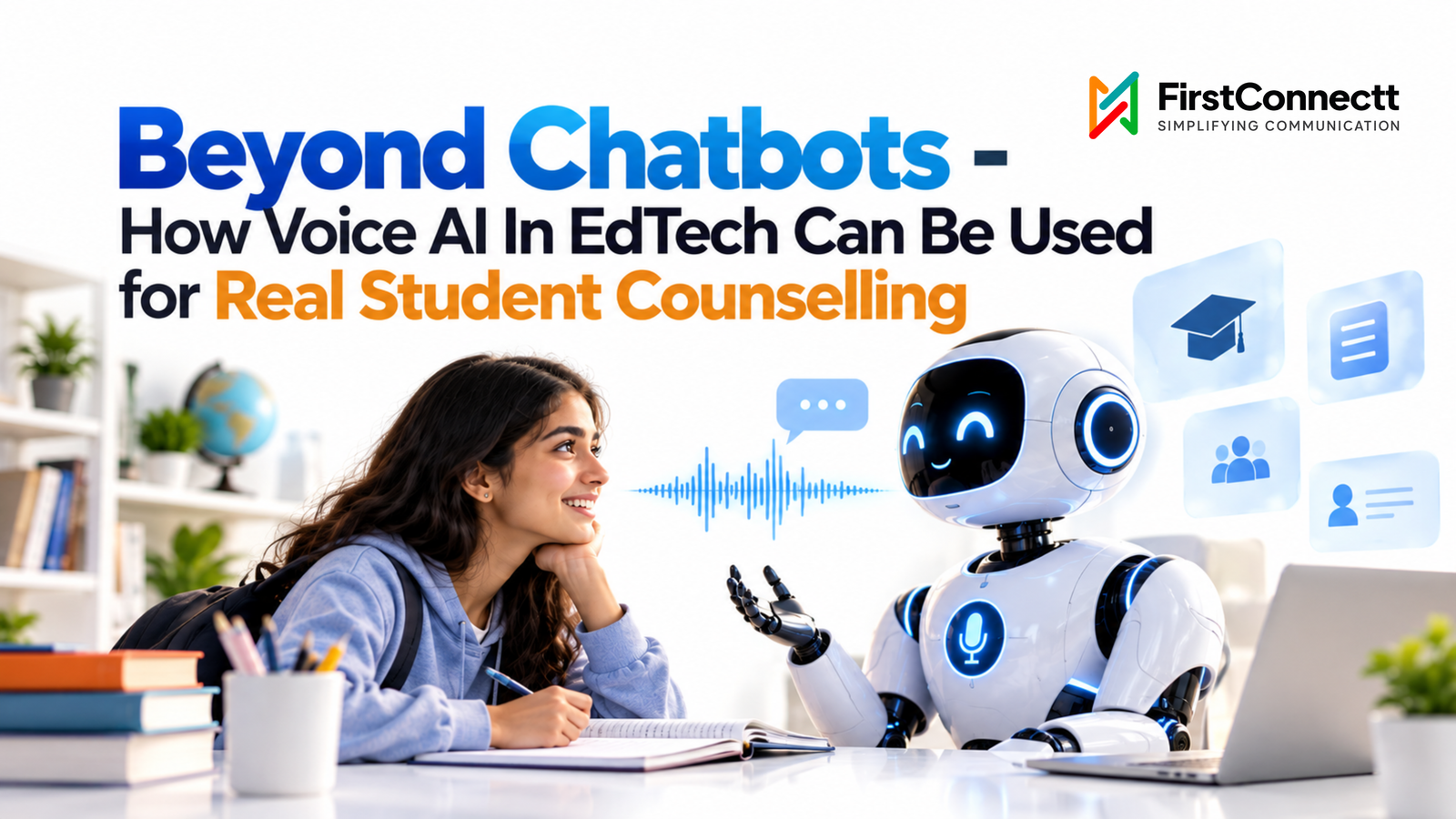
The education industry is changing rapidly. The reason? Students increasingly depend on digital platforms to explore courses, compare institutions, and make important academic decisions. For EdTech companies, providing timely and personalised guidance has become essential. However, managing thousands of enquiries while maintaining meaningful conversations with every student can be challenging.
Traditional chatbots help answer frequently asked questions, share course details, and collect student information. Yet students often need more than automated text responses. They want to discuss academic interests, understand admission requirements, explore career opportunities, and clarify doubts through natural conversations.
This is where Voice AI in EdTech is creating new possibilities. By combining artificial intelligence with voice communication, educational institutions can make counselling more accessible, responsive, and personalized.
FirstConectt helps businesses explore connected communication and automation solutions that can support these evolving student engagement needs.

Choosing an educational course involves several considerations. This includes fees, eligibility, scholarships, teaching methods, and future career opportunities. Students and parents often have questions that require accurate and timely answers.
During admission seasons, colleges, universities, and online learning platforms receive enquiries through websites, advertisements, telephone calls, and messaging applications. Managing these enquiries manually can create considerable pressure on counselling teams.
Delayed responses are a common challenge. Students who submit enquiries may have to wait for counsellors to become available. Repetitive questions about course duration, eligibility, and application deadlines also consume valuable time.
Limited availability creates additional difficulties. Students enquiring during evenings, weekends, or admission rush periods may not receive immediate assistance.
Language differences can further affect accessibility. Students from different regions may prefer discussing educational opportunities in familiar languages rather than navigating English-only communication systems.
Educational institutions therefore need communication systems that combine efficiency with personal attention. Voice AI in EdTech can help address routine enquiries while allowing human counsellors to remain involved in important academic decisions.
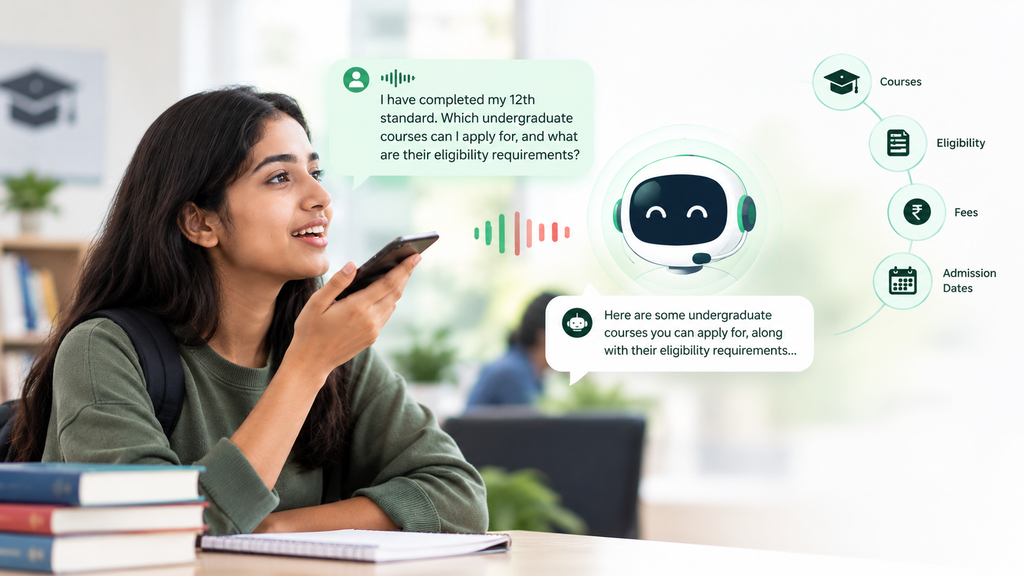
Voice AI in EdTech refers to technology that enables computer systems to understand spoken language, interpret questions, and respond through natural conversations.
Unlike traditional interactive voice response systems that require callers to select options using their telephone keypad, modern voice assistants can recognise speech and respond according to conversational context.For example, a student might ask, “I have completed my 12th standard. Which undergraduate courses can I apply for, and what are their eligibility requirements?”
An AI voice bot can interpret the question, retrieve relevant information from an institution’s approved knowledge base and explain available options.
The student can then ask a follow-up question about fees or admission deadlines without restarting the conversation.
This development makes conversational AI in education particularly useful for institutions managing large volumes of enquiries. Voice assistants can support incoming calls and permitted follow-up calls to students who have submitted enquiries.
Their effectiveness depends on accurate information, suitable conversation design, reliable infrastructure, and appropriate human supervision.
The real value of an AI voice bot lies in its ability to support conversations instead of simply delivering pre-written answers.
A well-designed system can follow a structured counselling journey while adapting its responses to students’ questions and requirements.
The Voice AI in EdTech starts with a conversation that can begin by asking about educational backgrounds, preferred subjects, course interests, and intended admission timelines.
These responses help establish the context ocv
It can explain application procedures, eligibility requirements, and course details using verified institutional information.
Conversational AI in education can maintain context during an interaction. If a student initially asks about an undergraduate programme and subsequently enquires about its fee structure, the system can connect the follow-up question to that programme.
This reduces repetition and makes communication easier to navigate.
If a student requires detailed guidance, the system can arrange an appointment with an appropriate counsellor and record relevant enquiry information.
For example, a student interested in digital marketing might initially ask about eligibility and later enquire about practical training. The assistant can maintain the conversation’s context and direct the student towards relevant information.
However, automated systems should not make unsupported promises about admissions, placements, or academic success. Personalised decisions must remain supported by qualified professionals.
FirstConnectt’s connected communication approach can help businesses coordinate enquiry handling and follow-ups across their communication workflows.
Voice AI can support students at different stages, from discovering educational opportunities to receiving assistance after enrolment.
When students submit enquiries through educational websites, an AI voice assistant can initiate permitted follow-up calls, introduce the institution, and understand their requirements.
It can collect basic information, answer common questions, and record whether students want further assistance. Counsellors can then receive organised enquiry details instead of beginning every conversation from scratch.
Students may be uncertain about which programmes match their interests. Voice assistants can explain available courses, entry requirements, and learning formats.
They can help students explore options without pressuring them into particular programmes. Complex academic decisions and personalised career guidance should remain supported by qualified professionals.
Missing an application deadline or forgetting to submit a document can interrupt the admission process.
Voice automation can deliver reminders about application steps, entrance examination dates, document submissions, and scheduled counselling appointments.
Institutions should ensure that reminders contain accurate information and respect communication preferences.
The role of conversational AI in education does not end after admission.
Educational platforms can use voice-based assistance to communicate class schedules, assignment deadlines, course updates, and technical support information.
For example, an online learner experiencing difficulty accessing a course may receive basic troubleshooting assistance or be connected to the relevant support team.
This extends automated communication beyond admissions into ongoing student engagement.
India’s education sector serves students from different linguistic and cultural backgrounds. A student may understand a course better when its details are explained in Marathi, Hindi, Tamil, Telugu, Bengali or another familiar language.
Multilingual VoiceAI in EdTech can make initial counselling more accessible by allowing students to communicate in supported languages.
For example, a student from a regional town enquiring about an online degree may prefer speaking in Marathi rather than typing a question in English. A suitably configured voice assistant can recognise the student’s speech and provide information in the supported language.
This can help institutions communicate with students beyond major metropolitan areas and reduce difficulties caused by language preferences.
However, multilingual capabilities must be tested carefully . Regional accents, background noise, mixed-language conversations, and specialised educational terminology can affect recognition accuracy.
Institutions should review language-specific responses and provide a straightforward option to speak with a human counsellor whenever the system cannot understand a question.
The objective is to make educational information easier to access, not to assume that every student has identical communication preferences.
Students rarely depend on a single communication channel. They may discover a course through social media, ask questions over a telephone call, receive a brochure on WhatsApp, and complete registration through a website.
A connected communication strategy helps educational institutions make these interactions more consistent. Consider a student who submits a form on the institution’s website. A configured AI voice bot follows up and answers basic questions about the programme.
With appropriate consent, the student then receives a WhatsApp message containing the official brochure and application link. If the student has further questions about course suitability, the system can arrange a conversation with a human counsellor.
This approach combines the convenience of spoken communication with the usefulness of written information. Voice calls support interactive discussion, while WhatsApp provides brochures, documents, links, and reminders. SMS and email can provide additional updates where appropriate.
For FirstConnectt, connecting voice and messaging workflows can help educational businesses coordinate communication across different touchpoints. Businesses can explore FirstConnectt’s communication solutions, organised follow-ups, and consistent student engagement.
The key is continuity. Students should not have to repeat their requirements whenever they move between channels. Communication records, consent, and access permissions must be managed appropriately to maintain trust.
Implementing Voice AI in EdTech can create operational benefits while improving the student experience.
Automated systems can acknowledge enquiries without waiting for counsellors to become available. Actual response times depend on system configuration and availability.
Routine questions can be handled through automation, allowing counsellors to focus on complex discussions, individual concerns, and academic guidance.
An assistant connected to an updated knowledge base can provide standardised course information. Regular reviews are essential to prevent outdated details from being shared.
During admission periods, voice automation can support higher enquiry volumes, subject to technical capacity and available telephony infrastructure.
CRM integration can record student preferences, interaction summaries, follow-up requirements, and unresolved questions. These records help counselling teams organise their work and identify communication gaps.
Together, these capabilities help institutions manage student communication more systematically without removing human involvement.
Student counselling should be accessible, responsive and personalised. Voice AI in EdTech offers educational institutions another way to answer routine questions, support multilingual communication, and manage growing enquiry volumes.
When combined with conversational AI in education, connected messaging, and human expertise, voice technology can make student interactions more convenient without sacrificing personal attention.
For educational businesses seeking to improve student communication, FirstConnectt offers an opportunity to explore connected voice and messaging solutions that support coordinated interactions and timely follow-ups.
Connect with FirstConnectt to explore communication automation solutions for your EdTech business and build more connected, accessible and student-focused counselling experiences.
The future of student counselling is not about replacing counsellors with automated conversations. It is about using technology to help students receive timely information and meaningful guidance when they need it.
➢ VoiceAI in EdTech uses artificial intelligence to understand spoken questions and provide relevant responses. It supports admissions, course enquiries, reminders, and student communication.
➢ A chatbot primarily communicates through text, while an AI voice bot supports spoken conversations and can respond to follow-up questions using conversational context.
➢ No, it can assist with routine enquiries, but complex academic decisions, sensitive conversations, and personalised guidance require human involvement.
Share this article
Article
 Article
 Article
Ready to put these ideas to work? Talk to our team about your communication stack.
Get Started →