
 Article
October 6, 2026
7 min read
 FirstConnectt
Enterprise communication insights
FirstConnectt
Enterprise communication insights
Article · FirstConnectt Insights
Customers don’t always want to type. But they don’t want to make a phone call either
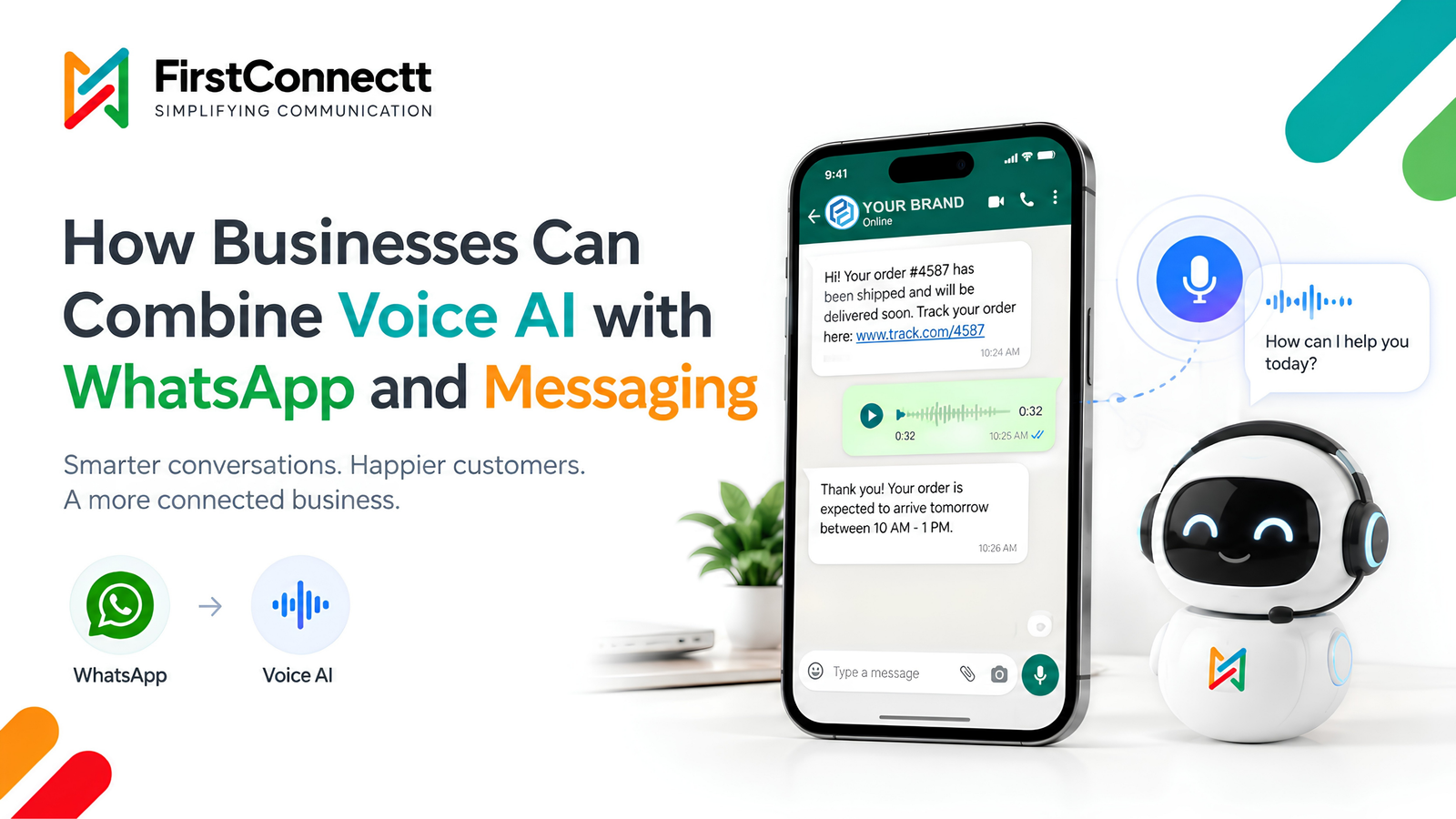
A customer may happily receive an order update on WhatsApp, but when something goes wrong, they may prefer speaking to someone instead of explaining the problem through multiple messages. Businesses today have to manage both expectations: quick digital messaging and convenient conversations.
This is where VoiceAI with WhatsApp can become useful. By connecting voice-based AI with WhatsApp and other messaging channels, businesses can create a customer communication journey that moves between text and voice when needed.
The goal isn’t to make every customer interaction automated. It’s about using the right channel for the right situation and making communication easier for both customers and businesses.
As businesses communicate with customers across multiple channels, simply offering messaging support may not always be enough. Combining messaging platforms like WhatsApp with VoiceAI can help businesses create a more connected communication experience while addressing different customer needs.
WhatsApp is convenient for many everyday interactions. Businesses can send order confirmations, appointment reminders, payment updates, links, documents, and other information through messages.
But some situations are easier to handle through conversation. Imagine a customer receives a message saying that their delivery has been delayed. They may have several questions: Why was it delayed? When will it arrive? Can the delivery date be changed?
Instead of making the customer go through a long text conversation, a VoiceAI system can help handle simple questions through a voice interaction. Once the conversation is complete, the customer can receive the relevant information or confirmation through WhatsApp.
This is one way VoiceAI for businesses can support customer service without making the communication process unnecessarily complicated.
Key takeaway: Messaging is useful for sharing information, while voice can make certain conversations quick and more natural.
The value of WhatsApp and voice integration comes from connecting the two channels instead of treating them as completely separate systems.
Consider a simple appointment example:
A customer receives a WhatsApp message reminding them about an appointment. The business then uses voiceAI to confirm whether the customer will attend. After the confirmation,
WhatsApp sends the appointment details again so the customer has them saved in the chat.
The journey could look like this:
WhatsApp reminder > Voice Confirmation > Information processed > WhatsApp follow-up.
The customer doesn’t have to start the conversation from the beginning every time they change channels.
This approach can also be useful for businesses handling a large number of routine interactions. Modern CPaaS platforms can connect communication channels such as WhatsApp and voice through APIs, helping businesses build communication into their existing applications and workflows.
Key Takeaway: The real value comes from making different communication channels work together
The combination of voice and messaging can be useful across different industries.
Online businesses can use WhatsApp for order confirmations, delivery updates, and tracking information. VoiceAI can assist when customers need quick answers about an order or delivery.
Healthcare providers can use WhatsApp for appointment reminders and information. VoiceAI can help with routine confirmations and reminders, while more sensitive or complicated situations can be directed to staff.
Hotels, travel companies, and other service providers can send booking confirmations and updates through WhatsApp. VoiceAI can assist with basic questions about bookings, timings, or changes.
Educational institutions can use messaging for application updates, reminders, schedules, and other information. VoiceAI can help answer routine questions or guide users through simple processes.
Customer support teams often spend time answering the same basic questions repeatedly. VoiceAI can handle some routine interactions, while WhatsApp can provide links, written instructions, or follow-up information.
These are practical examples of WhatsApp automation helping businesses manage repetitive communication while keeping customers informed.
Key Takeaway: Voice and messaging can support customer journeys across industries, from order updates to appointment reminders.
Automation is useful, but businesses should be careful about where they use it. A customer asking a simple question may not need a human employee. An automated system can provide the answer quickly. But a customer dealing with a complicated complaint may need empathy, judgment, and human assistance.
A useful communication model could look like this:
Simple request > AI
Routine update > Automated WhatsApp message
More detailed conversation > Voice AI
Complex problem > Human representative
This method allows employees to spend more time on situations where human involvement actually matters.
For businesses, AI-powered customer communication should therefore be viewed as a support system rather than simply a replacement for people. The technology can take care of repetitive interactions while employees focus on more complex customer needs.
Businesses should also make sure customers have a clear way to reach human support when automation is unable to resolve an issue.
Key Takeaway: Good automation knows when to assist and when to hand the conversation to a human.
There is another piece behind this communication system: the technology that connects the different channels. This is where CPaaS, or communications platform as a service, comes in.
In simple terms, CPaaS allows businesses to add communication capabilities such as messaging and voice to their applications using APIs, instead of building the entire communication infrastructure themselves. Modern CPaaS platforms can support channels including SMS, WhatsApp, and voice.
For example, a business could connect its customer information system with its messaging and voice services. When a customer completes an action, the system can trigger the appropriate message or voice interaction.
This can make WhatsApp and voice integration more practical for businesses that want to manage several communication channels through connected technology.
Key Takeaways: CPaaS can provide the technology layer that helps businesses connect communication channels with their existing systems.
Businesses don’t necessarily need to make every interaction happen through voice or every interaction happen through WhatsApp.
Different situations call for different channels.
| Customer need | Suitable Communication |
| Order Confirmation | |
| Appointment reminder | |
| Routine confirmation | VoiceAI |
| Detailed Conversation | VoiceAI |
| Sending a tracking link | |
| Sending documents or written information | |
| Complex Complaint | Human Support |
| Follow-up after a conversationWhatsApp |
The important part is that these channels should not feel disconnected. A customer shouldn’t have to explain the same problem repeatedly just because they moved from messaging to voice.
A well-planned voice AI with WhatsApp strategy can help businesses create a more continuous customer journey.
Key Takeaway: The best communication channel depends on what the customer needs at that moment.
Voice AI, WhatsApp, messaging, automation, and human support are not necessarily competing options. They can work together as different parts of the same customer communication system.
WhatsApp can handle quick updates and written information. VoiceAI can support conversational interactions. Automation can manage repetitive tasks. Human employees can step in when a situation requires understanding, judgment, or personal assistance.
When these elements are connected properly, businesses can create AI-powered customer communication that is faster without becoming impersonal.
The objective should not be to automate every possible interaction. Instead, businesses should identify where automation genuinely helps the customer and where human support remains important.
Bringing VoiceAI, WhatsApp, and other messaging channels together can make customer communication more seamless, but businesses need the right communication infrastructure to manage these channels effectively. This is where FirstConnectt can help.
FirstConnectt enables businesses to connect messaging, automation, and communication capabilities through a scalable CPaaS ecosystem. By bringing different communication channels together, businesses can create smoother customer journeys while automating routine interactions and maintaining opportunities for human support when needed.
Whether it is handling customer queries, sending updates, managing conversations, or creating automated communication journeys, businesses can use connected communication solutions to make interactions more efficient and consistent.
As businesses grow, having communication channels that can work together becomes increasingly important. FirstConnectt helps businesses build this connected communication infrastructure so they can engage customers through the channel that best suits their needs.
Ready to create a more seamless communication experience ? Let’s connect with FirstConnectt.
VoiceAI, WhatsApp, and other messaging channels do not have to work separately channels do not work separately. When businesses use each channel according to the customer’s needs, they can create a communication experience that is faster, more convenient, and still feels personal. VoiceAI can handle situations where customers need quick, conversational support, while WhatsApp and messaging can make updates, follow-ups, and everyday interactions easier.
The key is not to choose one channel over another, but to make different channels work together as a part of one connected customer journey. With the right CPaaS infrastructure, businesses can automate routine communication, provide timely support, and move customers between channels when needed.
As businesses continue to scale, connected communication can help them manage growing customer interactions more efficiently. FirstConnectt helps businesses bring messaging, automation, and communication capabilities together through a scalable CPaaS ecosystem.
If you are looking to combine VoiceAI, WhatsApp, and messaging to create a more seamless customer communication experience, FirstConnectt can help. Ready to connect your communication channels and improve the way you engage with customers? Let’s connect with FirstConnectt.
Voice AI can handle conversational interactions, while WhatsApp delivers confirmations, updates, links, and follow-up information, creating a more connected customer communication journey.
Combining Voice AI and WhatsApp helps businesses provide conversational support, automate routine tasks, share written information, and guide customers across different communication channels.
E-commerce, healthcare, education, travel, hospitality, and customer support teams can use Voice AI and WhatsApp for reminders, updates, routine queries, and customer assistance.
No. Voice AI and WhatsApp automation can manage routine interactions, while human representatives handle complex complaints, sensitive concerns, and situations requiring empathy or judgment.
CPaaS connects messaging and voice services through APIs, helping businesses integrate communication channels with existing applications, automate workflows, and create consistent customer experiences.
Share this article
Article
 Article
 Article
Ready to put these ideas to work? Talk to our team about your communication stack.
Get Started →