
 Article
October 14, 2026
6 min read
 FirstConnectt
Enterprise communication insights
FirstConnectt
Enterprise communication insights
Article · FirstConnectt Insights
Business messaging has quietly become the backbone of modern customer communication. Whether you’re confirming an order, sending an OTP, resolving a support ticket, or nurturing leads, customers expect messages to arrive instantly on the platforms they already use.
That’s exactly where Business Messaging APIs come in.
Instead of relying on disconnected communication channels, businesses can integrate messaging directly into their applications, websites, CRMs, and support systems. The result is faster conversations, automated workflows, and better customer experiences without sacrificing personalization.
If you’re wondering what Business Messaging APIs are, how they work, and whether your business should invest in them, this guide covers everything you need to know.
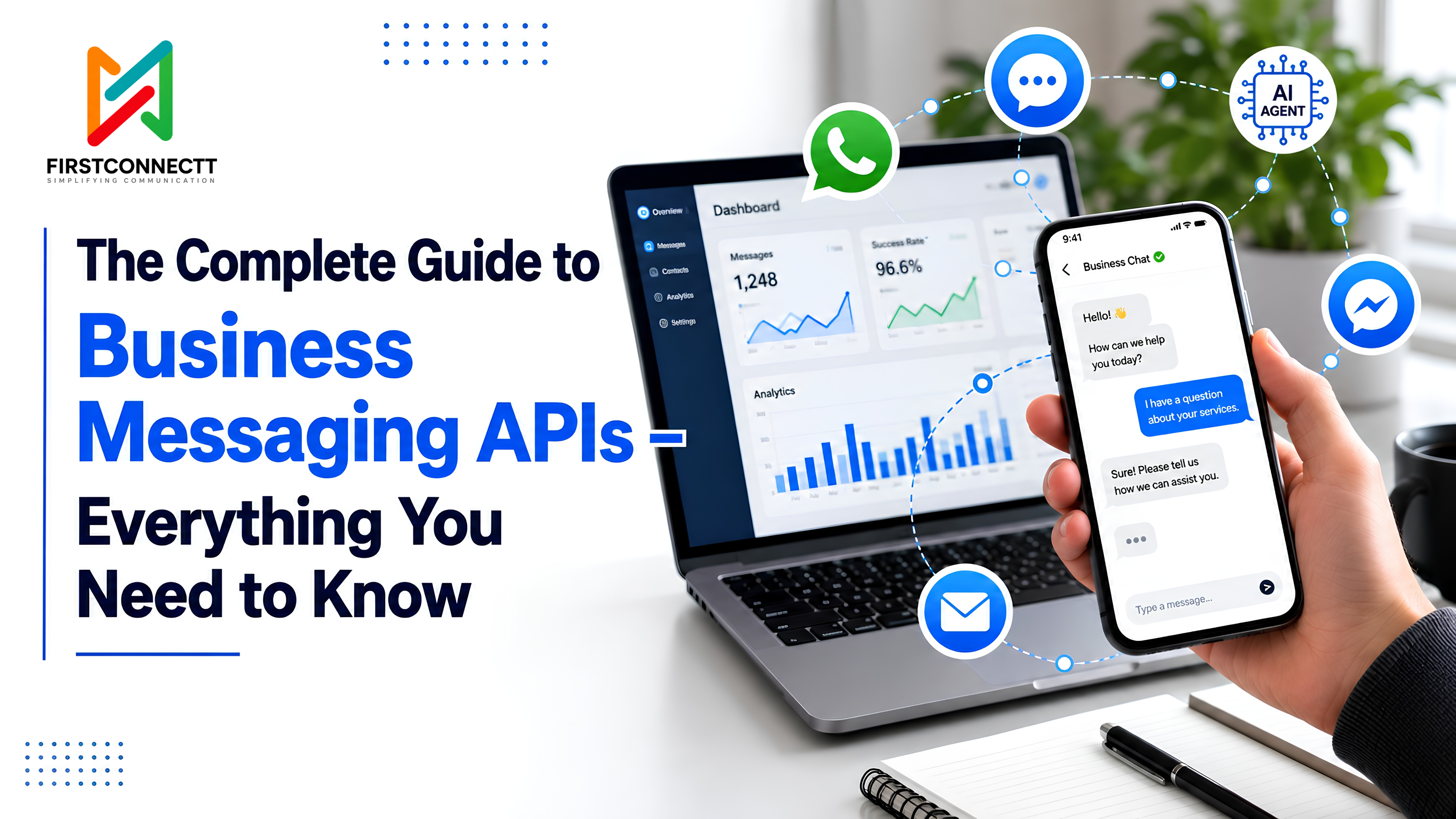
A Business Messaging API is a set of protocols and tools that allows businesses to send, receive, and manage customer conversations programmatically through messaging platforms like WhatsApp, SMS, RCS, Messenger, and other communication channels.
Instead of manually replying to every customer, companies integrate APIs into their existing systems so communication happens automatically whenever a specific event occurs.
For example:
In simple terms, Business Messaging APIs act as the bridge between your business software and your customers.
Consumer behavior has changed dramatically.
People no longer want to wait on hold or search through emails. They prefer messaging because it’s fast, familiar, and available on mobile devices.
Businesses that adopt messaging APIs benefit from:
Rather than forcing customers to visit your website repeatedly, your business reaches them where they’re already active.
Although the technical implementation varies between providers, the overall workflow remains similar.
A customer places an order, signs up, requests support, or performs another action.
Your CRM, ERP, eCommerce platform, or custom application detects the event.
The system sends a request to the messaging platform through the Business Messaging API.
The platform delivers the message instantly to the customer’s preferred messaging channel.
If two-way messaging is enabled, the customer’s reply flows back into your system, allowing automated or human responses.
This seamless process happens in seconds without manual intervention.
Connecting business systems with messaging channels can simplify everyday communication. FirstConnectt helps businesses build connected messaging workflows that respond to customer actions automatically.
One of the most popular messaging APIs for businesses worldwide. Ideal for:
It supports multimedia messages, interactive buttons, catalogs, templates, and end-to-end encrypted conversations.
SMS remains highly effective for time-sensitive communication. Common use cases include:
SMS doesn’t require internet connectivity, making it valuable for reaching virtually every mobile user.
Rich Communication Services (RCS) brings interactive features to standard messaging. Businesses can send:
It creates an app-like experience inside the messaging interface.
Useful for brands with active social media audiences. Common applications include:
Ideal for businesses generating leads through Instagram. Businesses can automate:
Different customer moments need different communication channels. FirstConnectt brings messaging capabilities together, helping businesses choose and manage channels based on their communication needs.
Banks, fintech companies, healthcare providers, and eCommerce businesses use messaging APIs to verify users securely.
Customers receive one-time passwords instantly during login or registration.
Instead of customers checking tracking pages repeatedly, businesses proactively send updates such as:
This significantly reduces support inquiries.
Healthcare providers, salons, educational institutions, and consultants reduce no-shows with automated reminders.
Businesses integrate messaging APIs with helpdesk software so agents can respond directly from one dashboard.
This creates a unified customer support experience.
Businesses use messaging APIs to deliver personalized promotions based on customer preferences and purchase history.
Unlike mass email campaigns, messaging often achieves significantly higher engagement.
Business Messaging APIs have become essential across nearly every industry.
Customers receive timely updates without needing to contact support.
Automation reduces delays while ensuring customers receive information immediately.
Messaging platforms generally outperform traditional communication channels because users check messages frequently.
Automated messaging eliminates repetitive manual tasks, allowing teams to focus on higher-value work.
Whether you’re serving hundreds or millions of customers, messaging APIs scale with your business.
Businesses can personalize messages using customer names, order details, locations, and purchase history.
Personalization increases engagement and customer trust.
As communication volumes grow, managing multiple interactions can become complex. FirstConnectt helps businesses support scalable messaging while keeping customer communication timely and connected.
While Business Messaging APIs offer significant advantages, implementation requires careful planning.
Common challenges include:
Selecting the right provider helps overcome many of these challenges.
Compliance, integrations, templates, and platform rules can make implementation challenging. With FirstConnectt, businesses can simplify the communication layer and focus more on customer interactions.
Customers should explicitly agree to receive messages. This improves trust while ensuring regulatory compliance.
Avoid overwhelming customers with unnecessary communication. Every message should provide value.
Use available customer information to create meaningful conversations rather than generic broadcasts.
Automation should enhance customer experiences, not replace human support entirely. Complex issues should transition smoothly to live agents.
Track key metrics such as:
Continuous optimization leads to better results.
Many businesses fail to maximize Business Messaging APIs because they:
Avoiding these mistakes improves both customer experience and campaign performance.
Not all providers offer the same capabilities.
Before making a decision, evaluate:
Can the provider support WhatsApp, SMS, RCS, and other messaging platforms?
Do they deliver messages reliably in your target markets?
Look for enterprise-grade encryption, compliance certifications, and robust data protection.
Can the platform handle increasing message volumes as your business grows?
Check compatibility with your CRM, ERP, marketing automation tools, and customer support platforms.
Detailed reporting helps optimize communication strategies over time.
Imagine an online fashion retailer. A customer purchases a jacket. Within seconds, the Business Messaging API automatically sends:
The customer never needs to wonder what happens next, and the support team receives fewer “Where is my order?” inquiries.
That’s the power of automated business messaging.
Customer expectations continue to evolve.
Businesses are moving toward conversational experiences where messaging becomes the primary interface for customer engagement.
Future developments are likely to include:
Organizations that invest in messaging infrastructure today will be better positioned to meet tomorrow’s customer expectations.
A Business Messaging API enables businesses to send, receive, and automate customer communications through messaging platforms like WhatsApp, SMS, RCS, and Messenger using software integrations.
Businesses of all sizes across retail, healthcare, banking, logistics, education, travel, and professional services can benefit from messaging APIs.
Yes. Most enterprise providers offer encrypted communication, authentication, access controls, and compliance with industry standards. Businesses should also follow local privacy regulations and platform policies.
Absolutely. Many providers offer scalable plans that allow startups and small businesses to automate customer communication without significant infrastructure investments.
A messaging app is used by people to communicate manually, while a messaging API allows software applications to send and receive messages automatically based on business events.
Business communication isn’t limited to emails and phone calls alone. Customers expect instant, convenient, and personalized conversations delivered through the messaging channels they already use every day.
A Business Messaging API makes that possible by connecting your business systems directly to platforms like WhatsApp, SMS, RCS, and Messenger. From automated order updates to secure OTP verification and responsive customer support, these APIs streamline operations while creating better customer experiences.
The businesses that embrace messaging automation today are not simply sending messages faster. They are building stronger relationships, improving operational efficiency, and meeting customers where conversations naturally happen.
FirstConnectt helps businesses move beyond basic messaging by bringing WhatsApp Business API, SMS, RCS, conversational AI, automation, and customer communication together through a scalable CPaaS ecosystem. From transactional notifications and marketing campaigns to customer support and automated conversations, FirstConnectt enables businesses to connect with customers across the channels they already use making communication more seamless, intelligent, and scalable.
Share this article
Article
 Article
 Article
Ready to put these ideas to work? Talk to our team about your communication stack.
Get Started →