
 Article
October 14, 2026
6 min read
 FirstConnectt
Enterprise communication insights
FirstConnectt
Enterprise communication insights
Article · FirstConnectt Insights
In business, products can be copied. Pricing can be matched. Features can be replicated.
But the way a company communicates with its customers often becomes its strongest competitive advantage.
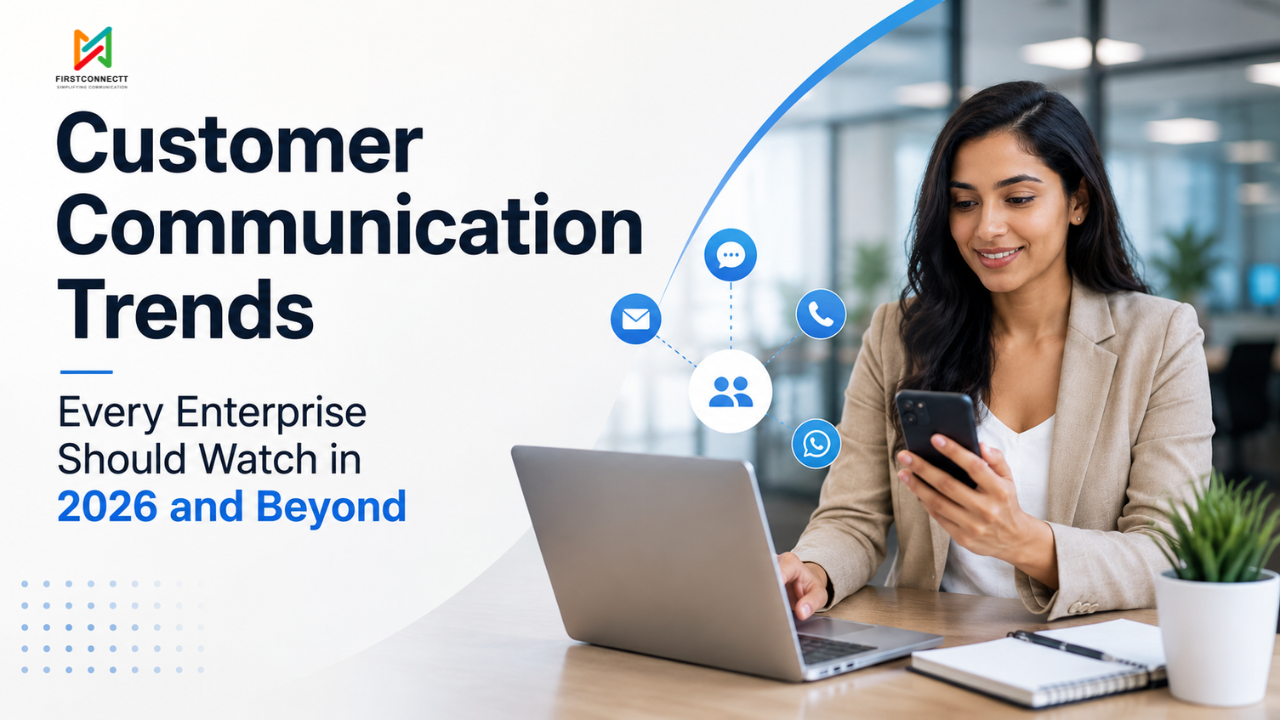
Today’s customers don’t compare your business only with your competitors. They compare every interaction with the best experience they’ve ever had, whether it came from a bank, an eCommerce platform, a healthcare provider, or a food delivery app.
That shift has fundamentally changed enterprise customer communication.
Communication is no longer a support function sitting at the end of the customer journey. It has become the customer journey itself.
For enterprises, this makes communication infrastructure more than a technology decision. It becomes part of how the brand earns attention and trust.
Enterprises that understand this are improving customer loyalty, increasing operational efficiency, and creating stronger relationships at scale. Those that don’t are discovering that poor communication is often the invisible reason behind declining customer satisfaction and rising churn.
Let’s explore the customer communication trends every enterprise should watch to stay competitive in the years ahead.
Digital transformation has changed customer expectations faster than many organizations expected. People no longer want to wait hours for updates, repeat their information across departments, or switch between multiple communication channels just to solve one issue. Instead, they expect conversations that are:
For enterprises, this means communication strategies must evolve from simply sending messages to creating connected customer experiences.
The days of one-way notifications are fading. Modern enterprises are creating conversations instead of broadcasting information. Customers now expect to:
Whether someone starts a conversation through WhatsApp, a website, mobile app, or voice assistant, they expect the experience to feel connected. The future belongs to enterprises that can maintain continuous conversations rather than isolated interactions.
This is where platforms such as FirstConnectt can play a strategic role. It helps businesses connect messaging, automation, and human support into a more continuous customer journey. The objective is not simply to automate replies, but to ensure that every conversation has the right context behind it.
Personalization has moved beyond simply inserting someone’s first name into an email. Today’s enterprise communication includes:
It represents messages based on customer actions. For example: A customer abandons an insurance application halfway through.
Instead of sending a generic reminder, the company sends a personalized message highlighting exactly where the application stopped and offers assistance.
Rather than reacting after problems occur, enterprises increasingly anticipate customer needs. Examples include:
Moreover, according to the stats, 75% of business leaders have increased customer spending from personalization efforts. Meanwhile, only 45% of consumers said they felt understood by the brands they interact with.
The gap highlights an important implementation challenge: personalization should be based on meaningful customer signals, not simply more messages. Communication platforms need to connect customer data, behavior, and delivery channels before personalization can work effectively.
For businesses building this capability, FirstConnectt can support the communication layer needed to turn customer signals into timely, relevant interactions across messaging and voice channels.
Customers appreciate businesses that solve problems before they need to ask.
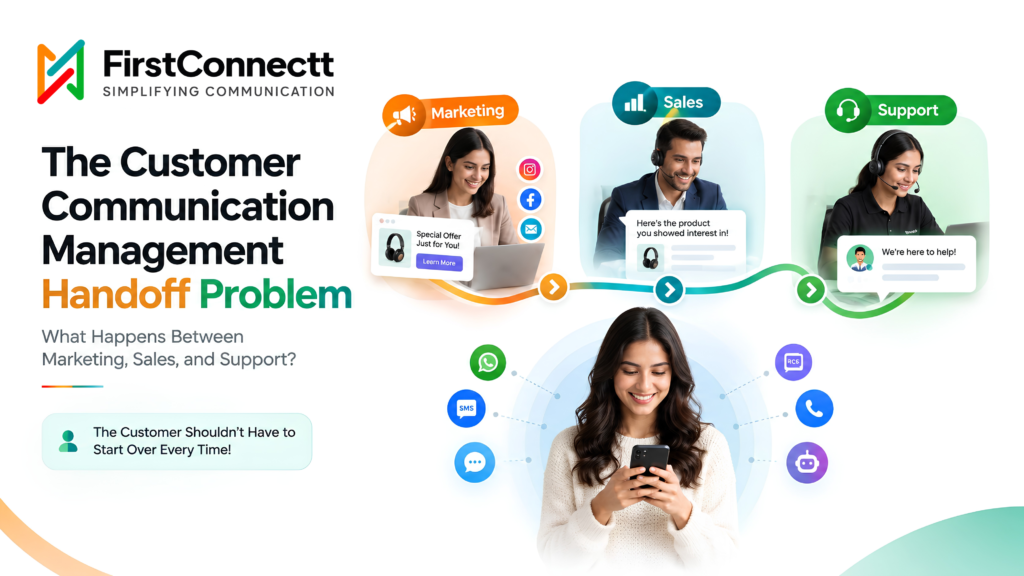
Many organizations believe they already have omnichannel communication because they offer email, SMS, phone support, and messaging apps. That’s only multi-channel. True omnichannel communication means every interaction is connected. Imagine this scenario.
A customer:
For enterprise teams, achieving this requires more than adding channels. It requires APIs, CRM integrations, routing logic, conversation history, delivery monitoring, and clear escalation workflows. These implementation details are often what determine whether an omnichannel strategy actually feels seamless to customers.
FirstConnectt approaches communication with this connected model in mind, helping businesses bring channels such as WhatsApp, SMS, RCS, and Voice into broader customer journeys.
The support representative already knows the entire conversation history. The customer doesn’t have to explain everything again. That’s the difference between being available everywhere and being connected everywhere.
Customers increasingly prefer messaging over traditional communication methods. Why? Because messaging feels natural. Instead of navigating complicated IVR menus or waiting on hold, customers can easily send a message whenever it’s convenient. Enterprise messaging now supports:
WhatsApp’s scale illustrates why messaging has become commercially important. Meta reported that more than 175 million people globally message a WhatsApp Business account every day.
For enterprises, the opportunity is not simply to be present on messaging platforms, but to build structured journeys around them, from discovery and support to payments, updates, and follow-ups.
Messaging has become an extension of the customer experience rather than an alternative communication channel.
Speed influences perception. Customers often judge service quality based on how quickly businesses respond rather than how long the overall issue takes to resolve. Real-time communication helps enterprises:
Consider logistics companies. Instead of customers wondering where their shipment is, proactive delivery notifications eliminate uncertainty before it becomes frustration. Communication reduces friction.
Modern communication strategies rely heavily on customer data. But collecting data isn’t enough. Successful enterprises transform data into meaningful conversations. This may include:
The result isn’t more communication. It’s more relevant communication.
Many customers don’t actually want to contact support. They simply want answers. That’s why enterprises are investing in:
The goal isn’t reducing human interaction. It’s reducing unnecessary interaction. Customers appreciate solving simple issues on their own while having easy access to human support for more complex situations.
As enterprises collect more customer information, privacy expectations continue to increase. Customers want transparency about:
Organizations that communicate openly about privacy often strengthen customer trust rather than weaken it. Trust has become a competitive advantage.
Text-only communication is no longer enough for many customer interactions. Enterprises increasingly use:
RCS is one example of how business messaging is becoming more interactive. Instead of limiting communication to plain text, RCS can support branded experiences, rich media, suggested actions, and interactive elements within the messaging environment.
For enterprises considering richer communication, the important question is not whether every message should become interactive. It is whether richer formats genuinely make a customer journey easier. FirstConnectt can help businesses evaluate where channels such as RCS add meaningful value alongside SMS, WhatsApp, and Voice.
Rich communication helps customers complete tasks faster while improving engagement. A visual explanation often solves questions more effectively than several paragraphs of text.
One of the biggest shifts happening across enterprises is moving from reactive communication toward proactive engagement.
Instead of waiting for customers to ask: “Where is my order?” Businesses now automatically send:
The same principle applies across industries. Banks notify customers about unusual account activity. Healthcare providers send appointment reminders. Utilities warn customers about scheduled maintenance. The best customer service often happens before customers realize they need help.
Despite advances in technology, many organizations continue making communication mistakes that frustrate customers.
Generic communication often feels impersonal and irrelevant.
More channels don’t automatically create a better experience. Disconnected systems often create confusion.
Sending excessive notifications leads customers to ignore important messages. Quality always beats quantity.
Some customers prefer messaging. Others prefer email. Respecting communication preferences significantly improves engagement.
This is why enterprises should evaluate communication providers based on more than channel count. API capabilities, delivery visibility, integration support, scalability, security, compliance, analytics, and human escalation can have a greater impact on the final customer experience.
A provider, FirstConnectt, can become essential. Not because they simply add another communication channel, but for helping you connect those channels to the systems and workflows they already use.
Organizations that consistently deliver exceptional customer experiences often follow similar principles.
Small improvements across multiple interactions often create significant long-term customer loyalty.
Imagine a telecommunications company launching fiber internet services. Instead of sending generic promotional emails, the company creates a connected communication journey. A customer visits the website to check availability. They receive a personalized follow-up message with installation options. After scheduling, they receive appointment confirmations and technician updates. Following installation, they receive setup guides, service tips, and satisfaction surveys. Months later, the company sends proactive maintenance alerts and personalized upgrade recommendations. Each interaction feels like part of one continuous conversation. That’s modern enterprise communication.
Organizations embracing these trends often experience measurable business improvements. These include:
Communication is no longer simply about delivering information. It’s about delivering confidence.
While modern communication creates opportunities, implementation isn’t always simple. Common challenges include:
Successful enterprises view communication as a long-term capability rather than a one-time project.
If your enterprise wants to improve customer communication, start with these practical steps:
Consistent progress often delivers greater results than sweeping overhauls.
Customer communication trends are evolving strategies, technologies, and best practices that help businesses engage customers more effectively across digital and traditional channels. They include personalization, omnichannel communication, proactive messaging, real-time engagement, and self-service experiences.
Omnichannel communication ensures customers enjoy a consistent experience across every touchpoint. Conversation history, customer preferences, and context remain connected, reducing frustration and improving satisfaction.
Personalization makes interactions more relevant by using customer data, preferences, and behavior to deliver timely, meaningful messages. This improves engagement, trust, and long-term loyalty.
Proactive communication involves providing updates, reminders, or assistance before customers request it. Examples include delivery notifications, appointment reminders, billing alerts, and maintenance updates.
The right mix depends on customer preferences, but enterprises commonly use email, SMS, messaging apps, live chat, mobile apps, customer portals, and voice support within a unified communication strategy.
Enterprise customer communication is evolving from one-way messaging to connected, personalized and proactive customer experiences. In 2026 and beyond, businesses need a customer communication strategy that delivers the right message, through the right channel, at the right time.
For enterprises, the next step is not simply adopting more channels. It is building a seamless omnichannel communication infrastructure where customer data, conversations and workflows work together. From WhatsApp Business API and SMS to RCS, Voice and AI-powered communication, the goal is to create faster, more relevant and connected customer journeys.
FirstConnectt helps businesses build this connected communication experience through CPaaS and intelligent communication solutions designed around real customer needs.
The future of enterprise communication belongs to businesses that don’t just communicate more, but communicate smarter, faster and more meaningfully.
Share this article
Article
 Article
 Article
Ready to put these ideas to work? Talk to our team about your communication stack.
Get Started →