
 Article
October 14, 2026
6 min read
 FirstConnectt
Enterprise communication insights
FirstConnectt
Enterprise communication insights
Article · FirstConnectt Insights
Customer support has always been a balancing act.
Every business wants faster response times, happier customers, and lower operational costs. Yet achieving all three often feels impossible. Hiring more agents improves service but increases expenses. Reducing staff cuts costs but usually leads to longer wait times and frustrated customers.
This is where conversational AI is changing the equation.
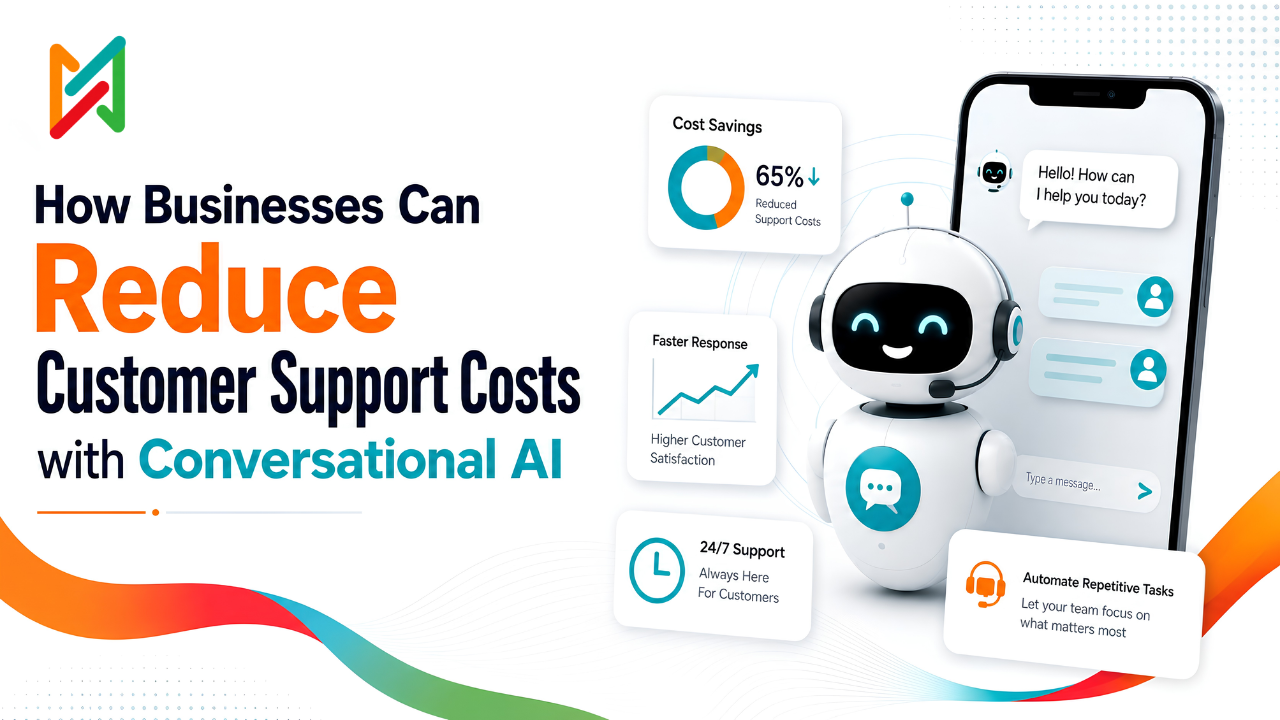
Instead of replacing human support, conversational AI helps businesses automate repetitive interactions, provide instant assistance around the clock, and allow support teams to focus on conversations that genuinely require human expertise. The result isn’t just lower support costs. It’s a better customer experience, improved efficiency, and a support operation that scales with business growth.
If your support team spends more time answering the same questions than solving real customer problems, with this guide you will exactly know how conversational AI can transform your customer service strategy.
The term ‘Conversational AI’ refers to technologies that enable computers to understand, process, and respond to human conversations in a natural way through text or voice.
Unlike traditional chatbots that follow rigid decision trees, conversational AI can understand intent, context, and variations in customer language to deliver more relevant responses. It powers:
The goal isn’t simply answering questions. It’s resolving customer issues quickly while reducing the need for human intervention. When combined with the right communication platform, conversational AI becomes more than automation—it becomes a seamless customer experience. FirstConnectt helps businesses bring these conversations together through one unified communication ecosystem.
Aside from this, Conversational AI is booming in 2026. Its global market has reached $17.97 billion, with adoption rates above 78% of enterprises and projected savings of $80 billion in contact‑center labor costs. Voice AI is the fastest‑growing segment, and countries like India have seen weekly usage penetration jump to 46% of internet users.
Many businesses don’t realize how expensive customer support becomes as they grow. Common cost drivers include:
A growing business may receive thousands of nearly identical questions every month. Examples include:
When support agents spend hours answering these repetitive questions, businesses pay more without creating additional value.
Research consistently shows that around 70–80% of customer support requests are repetitive. Instead of assigning these requests to human agents, conversational AI instantly handles routine questions. Examples include:
Every automated conversation saves valuable agent time. Imagine your support team no longer answering “Where is my order?” hundreds of times every day. That alone can significantly reduce operational costs.
Instead of overwhelming support teams with repetitive requests, businesses can automate these interactions through FirstConnectt while ensuring customers still receive fast, accurate, and personalized responses.
Customers don’t only contact businesses during office hours. They send messages late at night, on weekends, and during holidays. Traditionally, providing around-the-clock support required:
Conversational AI works continuously. Customers receive immediate assistance at any hour without increasing payroll costs. Human agents can then focus only on cases requiring personal attention. Because customers don’t wait for business hours, FirstConnectt enables organizations to stay available around the clock through AI-powered messaging and intelligent automation.
Studies show that 7 in 10 small business calls are repetitive and automatable. So, by 2026, AI systems are expected to handle 80% of routine customer interactions such as FAQs, order tracking, and troubleshooting.
Among them, Average Handling Time (AHT) is one of the most important customer support metrics. Conversational AI reduces AHT by:
Instead of spending five minutes gathering customer details, agents can immediately begin solving the issue. Even saving one minute per conversation creates significant cost savings across thousands of interactions.
Support teams often experience burnout because they repeatedly answer the same questions. Conversational AI acts as the first line of support. Only more complex conversations are transferred to human agents. Benefits include:
Happy agents often provide better customer experiences.
Around 30% of customer contacts are repeated due to unresolved issues. However, they appreciate having their problems solved during the first interaction. Conversational AI improves First Contact Resolution (FCR) by:
Higher FCR reduces repeat contacts, which directly lowers overall support costs.
Business growth usually means more customer conversations. Traditional support teams must hire additional agents to keep pace. Conversational AI scales differently. Each repetitive query handled by AI saves $7–$12 per call compared to human agents.
Whether handling fewer conversations or a high volume, the system can manage large volumes simultaneously without proportional increases in staffing. This makes it especially valuable during:
Today’s customers expect support across multiple communication channels. These may include:
Managing each channel separately increases operational complexity. Conversational AI centralizes communication while maintaining consistent responses across every touchpoint.
Imagine an eCommerce company receiving 8,000 customer inquiries every month. Before automation:
After implementing conversational AI:
The result is lower operational costs alongside better service. This is the kind of transformation businesses can achieve with a thoughtfully implemented conversational AI strategy. The results are far more rewarding if supported by an experienced communication partner like FirstConnectt.
Reducing support costs is only part of the story. Businesses often experience additional advantages such as:
Instant replies improve customer satisfaction and reduce frustration.
Unlike humans, automated systems provide consistent answers based on approved information.
Every conversation generates valuable data. Businesses can identify:
These insights help improve products and customer experience over time.
Customers generally value quick and accurate responses.
Even when an issue requires human assistance, conversational AI speeds up the process by collecting relevant information beforehand.
Conversational AI delivers excellent results, but implementation requires thoughtful planning. Potential challenges include:
Automation is only as effective as the information it can access. An outdated or incomplete knowledge base leads to inaccurate responses.
Not every conversation should be automated. Complex issues involving billing disputes, technical troubleshooting, or emotional situations often require human empathy and judgment. Successful businesses know when to escalate conversations.
Customer behavior evolves over time. Businesses should regularly:
Automation should continuously learn from real interactions.
Identify repetitive inquiries that consume the most agent time. Automate these first for quick wins.
Customers should always have the option to speak with a support representative when needed. A smooth handoff improves trust. The best customer experiences combine AI efficiency with human empathy. That’s why FirstConnectt’s solutions are designed to make handoffs between automation and live agents effortless.
Use customer information such as:
Personalized interactions feel more helpful and efficient.
Track performance using key support metrics such as:
These metrics reveal the real business impact of automation.
Many organizations fail to realize the full value of conversational AI because of avoidable mistakes.
These include:
Avoiding these pitfalls helps maximize return on investment.
Conversational AI delivers measurable value across many industries. Popular use cases include:
Customer expectations continue to rise.
People expect instant answers, personalized experiences, and seamless communication across every channel.
Businesses that continue relying solely on traditional support teams may struggle to keep up with growing demand.
Conversational AI isn’t replacing human support. It’s reshaping how support teams operate by eliminating repetitive work, improving efficiency, and enabling agents to focus on interactions where empathy, expertise, and problem-solving matter most.
The businesses that embrace this balance today are likely to deliver stronger customer experiences while keeping operational costs under control tomorrow.
Reducing customer support costs doesn’t have to mean reducing service quality.
Conversational AI enables businesses to automate routine conversations, shorten response times, improve agent productivity, and deliver consistent support at scale.
The greatest savings come from using automation strategically rather than attempting to automate every interaction. When paired with knowledgeable human agents, conversational AI creates a customer support model that is efficient, scalable, and customer-centric.
As customer expectations evolve, organizations that invest in smarter support systems will be better positioned to control costs, increase satisfaction, and grow sustainably.
Reducing support costs starts with smarter conversations. Whether you’re looking to automate customer support, improve response times, or deliver seamless experiences across WhatsApp, SMS, Voice, and AI-powered channels, FirstConnectt can help you build a communication strategy that scales with your business.
Because great customer support doesn’t begin with technology—it begins with better conversations.
Conversational AI automates repetitive inquiries, provides instant responses, reduces agent workload, shortens handling times, and enables businesses to handle more customer conversations without hiring additional staff.
No. It complements human agents by managing routine requests while escalating complex or sensitive issues to support professionals.
Industries with high customer interaction volumes, including eCommerce, banking, healthcare, travel, education, SaaS, and telecommunications, often see the greatest return on investment.
Yes. Modern conversational AI platforms are available for businesses of all sizes and can help small teams deliver faster support without significantly increasing costs.
Key metrics include cost per support ticket, first contact resolution rate, average handling time, customer satisfaction score (CSAT), automation rate, and agent productivity.
Share this article
Article
 Article
 Article
Ready to put these ideas to work? Talk to our team about your communication stack.
Get Started →